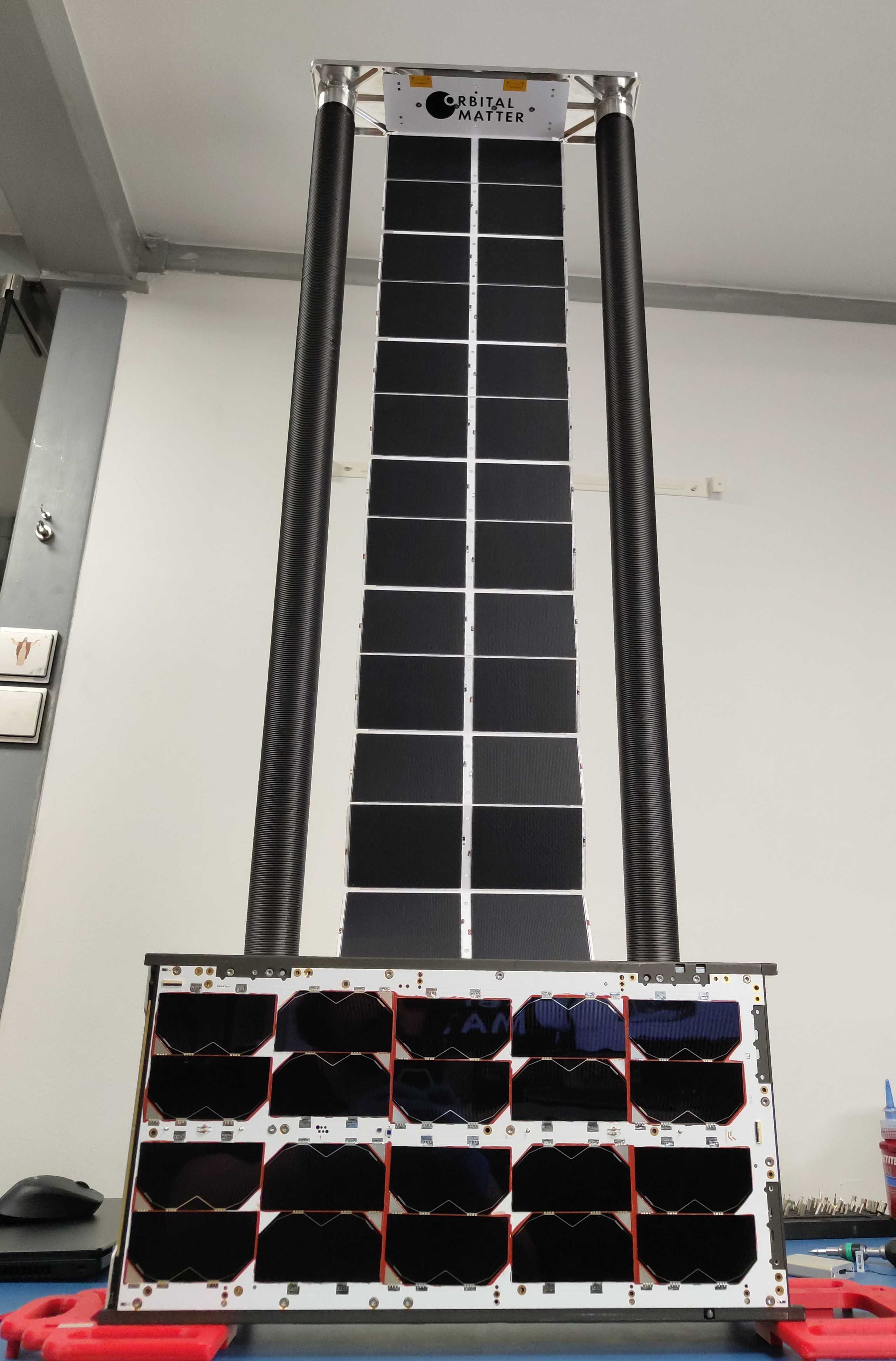
Orbital Matter's Replicator 2 satellite printed a half-metre rigid beam in orbit from a custom plastic material. According to the company, it is the first such case for a free-flying spacecraft, outside the pressurised environment of a space station.
Launched in July 2026 on a SpaceX rideshare mission, Replicator 2 carries four printers. Each extrudes resin in coils and cures it with ultraviolet light, forming a rigid cylinder — a process the company compares to cement and water. The idea is to build the structure where it will be used, rather than folding it on Earth and unfolding it in space.
The advance matters because larger satellites, constellations and orbital data centres need ever-larger solar arrays, radiators and antennas to generate power and shed heat, yet everything must fit inside a rocket fairing. Today's large structures are generally origami projects, folded for launch and unfolded in orbit with hinges, latches and motors that add complexity.
The flight was not flawless. Two printers were set up to deploy a flexible solar array and one failed due to an anomaly. Even so, TechCrunch reports that the beam produced successfully deployed the solar array, which the company treats as an important proof of concept. Earlier 3D-printing efforts in microgravity were limited to the pressurised International Space Station.
"Replicator 2 is the first proof that we can simply build the array in space, at whatever size the mission demands," said Jakub Stojek, CEO and co-founder of Orbital Matter. CTO Robert Ihnatisin told TechCrunch the company preferred to "learn in orbit and adapt the software as needed" rather than spend years testing every possibility on the ground.
Beam length is limited by the resin carried aboard, but company engineers consider 100-metre booms feasible — well beyond the 20-metre arrays on SpaceX's Starlink V2 satellites, cited for comparison. Orbital Matter works with the European Space Agency and Thales Alenia, which collaborated on Replicator 2, and plans a further demonstration in 2028 with a larger printer on a larger satellite, for a 5 kW solar array, as a step toward more than 100 kW per wing by 2030.
Image credit: Orbital Matter, via the official Replicator 2 launch release. The image shows the bench demonstrator of the solar array deployed by printed booms, not a photograph taken in orbit.
Sources
- TechCrunch — Orbital Matter 3D-printed the first rigid beam in the vacuum of space
- Orbital Matter — Orbital Matter launches Replicator 2
- Aerospace America — Startup tests 3D-printing concept for building large-scale space structures
Transparency note: this article was produced with the assistance of artificial intelligence, cross-checked against public posts and internet sources. Consult the original sources to confirm the details.
Muse