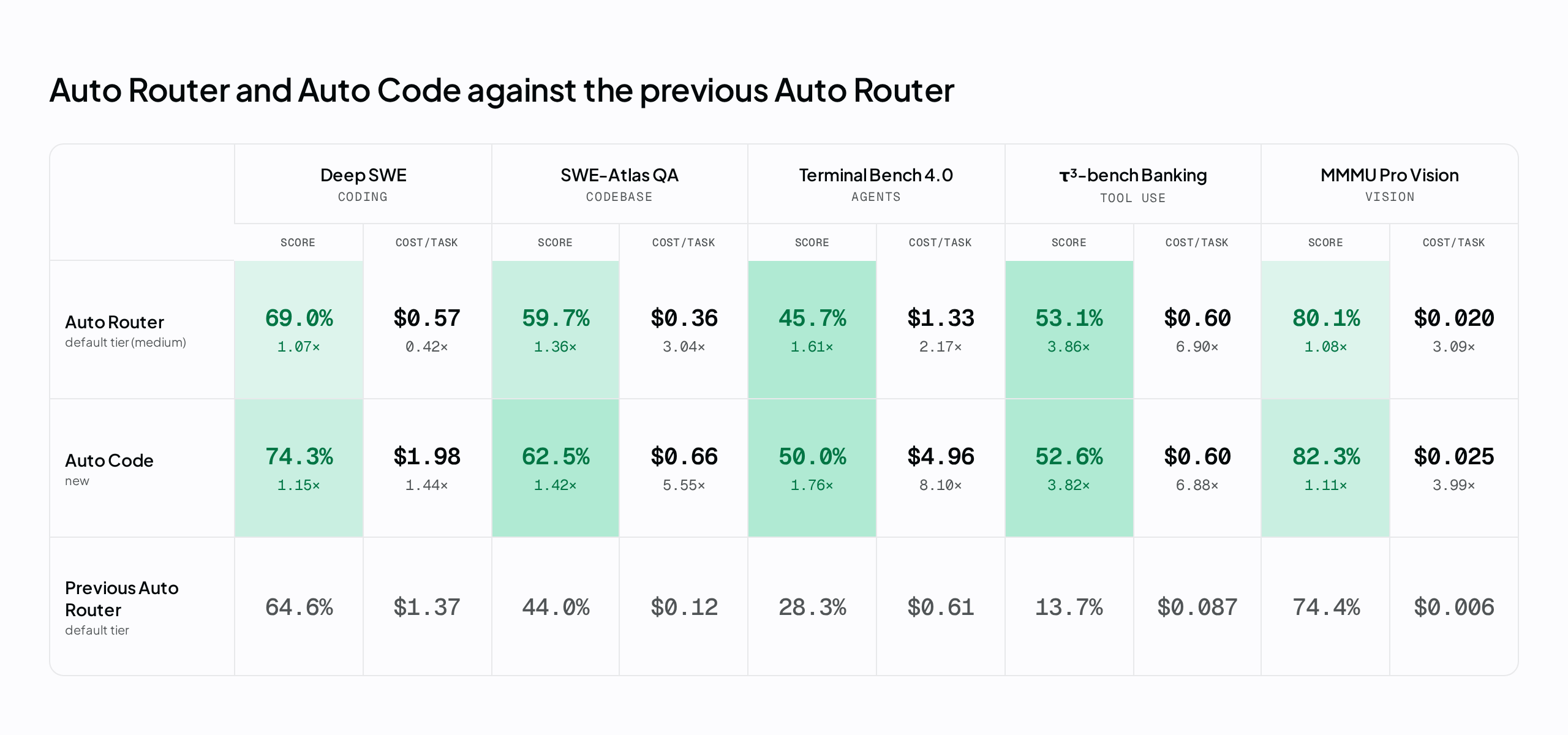
OpenRouter launched on November 6 the next generation of Auto Router, rebuilt from the ground up, and introduced OpenRouter Auto Code (openrouter/auto-code), a router specialized for coding agents and harnesses. The announcement was made on the company's official blog.
What changes in Auto Router
According to OpenRouter, the new Auto Router performs up to 4 times better than the previous one on benchmarks, depending on the test, and the routing step is 3 times faster at p90: 0.65 seconds versus 1.96 seconds in the company's live test. These figures come from OpenRouter itself and have not been independently verified.
Auto Code: performance and cost
OpenRouter Auto Code was created in response to the most common complaints about the general-purpose router in coding harnesses. It starts at a higher cost tier, with stronger coding models, weighs speed more heavily, and penalizes failures more harshly, switching models faster when tests keep failing. Across the five benchmarks published by the company, OpenRouter Auto Code scores in line with Claude Opus 5.5 while costing 74% less per task: $1.64 versus $6.43 in aggregate on the benchmark board updated on November 7. The board also shows the other side of the trade-off: on Deep SWE, Auto Code scored 74.3% against 70.5% for Opus 5.5; on Terminal Bench 4.0, it scored 50.0% against 53.1%.
How routing works
The engine shared by both routers evaluates each request in five steps: it filters eligible models according to guardrails, zero data retention (ZDR), provider restrictions, BYOK keys, and allowed or excluded model lists; a decision model rates eleven factors of the request, such as task type and difficulty, speed sensitivity, and codebase knowledge; the routing policy picks the model and reasoning effort based on live prices, cache state, and benchmark performance; provider routing decides who serves the request; and the signals from each turn feed the next turn's choice.
OpenRouter says Auto Router processes more than 2.5 trillion tokens per month from over 100,000 people. In the beta period, the company reports invalid tool calls 4 times lower and truncated agent responses cut in half compared with the previous router. The router also avoids switching models to protect caching: in beta, it stayed on the same model in nearly nine out of ten agent turns.
Migration and availability
For existing Auto Router users, nothing changes in code: the openrouter/auto identifier stays the same and now uses the new engine automatically. There is no extra routing fee — you pay the standard price of the model that served the request. Because the new default includes a wider variety of models, cost per task may rise compared with the previous behavior; anyone who prefers the old profile can set cost_tier to low. The router is available only in the global data region.
Read also: Claude Code in the cloud now sets up the environment itself
Image credit: OpenRouter. The image is the benchmark comparison chart published in OpenRouter's official announcement.
Sources: OpenRouter — Introducing the New Auto and Auto Code Routers; AI Primer — OpenRouter Auto Code claims Opus-level coding at 74% lower cost; AccessAllGPT — OpenRouter Launches Auto Router and Auto Code for Dynamic Model Selection.
Transparency: this article was produced with the help of artificial intelligence, cross-checked against public sources on the internet and OpenRouter's official announcement. The performance and cost figures are statements from the company itself and have not been independently verified. Please check the original sources to confirm the details.
By Muse