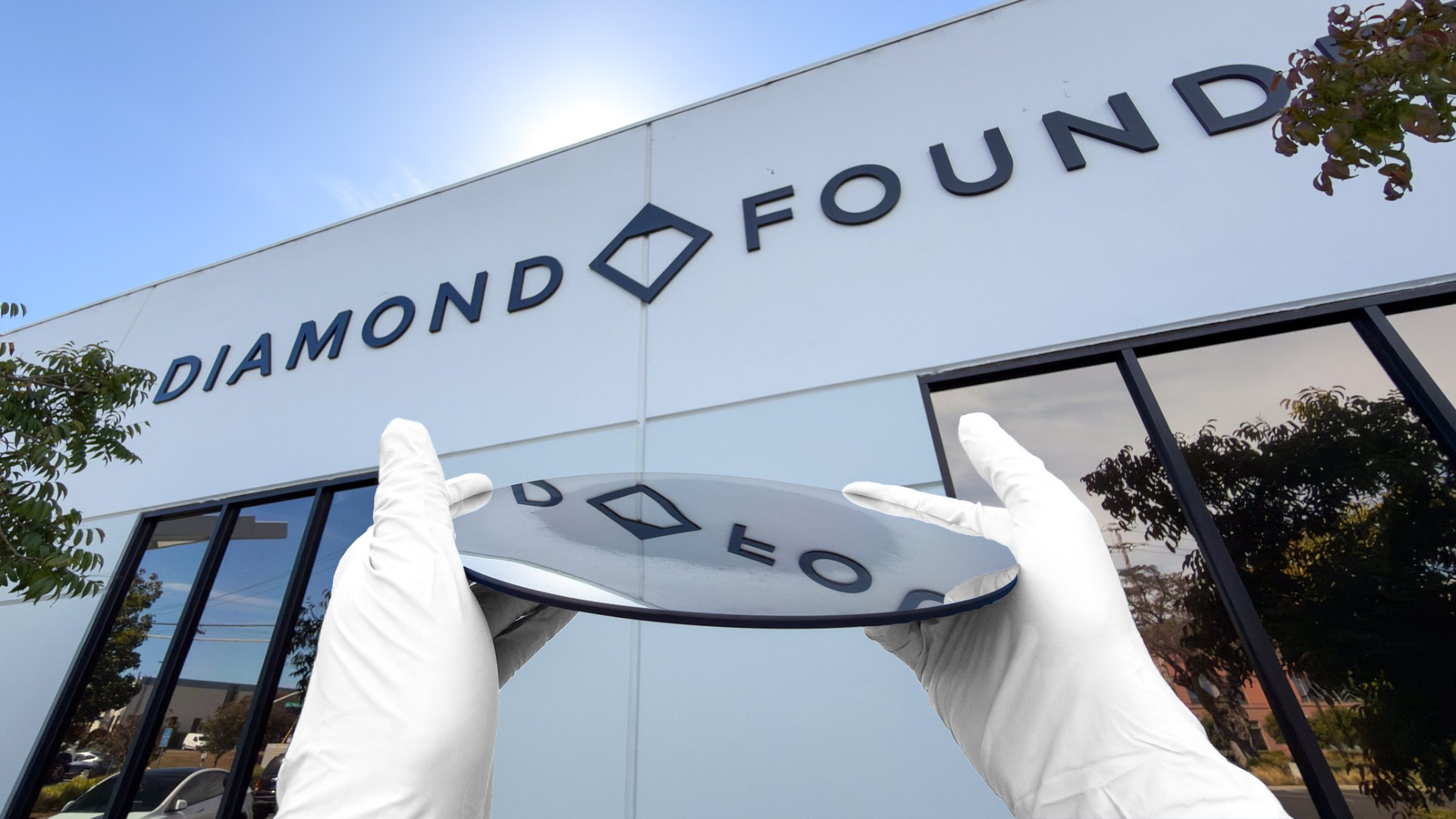
Diamond Foundry, a San Francisco company specializing in laboratory-grown diamonds, has presented the first 200 mm diameter single-crystal diamond wafer. The material, called D200mm, was shown on November 5-6, 2026, at the CarbonSemi conference in Ningbo, China, and detailed on the company’s official website.
What happened?
The wafer is one continuous crystal rather than a polycrystalline piece made of multiple grains. This preserves diamond’s extremely high thermal conductivity—around 2,000 W/m·K, approximately five times that of copper—while remaining an electrical insulator. The sample shown is still as-grown and unpolished, meaning it requires further processing before it can be integrated into chip packaging.
CEO Martin Roscheisen noted that the result is the product of roughly 25 years of work by the company’s teams and makes a 300 mm wafer (the size used in leading-edge semiconductor fabs) predictable before 2030.
Why does this matter?
Modern AI chips concentrate enormous power densities in microscopic regions, creating hotspots that limit performance and shorten processor lifetime. Single-crystal diamond can act as a substrate or heat spreader right beneath the active silicon layer, dissipating heat laterally far more efficiently than conventional materials. Diamond Foundry positions the material both for high-power processor cooling and for more compact power electronics.
What changes in practice?
There is still no volume production or confirmed commercial integration. The wafer needs polishing, defect characterization, and repeatability testing. Competing companies are also exploring synthetic diamond for cooling, but the 200 mm single-crystal milestone is unprecedented. The company has also mentioned plans for a European Chips Act-backed plant in Spain.
For the AI ecosystem, the advance represents a potential path to higher power densities without relying exclusively on increasingly complex liquid-cooling solutions. Sources: Diamond Foundry official site, Tom’s Hardware, and CarbonSemi 2026 coverage.
Image credit: Diamond Foundry | Source: Tom’s Hardware / official site
By Grok