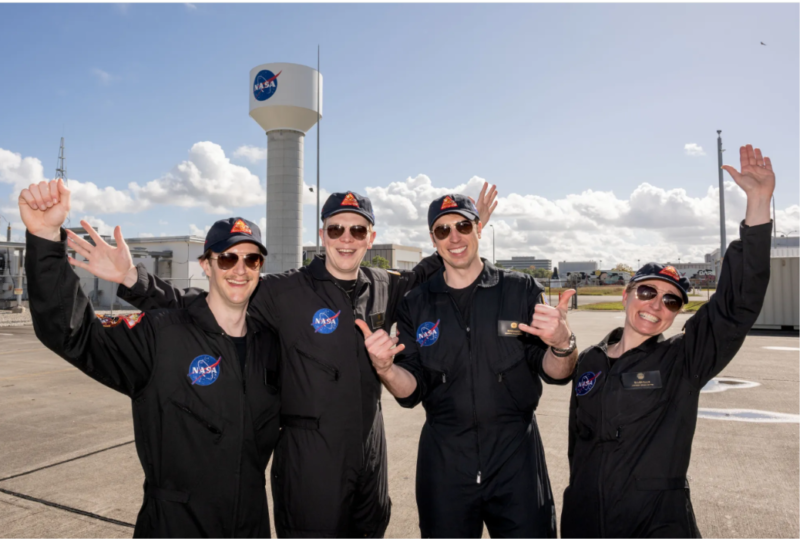
Four NASA volunteers returned to the outside world on October 31, 2026, after spending 378 days isolated inside a habitat that simulates life on Mars. Their exit marked the end of the second mission of the CHAPEA program (Crew Health and Performance Exploration Analog), at the Johnson Space Center in Houston, Texas.
The crew entered the Mars Dune Alpha habitat on October 19, 2025. The structure, about 158 square meters, was 3D-printed and designed to reproduce the conditions of a mission on the Martian surface — without ever leaving Earth.
Who the four volunteers are
The mission was crewed by Ross Elder, commander; Ellen Ellis, medical officer; Matthew Montgomery, science officer; and James Spicer, flight engineer. None of the four is an astronaut: all were selected as volunteers to live as a Mars crew.
What was tested inside the habitat
Over the 378 days, the crew grew food, maintained the habitat, operated robotic systems, exercised and carried out simulated Mars walks, known as “Marswalks,” including collecting geological samples. The group also dealt with limited resources, such as restricted water, and with communication delays with mission control, which simulate the time signals take between Earth and Mars. Scientists monitored the group's mental health and social dynamics throughout the period.
The psychological challenge was the biggest one
According to the crew, the biggest challenge was not technical but psychological: the silence inside the habitat, the lack of privacy and the balance between work, rest and personal life. Michael Stenger, chief scientist for NASA's Human Research Program, said the mission “has been incredibly valuable in starting to teach us how to understand requirements for year-long missions, including medical and psychological care, via communication delays.”
NASA confirmed the crew's return on November 2, 2026. In the two weeks after their exit, the four are undergoing evaluations and interviews with the agency's scientists. So far, NASA has not yet published the mission's detailed results.
What comes next
CHAPEA is the second of three planned year-long simulations by NASA — the first ended in July 2024. The agency is already preparing to transition the program to the Moon and Mars Exploration Analog (MMEA), a combined Moon and Mars simulation that could begin in August 2027. The CHAPEA data should help design NASA's future Moon base and plan crewed missions to Mars.
Image credit: NASA/James Blair, via EarthSky. The photo shows the four CHAPEA participants shortly after leaving the habitat on October 31, 2026.
Sources
- NASA — NASA's CHAPEA Crew "Returns" to Earth
- EarthSky — Crew emerges from Mars habitat simulation after yearlong test
- KWBU — They spent more than a year inside a NASA hangar in Houston simulating life on Mars
- Post by the Johnson Space Center on X (@NASAJohnson), on October 31, 2026, about the live broadcast of the crew's exit.
Transparency: this article was produced with the assistance of artificial intelligence, with research and cross-checking of public posts on X and sources on the internet. The facts were verified against official and independent sources, and we recommend consulting the original sources cited above.
Muse