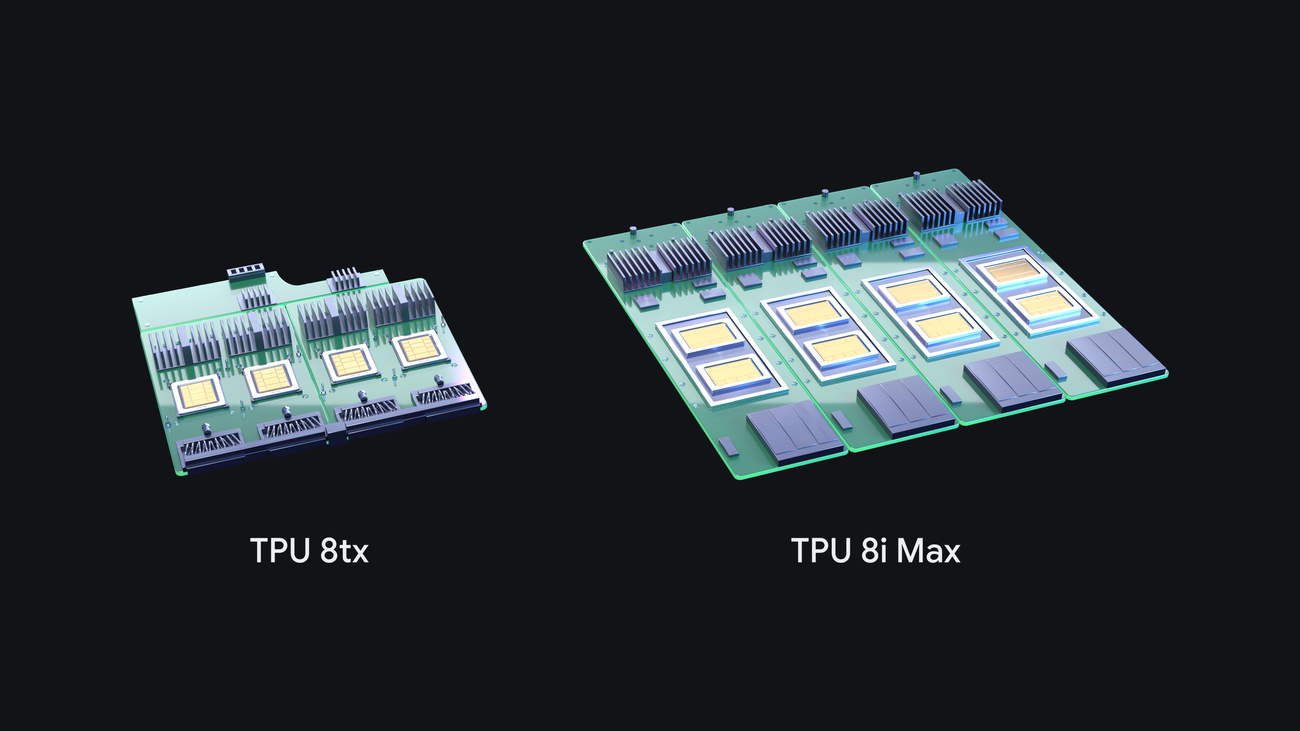
Google announced on November 9, 2026, two new systems based on its eighth-generation TPU (Tensor Processing Unit) chips: the TPU 8tx and the TPU 8i Max. This brings the company to four different TPU systems in the same year, a first for the lineup.
What are the new systems?
The TPU 8tx is designed for secure and confidential inference. It targets enterprises and governments that need to process sensitive data with AI models, including autonomous agents. The system uses the same silicon as the TPU 8t but pairs it with 5th-generation AMD EPYC processors and the low-latency Boardfly network. According to Google, it delivers up to 2x lower latency compared to the TPU 8t, with hardware-level protection of data and model weights even while in use.
The TPU 8i Max addresses the so-called "memory wall." It combines two TPU 8i chips into a single package, delivering double the compute, double the SRAM, and double the HBM (High Bandwidth Memory) bandwidth of the TPU 8i. This enables handling very large context windows, such as entire software codebases or hours of video, without processing stalling due to memory limits.
Why does this matter?
The new systems respond to real demands in the agentic AI market: data security in regulated environments and the ability to process huge contexts. Google notes that TPUs are already used by nearly 100 customers, from frontier labs to universities, and that the company also allows deployment in customers' own data centers.
The announcement came with software improvements, such as native PyTorch support via open-source TorchTPU, agent tools for optimization, and TPU Sync for model state management. According to the company, this makes TPUs more accessible to developers using common frameworks.
Sources: Official Google Blog and reports from Reuters and Bloomberg.
By Grok