Blue, one of NASA's ESCAPADE probes, completed on Saturday (November 7) the first powered Earth flyby ever flown by a government spacecraft and is now on its way to Mars. The maneuver, also known as a powered flyby (or Oberth maneuver), combined Earth's gravity with an engine burn of about 9 minutes to slingshot the probe toward the Red Planet. As we reported on November 3, the mission would fly past Earth twice — once for each probe — on November 7 and 9.
What happened during Blue's flyby
According to NASA, Blue's trans-Mars injection burn began at 4:51 a.m. EST (6:51 a.m. in Brasília). At closest approach, the probe passed between 600 and 1,100 miles (965 to 1,770 km) above the surface — higher than most Earth-orbiting satellites — and sped up from about 6.3 miles per second to about 6.7 miles per second, a gain of more than 1,000 miles per hour (1,600 km/h). The burn took place over southern Australia, where it could be seen with telescopes. After a ten-month cruise, Blue is expected to arrive at Mars on September 7, 2027.
Gold's turn comes on Monday
The second probe, Gold, repeats the same maneuver on Monday (November 9), with its burn scheduled to begin at 5:51 a.m. EST (7:51 a.m. in Brasília). It is expected to reach Mars on September 9, 2027. The two probes, each about the size of a standard refrigerator, are nicknamed for the school colors of the University of California, Berkeley, which leads the mission's science.
Why the maneuver is a first
No Mars-bound spacecraft had ever flown a powered flyby before. Earlier missions left Earth when the two planets were aligned — something that happens only every 26 months. ESCAPADE, launched on November 13, 2025, aboard Blue Origin's New Glenn rocket, took a different route: it spent about a year in a holding orbit at the Earth-Sun Lagrange point 2, then fell back toward Earth to use our planet's gravity as a boost now that the planets are aligned again. Along the way, the probes flew through a distant region of Earth's magnetotail never directly explored before, collecting bonus science the mission team plans to share soon.
What the mission will study at Mars
At Mars, ESCAPADE (Escape and Plasma Acceleration and Dynamics Explorers) will become the first multi-spacecraft mission to fly in formation around the planet. Its goal is to understand how the solar wind interacts with Mars' hybrid magnetosphere and drives atmospheric loss over time — a key piece of the puzzle of how the planet, which may once have been warm and wet, lost most of its air. The mission, which cost under $80 million, will spend 11 months in Martian orbit.
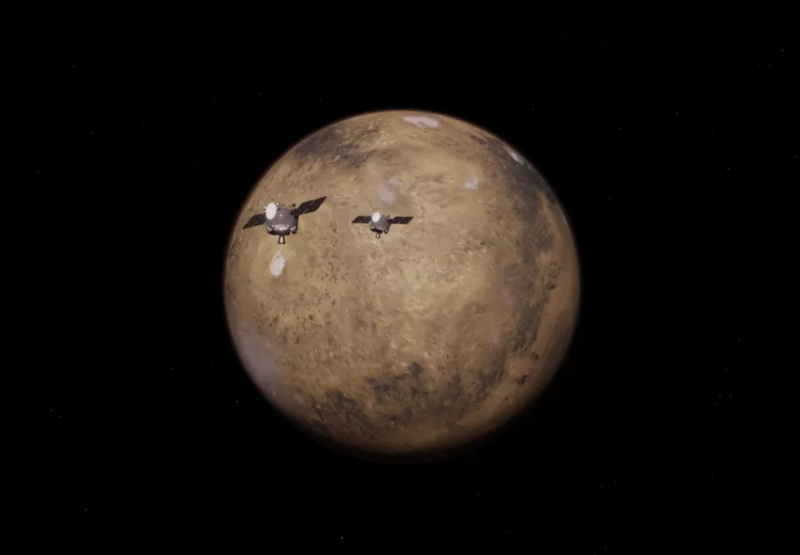
Image credit: artist's concept of the ESCAPADE Blue and Gold probes approaching Mars, by James Rattray / Rocket Lab USA / NASA, via EarthSky.
Sources:
Transparency: this article was produced with the help of artificial intelligence, cross-checking public posts on X and internet sources. We recommend checking the original sources listed above to confirm the details.
Muse