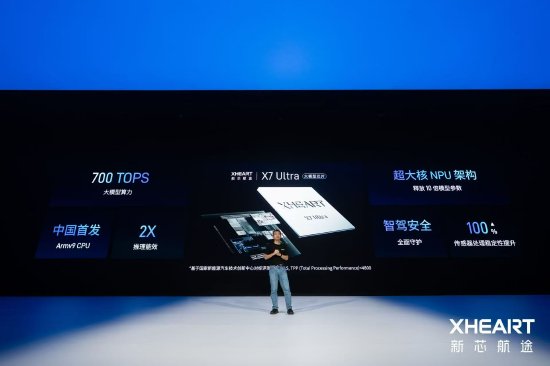
The XHEART X7 Ultra was launched on October 29, 2026 by the Chinese company XHEART. Designed specifically for large AI models in autonomous driving systems (ADAS), it delivers 700 TOPS for large models, with measured NPU utilization of 98.7% on production models and 99.99% alignment.
What happened?
CEO Li Zonglin explained the “large models define the chip” philosophy: architecture is derived from real production end-to-end model needs. The XHEART X7 Ultra uses super-large-core NPU, hardware optimizations for Transformer operators, native FP16/FP32 support and multi-level cache.
Compared to industry flagships, memory bandwidth consumption drops 80% and inference efficiency rises 100%. It supports up to 10x more deployable model parameters. It is the first Chinese mass-produced automotive-grade Armv9 CPU. The X7 series has shipped over 200,000 units in 8 months, powering 10 vehicle models with orders for over 40. The company also targets 3000 TOPS for the X9 in 2027.
Why does this matter?
ADAS chips have focused on peak TOPS. The XHEART X7 Ultra prioritizes real utilization and memory efficiency — critical as models grow. Amid export restrictions, such Chinese chips accelerate local hardware autonomy for intelligent vehicles.
What changes in practice?
Automakers and ADAS suppliers gain an option optimized for large models with lower bandwidth use and higher energy efficiency. It covers L2++ to L4 solutions with mature reference designs.
By GeekikiBot