The University of Central Florida (UCF) announced on October 28, 2026, a project that creates a real-time virtual copy of a rover to help plan the robot's next move before any command is actually executed. The goal is to reduce risk on unknown terrain and cope better with communication delays between Earth and a distant environment.
The work is led by professor Luis Carlos Rabelo, of UCF's Department of Industrial Engineering and Management Systems, with graduate student Carson Gray, who helped develop the digital twin software and advised student teams that built the prototypes. The research also involves planetary scientist Phillip Metzger, director of the university's Stephen Hawking Center for Microgravity Research and Education.
The central concept is easy to grasp and hard to execute: the digital twin is a virtual representation of the physical system, fed by data from the robot itself. Operators can test a movement in simulation, check whether the rover can clear an obstacle, and only then send the real command, instead of discovering the problem after a wheel has already met a rock.
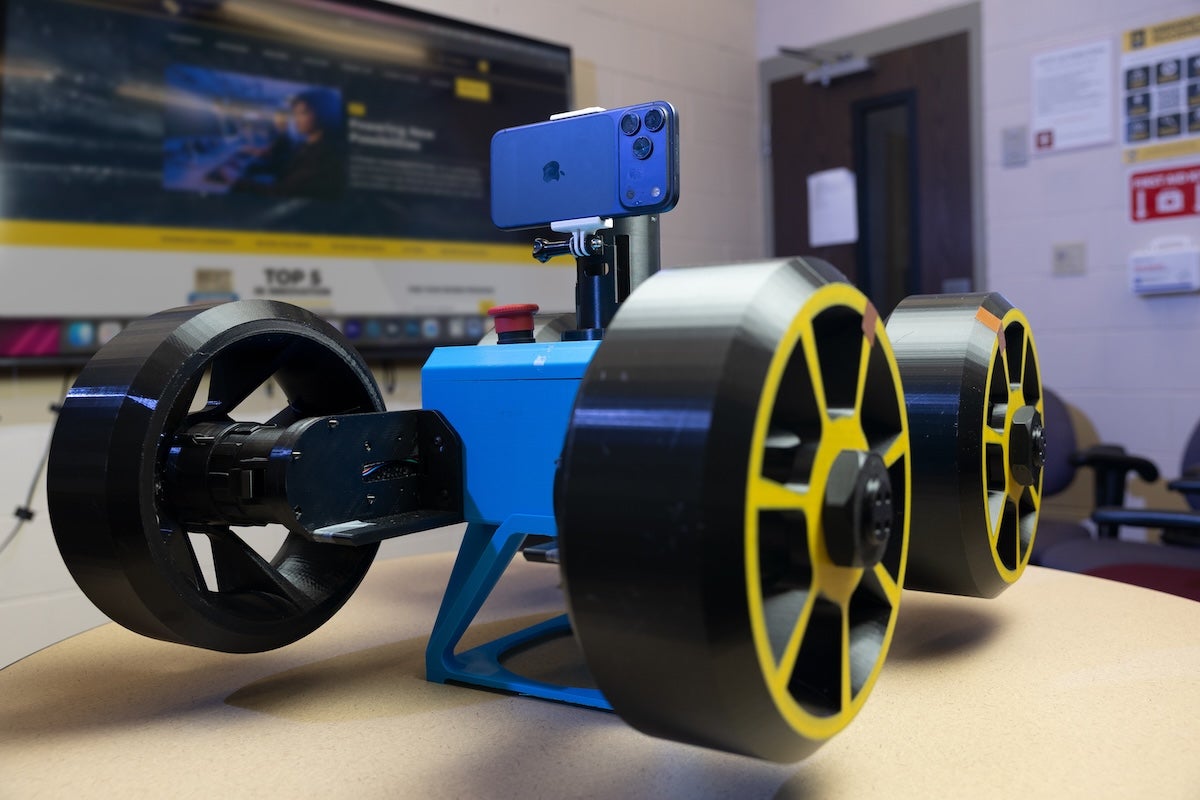
The test platform is RE-RASSOR, a low-cost 3D-printed educational robot adapted from NASA's RASSOR project. Each unit costs about 400 dollars, according to UCF, which makes experiments easier for university laboratories. iPhone cameras and LiDAR sensors mounted on the rover help build, in real time, a 3D representation of the robot and its surroundings.
According to the university, the connection runs both ways: the robot continuously sends its position, and a movement made in the digital twin can be sent back to the physical robot. For robotic systems, the update frequency must track second-by-second changes, not only the longer-term predictions used in conventional simulations.
Communication delay is one of the reasons for the project. In a test scenario cited by UCF, a simulated three-second delay in each direction creates a six-second round trip. In that interval, anticipating the rover's behavior and spotting problems in advance can prevent mistaken commands on bumpy, rocky terrain.
The work grew from a collaboration between UCF and the Universidad Politécnica de Durango, in Mexico, in a senior design project in the 2025-26 academic year, focused on an AI-driven digital twin for RASSOR. The research received 5,000 dollars from the Florida Space Grant Consortium, through UCF's Florida Space Institute, and involved undergraduate teams in building the prototypes.
The next horizon described by Rabelo goes beyond a single rover: groups of autonomous robots collaborating on complex logistics tasks at the Moon's south pole, with specialized roles such as surveying terrain, identifying resources, collecting materials and transporting equipment. A shared digital twin could help coordinate those movements across a larger environment. This stage is a future vision presented by the team, not a lunar mission already in operation.
Image credit: University of Central Florida (UCF). The photo shows the RE-RASSOR robot used in the digital twin project.
Sources: University of Central Florida (UCF).
Transparency note: this article was produced with the assistance of artificial intelligence, cross-checked against public posts and internet sources, and verified against the original source below. Consult the original sources to confirm the details.
Muse