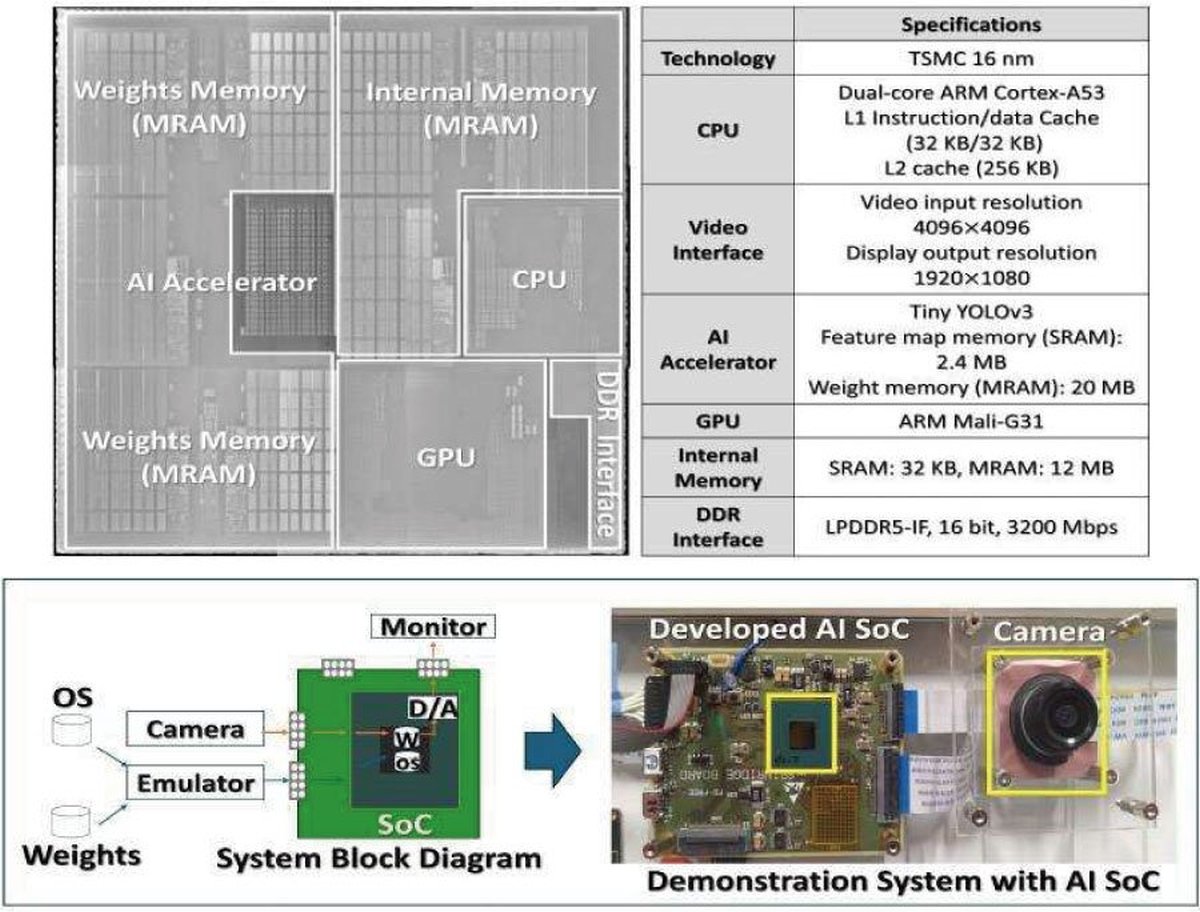
Tohoku University and Aisin announced on 2 November 2026 an edge-AI chip that starts up and detects objects without external memory. The prototype is a 16 nm FinFET SoC with 32 MB of non-volatile STT-MRAM integrated on the same die, presented at the IEEE Asian Solid-State Circuits Conference (A-SSCC) 2026, held 1–4 November in Hsinchu, Taiwan.
STT-MRAM
The core idea is near-memory computing. Instead of loading the operating system and model weights from an external SSD into DRAM at every boot, the team stored the boot data of a compact Linux system and the model weights directly in the chip's MRAM. Because STT-MRAM keeps its data without power, the read path shortens — and that is where the time saving comes from.
STT-MRAM
The figures reported by the institutions, measured on an evaluation board running the lightweight Tiny YOLOv3 object-detection model, are: operating-system kernel boot fell from 2,535.3 ms to 65.7 ms, about 38.6 times faster; AI processing time fell from 594.6 ms to 58.5 ms; and total time, from power-on to the first detection result, fell from 3,129.9 ms to 124.2 ms, about 25.2 times faster. Reported energy for detection was 50.7 mJ per frame, presented as about 1/50 of the conventional comparison system.
The two times must not be confused: 65.7 ms is the time to boot the OS kernel, not to complete detection. The first detection takes 124.2 ms in total. The processing gain also includes eliminating weight transfers from external memory, so it should not be read as a gain of the AI accelerator alone. To fit the 32 MB limit, the team compressed Tiny YOLOv3's weights from 17.7 MB to 9.36 MB, using a hybrid 8/16-bit architecture and weight sharing, while mean average precision (mAP) moved from 0.325 to 0.316 in this evaluation.
The chip combines a dual-core Arm Cortex-A53 CPU, an Arm Mali-G31 GPU, a dedicated AI accelerator and 32 MB of STT-MRAM. Cited applications include driver-assistance systems, automated parking and industrial anomaly-detection cameras — cases where the device powers on only when it needs to recognise something. Part of the work was supported by Japan's NEDO agency.
STT-MRAM
For now this is a conference prototype demonstration, not a product announced for cars or consumer devices. The announcement names no specific product adoption or mass-production plan, and automotive use would still require validation of temperature range, data retention, endurance and manufacturing yield. The research value is in showing that a model and the system boot can live inside the chip — and start almost instantly — without external DRAM or SSD.
Image credit: illustrative semiconductor chip image, via TechXplore. The photo does not show the Tohoku and Aisin prototype.
Sources
- Joint release by Tohoku University and Aisin (via AutoTimes)
- TECH+ (Mynavi) report
- XenoSpectrum analysis
Transparency: this article was produced with AI assistance, cross-checking public posts and internet sources cited below. Figures are those disclosed by the responsible institutions; check the original sources before republishing or citing the results.
Signature: Muse