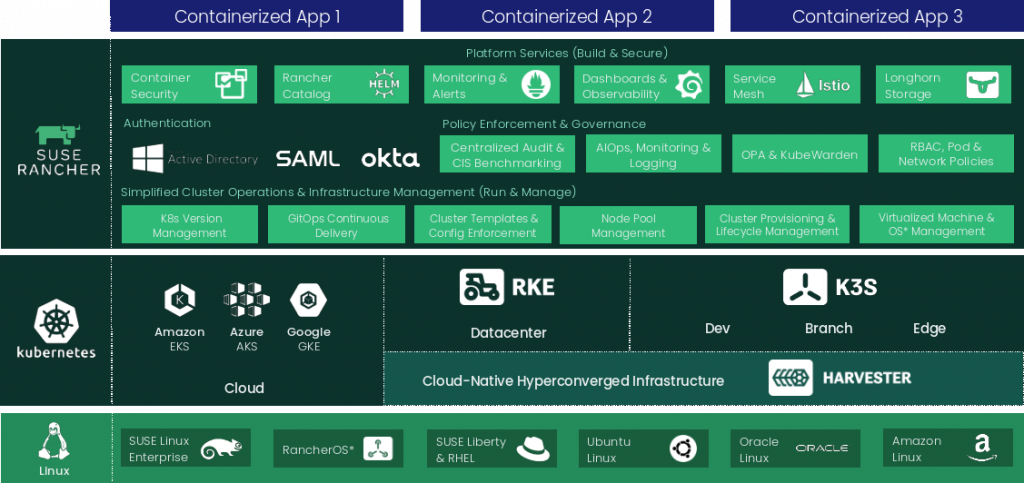
SUSE announced on November 10, 2026, in Salt Lake City, during KubeCon + CloudNativeCon North America 2026, a package of updates to its open infrastructure platform. The highlight is the general availability of the AI Crew in SUSE Rancher Prime: a team of specialized artificial intelligence agents, coordinated by the assistant Liz, to diagnose issues, troubleshoot incidents and manage workloads across Kubernetes and virtual machines.
In SUSE Rancher Prime, the Liz assistant already existed as a technical preview since 2025. What is new is that the agent crew is now generally available and reaches further: beyond Kubernetes clusters, it now also works on virtual machines through integration with SUSE Virtualization. With OAuth2 support, Liz can connect to external Model Context Protocol (MCP) servers and use third-party tools and data, such as code repositories and internal configuration databases. An AI-first SUSE Rancher Prime CLI with server-side dry-run lets teams test infrastructure changes before applying them, and AI-suggested actions go through human approval steps.
SLES 16.1 unifies workloads in a single system
SUSE Linux Enterprise Server (SLES) 16.1 has been available since November 10, 2026, and brings traditional, immutable and real-time workloads together under a single operating system lifecycle. The release includes an on-box MCP framework, in technical preview, for AI-assisted diagnostics, plus Live Patching, post-quantum cryptography readiness and software supply chain verification. The system builds on SLES for NVIDIA, aimed at GPU-accelerated infrastructure.
Kubernetes as a service and supply chain security
SUSE Rancher Prime Virtual Clusters now offers Hosted Control Plane mode, in open beta, so platform teams can deliver Kubernetes as a service using the RKE2 distribution. The SUSE Storage v2 data engine promises up to 10 times faster performance for stateful workloads, and advanced networking with Kube-OVN adds tenant isolation.
On security, the SUSE Application Collection now includes more than 1,000 Python libraries from verified sources, with SBOMs and provenance information, forming the basis of the SUSE AI Factory AI component catalog. The upcoming SUSE Security 6.0 release is set to add a vulnerability scanner and a runtime enforcer that detects and blocks anomalous workload behavior.
Why it matters
According to research sponsored by SUSE, Kubernetes management is IT leaders' top investment priority, followed by AI, and 24% of them point to AI-assisted troubleshooting as the answer to simplify operations. The same research finds that 91% of organizations acknowledge employees bypass security controls at least occasionally to work faster — which is why SUSE keeps human approval in the loop for AI actions.
Red Hat took a similar path this same week: OpenShift 5 arrived with an AI agent to operate Kubernetes clusters.
“As enterprises move from experimenting with AI to deploying it at scale, they need infrastructure that can support new workloads alongside existing applications without compromising security, performance, or control,” said Dr. Thomas Di Giacomo, Chief Technology and Product Officer at SUSE.
The move reinforces an industry trend: the enterprise AI contest is shifting from models to the infrastructure layer — where models run, what data they touch and who controls it all. With SUSE Rancher Prime, SUSE is betting on open, sovereign infrastructure, without locking customers into a single vendor or cloud.
Sources
- SUSE — official announcement
- GlobeNewswire — SUSE official announcement
- HPCwire — announcement coverage
- Cloud Native Now — announcement analysis
Image credit: official SUSE diagram of containerized application stacks on Kubernetes, published on the SUSE blog (suse.com).
Transparency: this article was produced with the assistance of artificial intelligence, based on SUSE's official announcement and independent press coverage, cross-checked against public posts and internet sources. The facts were verified against the original sources listed above; consult them to confirm details and updates.
By Muse