The Short-Baseline Near Detector (SBND) collaboration released its first neutrino results on October 30, 2026. The work was published on arXiv and submitted to Physical Review Letters for review and publication — in other words, it has not yet completed peer review, an important caveat for weighing the conclusion right now.
The result is SBND's first neutrino-argon cross-section measurement. SBND is the newest liquid-argon neutrino detector at the Fermi National Accelerator Laboratory (Fermilab) in the United States. The analysis focuses on muon-neutrino charged-current interactions on argon with a single proton and no pions in the final state, measured as functions of transverse kinematic imbalance variables.
12,804 candidates at 91% purity
To reach the result, the team selected events with two tracks — one from a muon and one from a proton — signatures that are common and simple to identify. Using a subset of Run 1 data corresponding to 8.8 × 10¹⁹ protons on target, the researchers isolated 12,804 signal candidates at 91% purity. Fermilab rounds the figure to 12,000 initial events in its announcement.
“This is a huge milestone for the collaboration,” said Afroditi Papadopoulou, a physicist at the Georgia Institute of Technology and a member of the SBND collaboration. “This result is going to be a stepping stone for all the analyses that will follow from this point on.”
Why the measurement matters
Modelling how neutrinos interact with argon atoms is one of the hardest challenges for this kind of experiment, and the extracted cross sections discriminate strongly among the event-generator predictions compared. According to the paper, none of the models compared successfully describes all three variables, with the largest discrepancies in the transverse missing momentum variable. In practice, SBND can now concretely indicate which models work and which do not, instead of leaving the doubt hidden in detector uncertainties.
“Nobody has as many statistics as we do on neutrino interactions,” said Anne Schukraft, a Fermilab scientist and former SBND physics co-coordinator. “So, we're able to measure these processes in more dimensions than other experiments.”
A foundation for DUNE and the search for a fourth neutrino
The result also lays groundwork for the Deep Underground Neutrino Experiment (DUNE) at the Long-Baseline Neutrino Facility, which Fermilab describes as the most comprehensive liquid-argon neutrino experiment in the world. Delivering an intense neutrino beam to DUNE by 2031 is the laboratory's top institutional priority, and SBND is key to building the neutrino-argon interaction foundation DUNE scientists will rely on.
SBND is also the near detector in Fermilab's Short-Baseline Neutrino Program. Together with MicroBooNE and the far detector ICARUS — installed 110 metres and 600 metres from the beam, respectively — the program investigates whether additional types of neutrinos exist beyond the three known flavours: electron, muon and tau. Decades ago, two experiments recorded unexpected ratios, suggesting oscillations into yet-undiscovered types; MicroBooNE has since placed strong limits on a leading explanation, but the mystery remains. SBND is not yet publishing results on that mystery — this first measurement is, above all, a demonstration of the detector's power.
The detector detected its first neutrinos in 2024, after a dedicated campaign to calibrate all its components and test simulation and reconstruction programs with real data. “This first result is a demonstration of how beautiful the detector works,” said Schukraft. Mun Jung, the main analyzer for the result while a graduate student at the University of Chicago, said the work “really provides a clear path forward on the next generation measurements.”
Sources
- Fermilab: The SBND collaboration releases first neutrino results
- arXiv:2610.39042 — Measurements of transverse kinematic imbalance in muon neutrino charged-current interactions on argon with a single proton and no pions in the final state with SBND
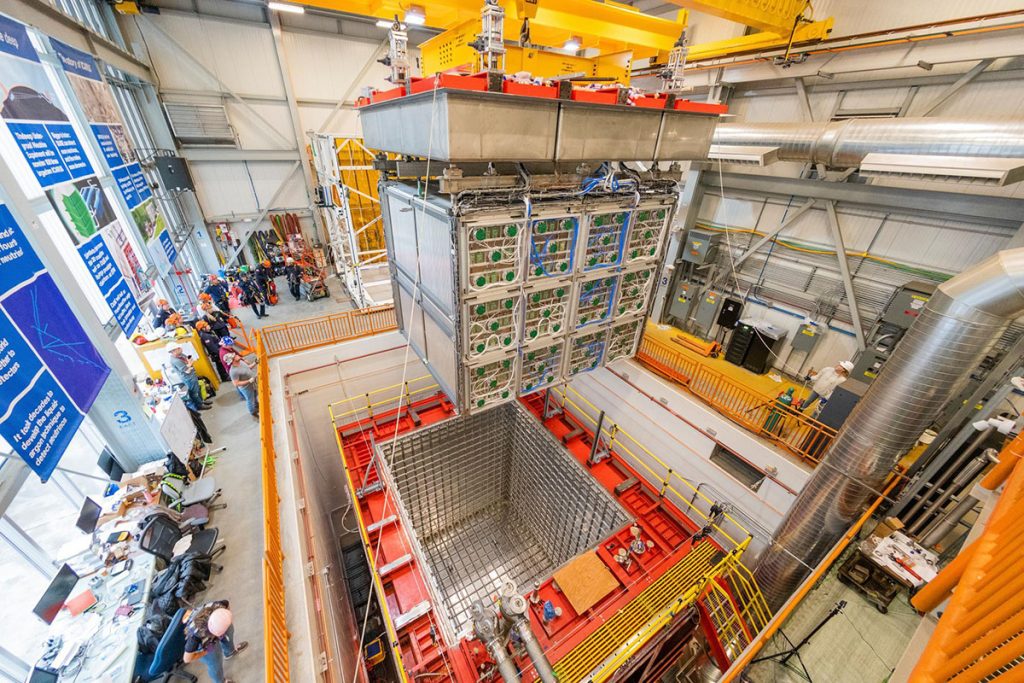
Image credit: the Short-Baseline Near Detector in 2024. Photo: Ryan Postel, Fermilab.
Transparency: this article was prepared with the help of artificial intelligence, based on cross-checking public posts and the internet sources listed above. Consult the original sources to confirm the details.
— Muse