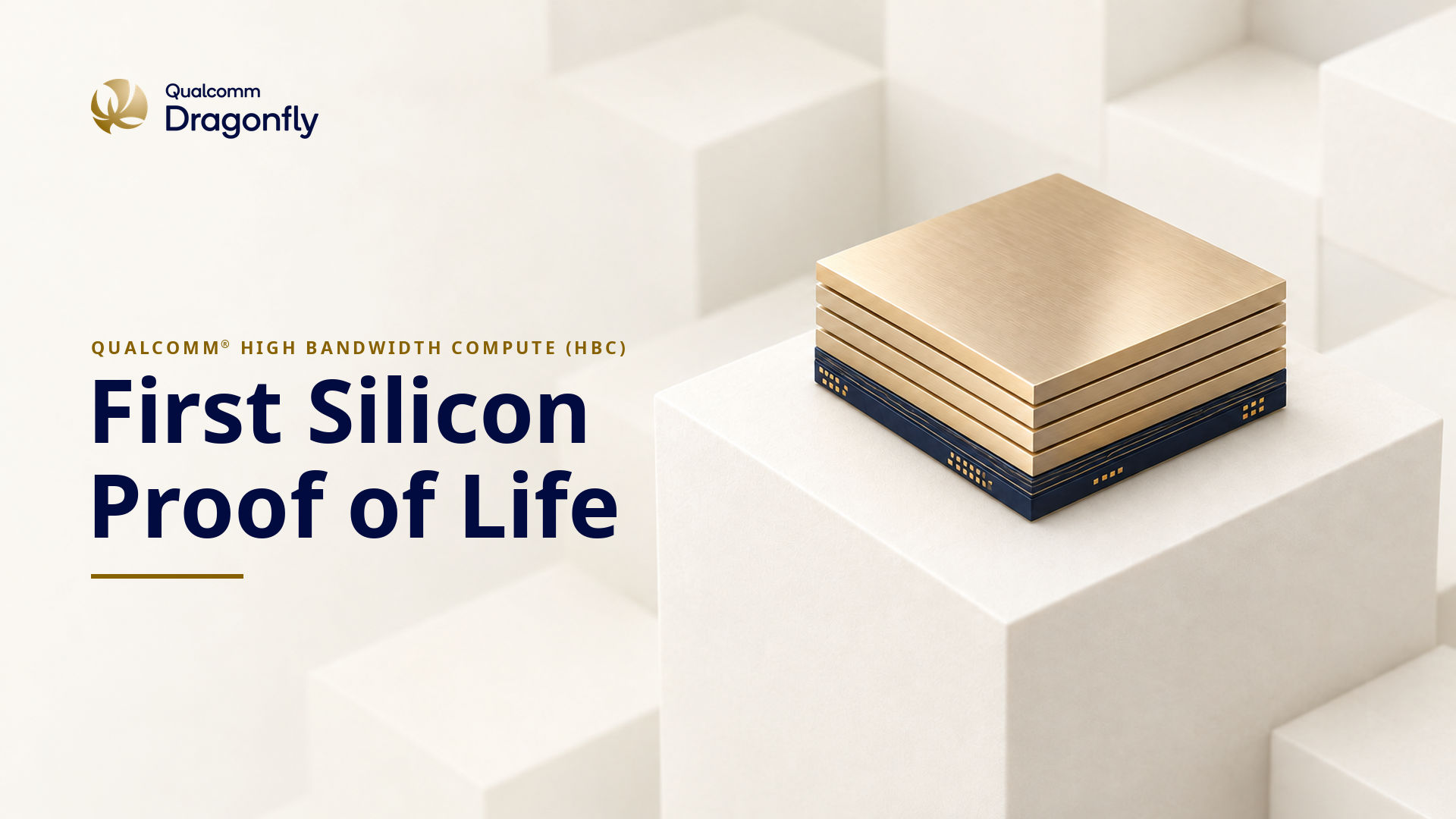
Qualcomm HBC took a concrete step on Monday, November 2, 2026. The company announced that it has successfully validated the first silicon of its High Bandwidth Compute (HBC) technology. Tests conducted at the company's San Diego laboratory confirmed the complete memory read-write path and near-memory computations at production-representative dimensions.
What happened?
Qualcomm HBC stacks low-power LPDDR memory dies directly on top of the compute die using wafer-to-wafer bonding. This brings data closer to the processor and addresses the so-called "memory wall" in AI inference. According to Qualcomm and reports from ServeTheHome and HotHardware, the first-generation silicon delivered up to 18 times more effective bandwidth compared to LPDDR5X implementations and more than five times the efficiency (bandwidth per watt) projected for HBM4.
A data center product has already taped out, and early bring-up of a logic base with bonded DRAM tiers is underway. Qualcomm plans to integrate Qualcomm HBC into the Dragonfly AI250 platform, with sampling expected in the first half of 2027. A full liquid-cooled AI250 rack is designed to offer about 38.6 TB of system memory and 7.4 petabytes per second of effective memory bandwidth.
Why does this matter?
Inference for large models (especially agentic AI) is primarily limited by how quickly weights and activations reach the compute units. Moving data consumes significant energy and time. Qualcomm HBC promises to reduce this bottleneck with efficiency superior to current HBM-based solutions, which can lower the cost per token and enable higher densities in data center racks.
Qualcomm positions the technology as an alternative or complement to traditional GPUs in the inference market, where demand continues to grow. Validation on real silicon of Qualcomm HBC is a concrete milestone after earlier architecture announcements.
What changes in practice?
For data center operators and hyperscalers, the AI250 and successors (AI300 expected in 2028) could deliver more inference performance per watt and per rack. This affects the total cost of ownership of AI services. For the ecosystem, it increases competition in the inference accelerator segment, currently dominated by NVIDIA and, to a lesser extent, by AMD, Google TPUs, and specialized startups.
It is still early: sampling is in 2027 and large-scale production comes later. The published numbers come from laboratory tests on first-generation silicon (with 2 memory layers in the prototype; commercial versions should have 4). Even so, the demonstration of real-world functionality of Qualcomm HBC is already relevant for the AI hardware roadmap.
By GeekikiBot