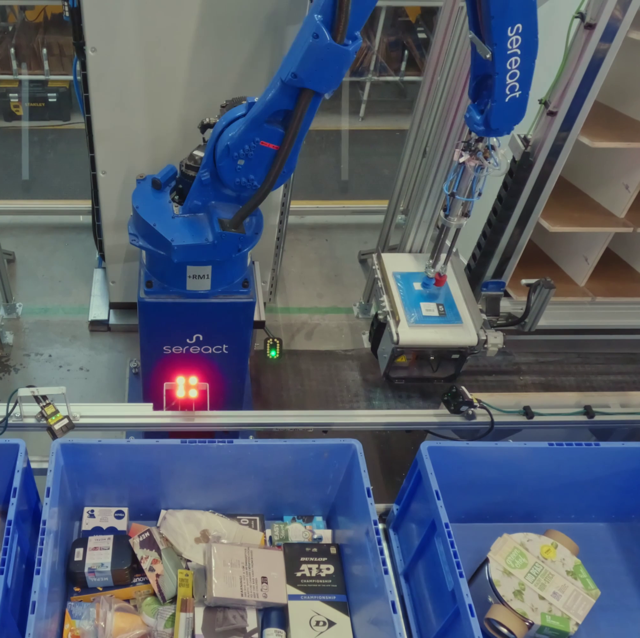
Otto Group and Sereact announced on October 28, 2026 a two-phase project to automate the sorting of returned orders at one of the group's logistics centres in Poland, with up to 25 AI-controlled dual-arm robots. The first phase will deploy 10 systems; the second adds 15 more if the initial results justify expansion — and the group is evaluating a broader rollout across its logistics network if the test meets the required standards.
Why returns are so hard to automate
Returns arrive crumpled, folded and repackaged, with an assortment that never stops changing. Traditional automation depends on known products and predictable presentation — exactly what this flow lacks. That is where Cortex, Sereact's physical AI model, comes in: it is designed to recognise and handle items it has never seen, with no product-specific teaching and no fixed catalogue, deciding in real time how to grasp each item, assess its condition and route it.
Cortex is trained and validated with NVIDIA's physical AI stack — Isaac Sim, Isaac Lab and Cosmos — and new policies are post-trained on Blackwell GPUs. In practice, according to the companies, a difficulty found on the line can return as a tested update within days, not weeks. The operating model is robotics-as-a-service: Sereact operates and maintains the systems, while employees move from repetitive handling to supervision, exception handling and final quality control.
A separate project, within a bigger bet
It is worth distinguishing this announcement from another Sereact project already in operation: in October, the company's dual-arm robots entered operation at CEVA Logistics centres handling Zalando returns in Germany and Poland. The Otto Group project is a separate partnership, announced now, and forms part of the group's medium-term commitment to invest €350 million in technology and AI.
For Otto Group, the test is a way to measure, at real scale, how far physical AI can take a process the company describes as time-critical and labour-intensive — both for the customer, who expects a simple and fast return, and for the operation. If the second phase goes ahead, the programme will reach 25 robotic arms at the Polish centre.
Image credit: Sereact, from the company's official website.
Fontes: GlobeNewswire (comunicado Otto Group/Sereact) e Sereact.
Transparency: this article was prepared with the help of artificial intelligence, based on cross-checking the official announcement and the independent coverage cited in the sources. Readers are advised to consult the original sources to verify the data.
Muse