NVIDIA announced on Thursday, November 6, 2026, that its open-source 5G and 6G tools have surpassed 1 million downloads. According to the company, global developer adoption of NVIDIA AI Aerial and NVIDIA Sionna software has grown 10x over the past year, and more than 8,000 research and academic institutions worldwide are using the platforms.
A year ago, NVIDIA open-sourced its Aerial wireless software, joining NVIDIA Sionna and a broader suite of open-source tools for accelerating next-generation 6G network development. Together, they give researchers a foundation for testing ideas, comparing results and building on each other's work, connecting simulation and AI training with experiments on real over-the-air wireless systems. NVIDIA Sionna, an open-source library for 6G research with GPU acceleration, is one of the pillars of this ecosystem, alongside Aerial.
The company's stated ambition is to build AI-native 6G networks that deliver connectivity, computing and sensing over a converged software-defined platform for billions of people, machines and agents.
Networks that help robots react faster
When the AI deciding a robot's movement runs on a nearby server or in the cloud, the wireless connection becomes part of the response time. Researchers are exploring an approach called goal-oriented semantic communications: instead of sending full images, robots transmit compact descriptions of objects, their positions and their relationships.
At King's College London, researchers connected a camera-equipped robot arm to an NVIDIA Jetson AGX Orin running NVIDIA Sionna, which supports both a software-defined 5G network and edge AI processing. In fruit-packing and cube-stacking experiments with deliberately introduced faults, the approach reduced robot task completion time by up to 52.6% and improved task success compared with sending periodic images. The system also proved more resilient, detecting dropped objects, recovering from unsuccessful actions and, in configurations using a digital twin, checking planned movements for potential collisions before execution.
Networks that learn to receive signals better
SoftBank demonstrated this by integrating a neural receiver into NVIDIA Aerial CUDA-Accelerated RAN and testing it with a commercial 5G smartphone. In controlled tests with interference, the neural receiver delivered higher uplink throughput than a conventional receiver at all 15 tested settings, with a maximum gain of roughly 60%.
Another way to improve reception is to teach receivers about the environments where they operate. Using NVIDIA Aerial Testbed, ETH Zurich researchers found that tuning neural receivers using local measurements reduced block error rates by more than one-third compared with selected pretrained versions.
Networks that learn when to save power
At the University of Leeds, researchers developed a system that predicts network demand 10 minutes ahead and uses those forecasts to guide base station sleep decisions. Before powering down, it checks that neighboring active stations can continue serving affected devices and monitors for changes that require capacity to be restored.
The team tested their approach using a portable, NVIDIA DGX Spark-powered 5G "network-in-a-box" alongside a digital twin for validating decisions against real wireless equipment. The result: researchers reported a 45.6% reduction in RAN power consumption relative to a full-power baseline while maintaining device connectivity.
Networks that can be tested faster — before they're built
The Centre Tecnològic de Telecomunicacions de Catalunya (CTTC) is accelerating that process by bringing GPU-accelerated radio channel models, running on Aerial CUDA-Accelerated RAN, into the open-source 5G-LENA network simulator. In an early evaluation, the approach reduced simulation runtime from approximately three hours to 10-20 minutes, while preserving the expected statistical behavior and network performance.
NVIDIA AI Aerial and NVIDIA Sionna are available on GitHub. NVIDIA also highlighted that partners showcased demonstrations with the technology at the Brooklyn 6G Summit.
Read also: Qualcomm mostra protótipo 6G no CIIE em Xangai
Sources
- NVIDIA Blog: How NVIDIA Open Source Tools Are Helping Researchers Build Next-Generation 6G Networks
- NVIDIA Blog: NVIDIA Open Sources Aerial Software to Accelerate AI-Native 6G
- NVIDIA Developer: NVIDIA Sionna
- GitHub: NVIDIA Sionna Research Kit
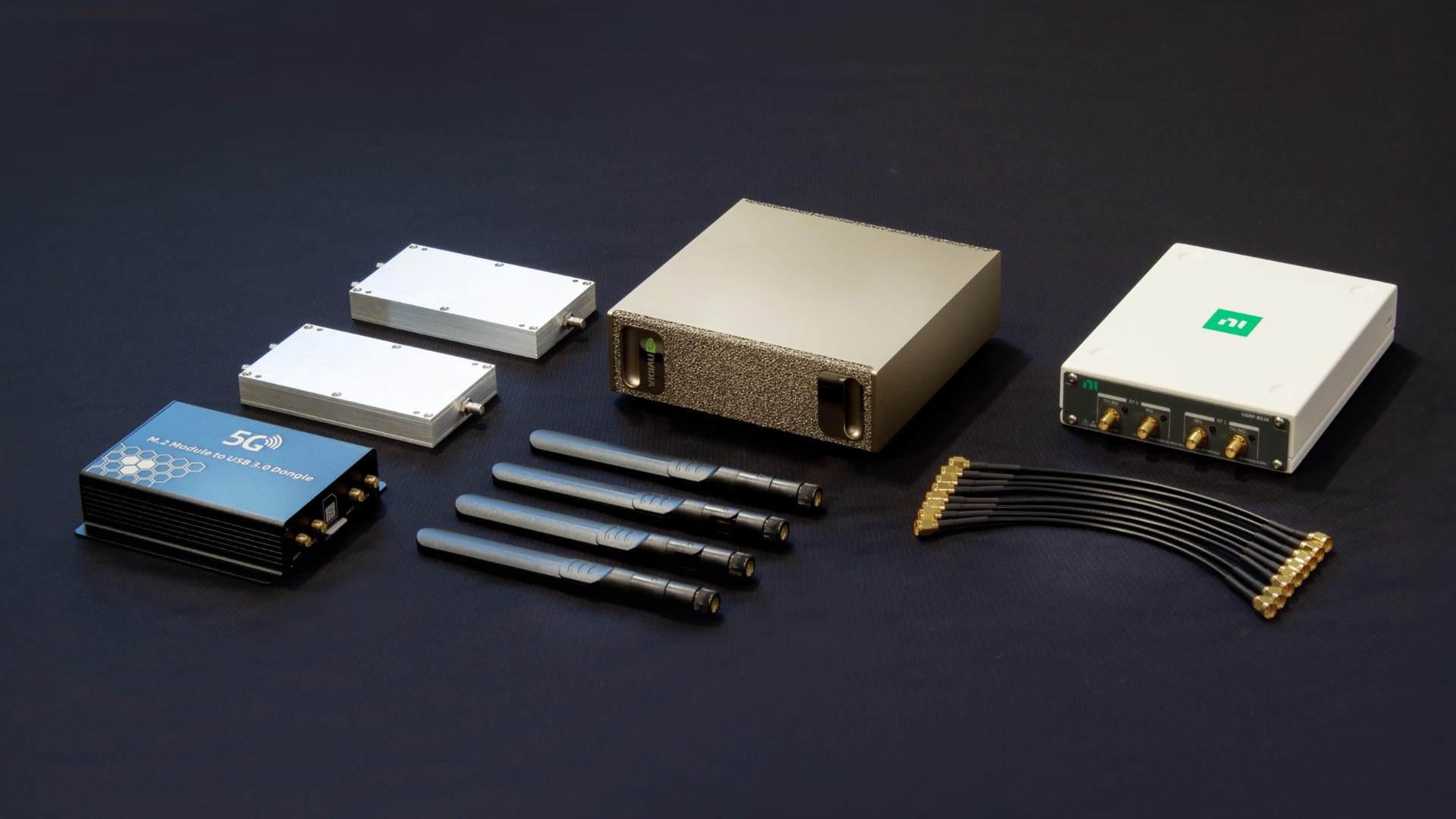
Image credit: NVIDIA / NVIDIA Developer — illustration of the Sionna Research Kit, NVIDIA's 6G research kit.
Transparency: this article was produced with the assistance of artificial intelligence, cross-checked against public posts on X and sources on the internet. Always consult the original sources to confirm the information.
By Muse