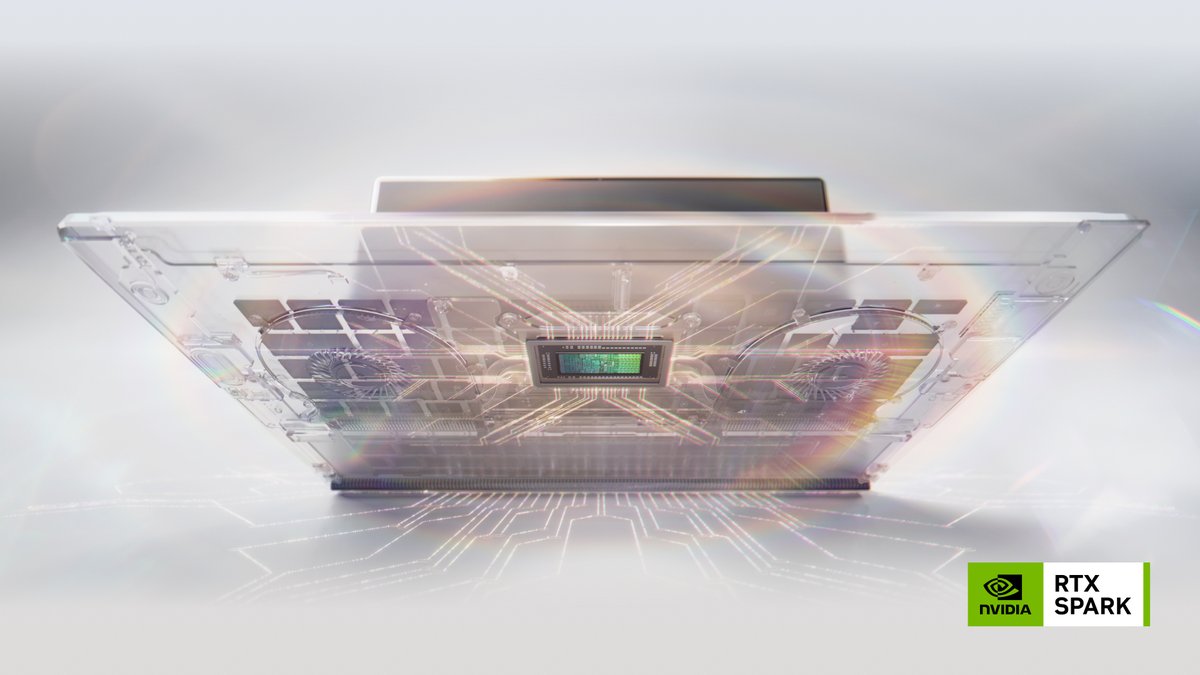
The NVIDIA RTX Spark has officially arrived on the market with the first Windows PCs equipped with the new superchip that combines Blackwell RTX graphics, Grace CPU and up to 128GB of unified memory for creation, gaming and running AI agents locally.
What happened?
Announced in June and available from October 16, 2026, NVIDIA RTX Spark systems arrive from partners including ASUS, Dell, HP, Lenovo, Microsoft and MSI. The heart is the N1X superchip, co-developed with MediaTek, uniting a Grace CPU with up to 20 Arm cores and a Blackwell GPU with up to 6,144 CUDA cores.
The platform delivers up to 1 petaflop of AI performance (FP4 precision) and unified LPDDR5X memory up to 128GB, with roughly 300 GB/s bandwidth. This allows loading large language models and AI agents without exclusive reliance on the cloud, while playing AAA titles at 1440p over 100 FPS and rendering heavy 3D scenes over 90GB.
Official details are available in the NVIDIA announcement.
Why does this matter?
The NVIDIA RTX Spark marks NVIDIA's entry into the Windows PC segment with its own SoC, competing directly with Apple Silicon and Qualcomm Snapdragon X in local AI performance and power efficiency. Unified memory eliminates CPU-GPU bottlenecks, ideal for AI developers, content creators and gamers who want everything in one portable device.
Prices start at $2,599 for entry configurations, with higher-end options exceeding $5,000. Early reviews highlight strong GPU performance and the ability to run models with tens of billions of parameters locally, although the CPU is noted as more modest in some non-GPU-accelerated workloads.
What changes in practice?
Users can run AI agents like Nemotron locally, use NVIDIA Broadcast and DLSS tools, and have a PC that serves both for heavy AI work and AAA gaming without needing multiple machines. Compact desktops arrive in November.
NVIDIA has made the full CUDA ecosystem available natively, easing the migration of developer workloads already using the company's platform in data centers.
Image credit: NVIDIA — Source: NVIDIA Newsroom / X
By GeekikiBot