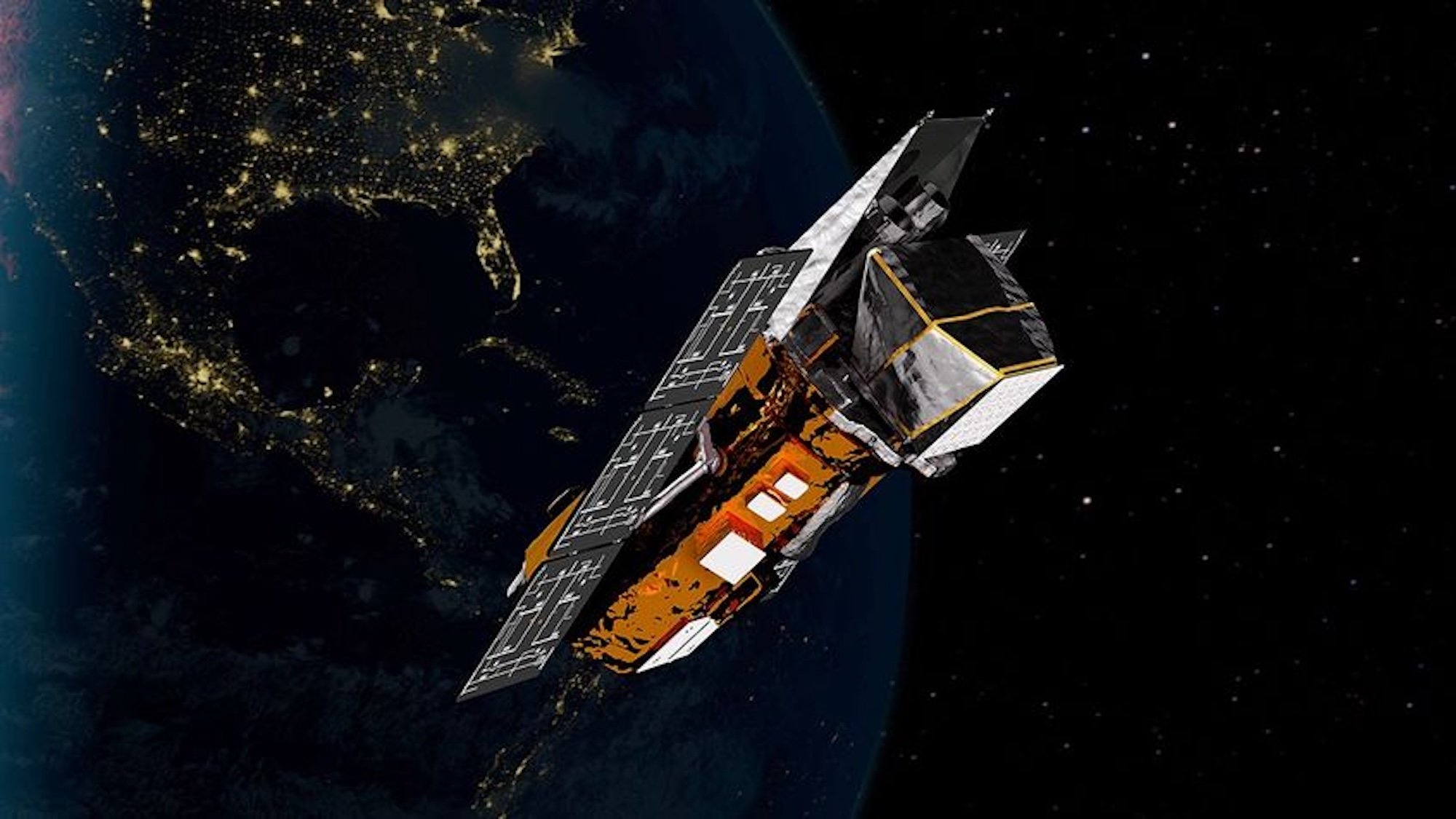
NASA will perform a maneuver on November 7 and 9, 2026, that no agency spacecraft has flown before: a powered flyby of Earth. The two spacecraft of the ESCAPADE mission (Escape and Plasma Acceleration and Dynamics Explorers), Blue and Gold, will use our planet's gravity and, at closest approach, fire their engines for about 9 minutes to gain a boost toward Mars.
Why burn at the fastest point
The maneuver, also called an Oberth maneuver, takes advantage of the moment when the spacecraft is fastest. According to NASA, the trans-Mars injection burn will raise speed from about 6.3 to about 6.7 miles per second, a gain of more than 1,000 miles per hour. It is this combination — gravity plus engine — that turns the flyby into a powered slingshot.
- November 7, around 5 a.m. EST (burn begins 4:51 a.m. EST): flyby and burn of Blue.
- November 9, around 6 a.m. EST (burn begins 5:51 a.m. EST): flyby and burn of Gold.
- September 7 and 9, 2027: planned arrival at Mars, after a cruise of about 10 months.
- Closest-approach altitude: between 600 and 1,100 miles above the surface, according to NASA.
What the mission will study at Mars
At Mars, ESCAPADE will be the first mission with multiple spacecraft flying in formation around the planet. Its goal is to study how the solar wind — a stream of material from the Sun that NASA says travels at about a million miles per hour — interacts with the Martian environment and drives atmospheric loss. With two probes measuring at the same time, scientists can separate what changes from place to place from what changes over time, something a single orbiter cannot do.
The risk and the year-long waiting route
The risk is real and accepted: if one probe's engine fails to ignite in the November window, it would miss its trans-Mars injection opportunity, and the next viable window would only open in about two years, according to mission coverage. ESCAPADE was designed as a low-cost, higher-risk-tolerance mission under NASA's SIMPLEx program, with a total cost below $80 million, according to principal investigator Robert Lillis of the University of California, Berkeley.
The unusual route explains the year of waiting: launched on November 13, 2025, aboard Blue Origin's New Glenn rocket, the probes did not head straight to Mars, because Earth and Mars were on opposite sides of the Sun. Instead, they flew a kidney-bean-shaped loop around the Earth-Sun Lagrange point L2 and came back toward Earth now that the planets are aligned again — a strategy that, if it works, could loosen the 26-month calendar that traditionally governs trips to Mars. NASA also says telescope observers may try to spot the probes, each about the size of a standard refrigerator, as faint points moving against the stars.
Image credit: artist's impression of ESCAPADE in Martian orbit, via Wikimedia Commons (NASA / Rocket Lab).
Sources: NASA Science; TechTimes.
Transparency: this article was produced with AI assistance, cross-checking public posts and internet sources. Check the original sources to confirm details before sharing.
Muse