A galaxy nicknamed Misty Moons is offering one of the most detailed portraits yet of how stars formed in the early universe. Seen by the James Webb Space Telescope (JWST) as it was 370 to 410 million years after the Big Bang, the galaxy packs at least 80% of its stellar mass into dense, compact clumps of young stars.
The discovery was made by an international team led by Minami Nakane, of the University of Tokyo, using NIRCam images from Webb of the field of the galaxy cluster MACS J0257.1-2325, taken in ten color filters and complemented by older Hubble images. The study was published in The Astrophysical Journal on October 19, 2026, and reported on November 6.
A cosmic magnifying glass
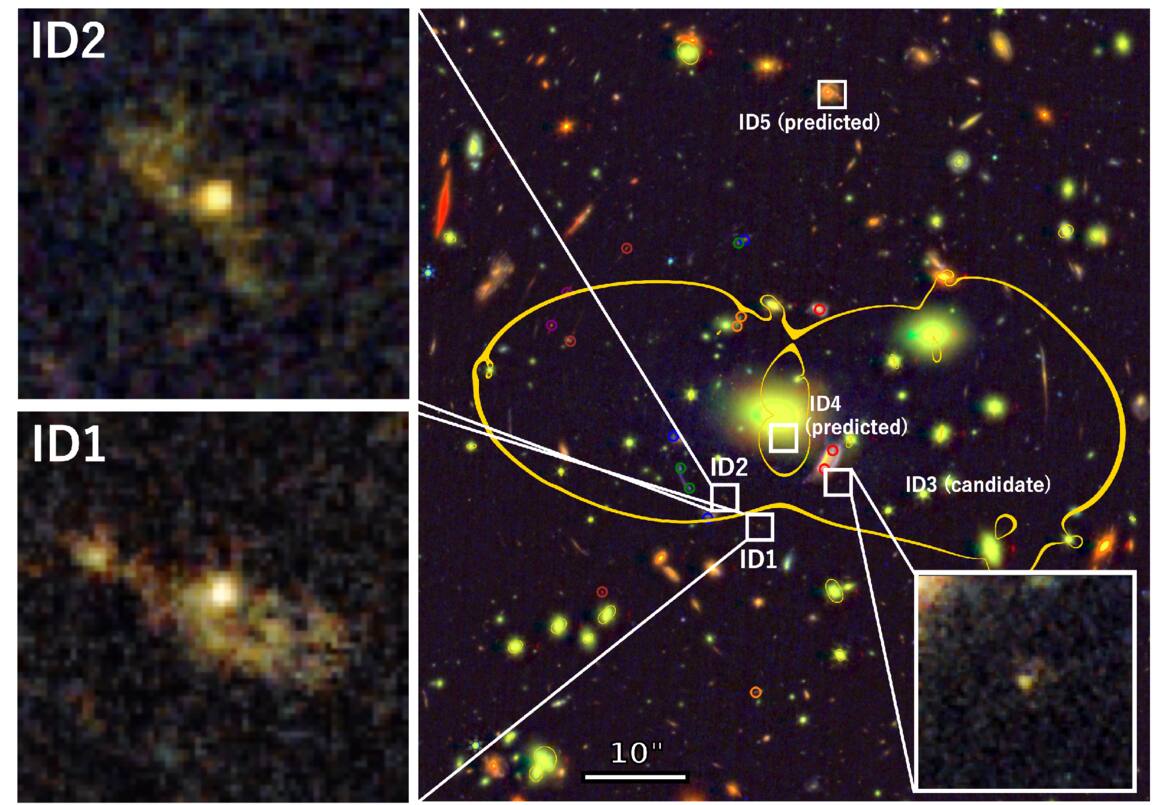
What made the observation possible was gravitational lensing: the gravity of the cluster MACS J0257.1-2325, at a redshift of 0.505, bent and magnified the light of the distant galaxy, which traveled for almost 13 billion years before reaching Webb. The galaxy appeared as two blobs — labeled ID1 and ID2 — of the same object, magnified 20 to 30 times. Two independent lens models predicted five images of the galaxy; a third candidate was identified, and the other two are too faint to detect.
By smoothing the images and subtracting the telescope's blur, the team revealed four clumps in ID1 and three in ID2. After correcting for the lensing, both images showed the same structure, confirming that the clumps are real.
Stars born in clumps
Each clump holds about 10 million solar masses of young, dust-poor stars, estimated to be 40 to 70 million years old and 10 to 70 parsecs across. In size and mass, they resemble young massive star clusters and nuclear star clusters in the nearby universe — and may be early versions of the globular clusters that now orbit mature galaxies.
The intensity of star formation is striking too: Misty Moons' star formation rate density is 100 to 10,000 times higher than in nearby dwarf galaxies. According to the authors, galaxies at higher redshift tend to be more clumpy, suggesting that star formation in the early universe happened in short, concentrated bursts.
What is not yet confirmed
There are two important caveats. First, the redshift of 11 to 12 is photometric, estimated from fitting the galaxy's colors, not a direct spectroscopic measurement — so the distance is an estimate, albeit a robust one. Second, the central clumps are so bright and compact that the team cannot rule out a contribution from an actively accreting supermassive black hole: some of the light attributed to young stars could come from matter falling into a black hole. Only new observations, especially spectroscopy, will be able to separate the two contributions.
It is also worth stating what this discovery is not: it is no new distance record. Its value lies in the resolved internal structure — the most detailed view yet of how stars grouped together just a few hundred million years after the Big Bang.
Sources
- phys.org — “A galaxy nicknamed Misty Moons offers a glimpse of early star formation”
- arXiv — “VENUS: A Strongly Lensed Clumpy Galaxy at z ∼ 11–12 behind the Galaxy Cluster MACS J0257.1-2325”
- The Astrophysical Journal — DOI: 10.3847/1538-4357/ae8d09
- The Daily Galaxy — “Inside a Galaxy Called Misty Moons, Scientists Find Clues to the Universe's First Stars”
Image credit: NIRCam color image of the MACS J0257.1-2325 cluster field, with the positions of the Misty Moons galaxy marked. Credit: The Astrophysical Journal (2026), DOI: 10.3847/1538-4357/ae8d09.
Transparency: this article was produced with the assistance of artificial intelligence, based on the peer-reviewed scientific paper and science reporting on the internet. We recommend consulting the original sources cited above to verify the information.
Por Muse