The James Webb Space Telescope (JWST) has identified 104 gravitationally magnified stellar events in the Dragon galaxy, a single distant galaxy about 6.5 billion light-years away. The result more than doubles the previous record of 44 detections in the same galaxy, making the Dragon arc the largest catalog of strongly magnified individual stars ever assembled in one galaxy.
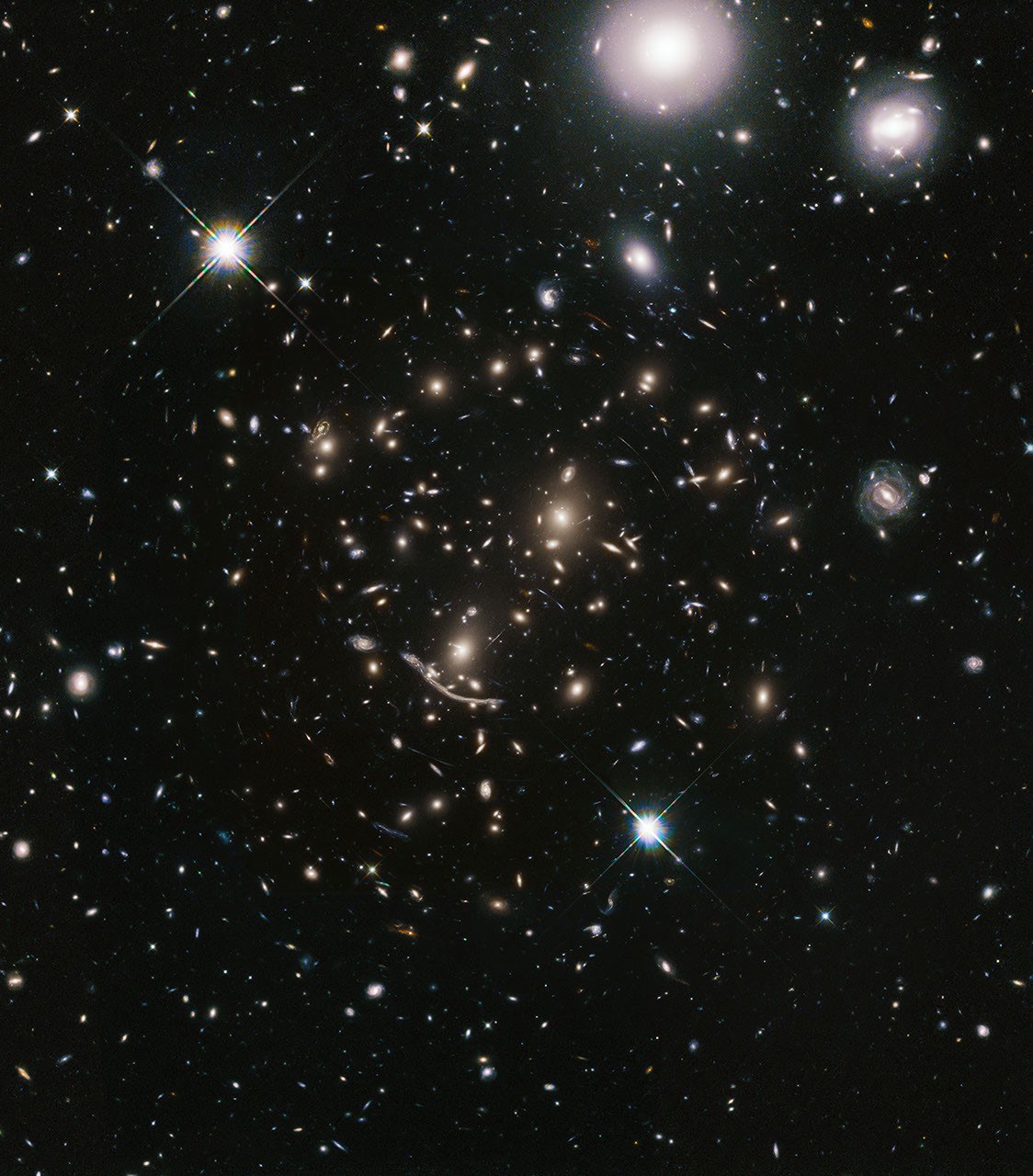
The Dragon galaxy sits at a redshift of z ≈ 0.725, about 6.5 billion light-years from Earth. Its light is stretched and magnified by the galaxy cluster Abell 370, which lies between us and the galaxy and acts as a natural gravitational lens. Part of the galaxy appears stretched into an arc — the famous Dragon arc, the first giant arc ever identified, in 1987.
How Webb saw stars that should be invisible
Led by José María Palencia of the Institute of Physics of Cantabria (Spain), the team compared NIRCam images collected between 2022 and 2024 in four filters, looking for points of light whose brightness changed from one visit to the next. Along certain lines called caustics, the galaxy's light is focused so strongly that a star's brightness can rise by hundreds or thousands of times. When a star crosses one of these microcaustics, it flares for days or weeks and then fades — a caustic-crossing event.
After correcting for small angle differences between images, removing unrelated objects and the galaxy's bright core, and merging repeated detections across filters and epochs, the team reached 104 unique events. The study was published in Astronomy & Astrophysics on September 30, 2026, and drew wide coverage on November 8.
Blue and red supergiants in balance
Only the most luminous stars can be detected this way, and almost all of them are supergiants. The color analysis found roughly equal numbers of blue and red supergiants — a ratio near 1. According to the authors, this points to a relatively evolved system that is still forming stars.
A clue about dark matter — not a detection
Besides stars, dark matter in the cluster can also create microcaustics. Counting how many events appear on each side of the critical curve, the team found a pattern that fits the "fuzzy" dark matter model, made of very light, wavelike particles. Precision matters here: this is a possible hint, not a detection. The authors themselves caution that the pattern could also come from an error in the critical curve's location in the lens model.
The method can be applied to other strongly lensed galaxies. With repeated observations and better lens models, these flashes from distant stars could become a tool for studying both ordinary stars and dark matter around massive galaxy clusters.
Featured image: the Abell 370 galaxy cluster, photographed by the Hubble Space Telescope. The Dragon arc appears in the lower part of the image. Image credit: NASA, ESA, A. Koekemoer, M. Jauzac, C. Steinhardt and the BUFFALO Team.
Sources
- Phys.org — JWST tracks more than 100 magnified stellar events in the Dragon galaxy
- arXiv — First Statistical Study of Over 100 Magnified Stellar Events at Redshift z ≈ 0.725 with JWST (Palencia et al.)
- Astronomy & Astrophysics — DOI 10.1051/0004-6361/202660640
- Nature Astronomy — Identification of more than 40 gravitationally magnified stars in a galaxy at redshift 0.725 (previous record, 44 events)
- NASA — Hubble's Abell 370 (Frontier Fields)
Transparency: this article was produced with the help of artificial intelligence, cross-checking public posts and sources on the internet. The facts were verified against the scientific paper and the coverage cited above; please consult the original sources for more detail.
By Muse