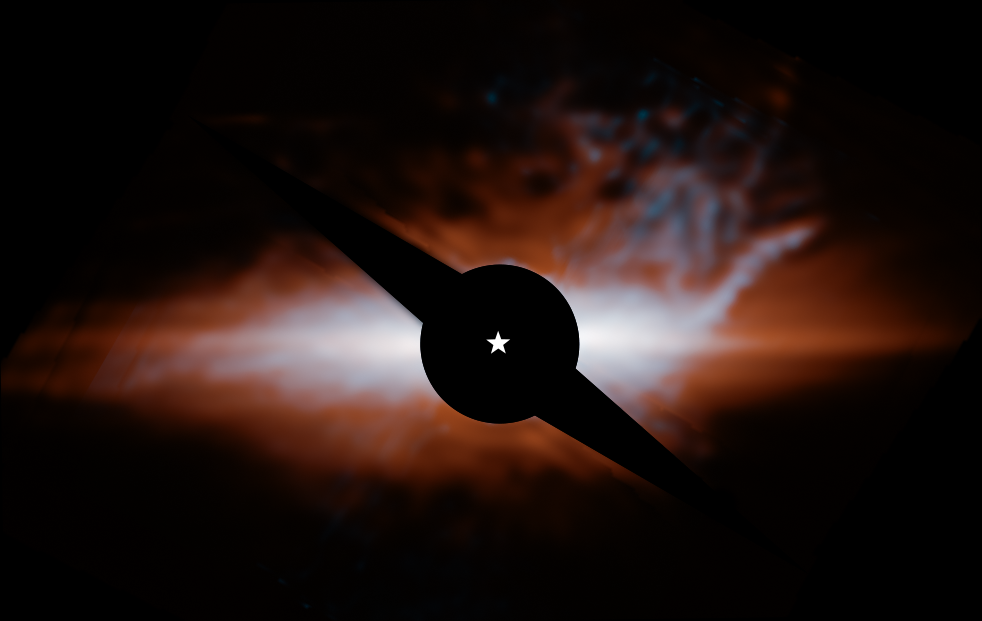
The James Webb Space Telescope has found ice in Beta Pictoris older than the star itself: frozen water and carbon dioxide in the debris disk around Beta Pictoris, a star only about 20 million years old, roughly 63 light-years from Earth. The result was published in the journal Science and reported by Ars Technica on November 14.
The team, led by Sarah Betti, an astronomer at the Space Telescope Science Institute (STScI) in Baltimore, observed the system on December 7, 2023, with Webb's Near Infrared Spectrograph (NIRSpec). Earlier searches had found neither water vapor nor the signature of water ice in the disk — this time, the telescope detected both ices.
What Webb found
The spectra show water ice and carbon dioxide ice, the latter in both its common form and the rarer one containing the heavier carbon-13 isotope. The water is glassy and amorphous rather than crystalline: less than 7% of the water ice is crystalline, something models did not predict for debris disks, where ice was expected to be mostly crystalline. The carbon dioxide is intimately mixed with the water ice, at a ratio of about one CO2 molecule for every ten water molecules — roughly 11% of the ice.
For the ice in Beta Pictoris to survive in amorphous form, it must stay below about 100 Kelvin (minus 173 °C); above that, starlight or cosmic rays would reorganize its structure.
Why the ice is older than the star
The glassy form and the mix with CO2 indicate that the ice in Beta Pictoris formed in very cold conditions, most likely in the interstellar medium, before Beta Pictoris and its planets began to take shape — not in the disk, after the star was born. The proportions of the mixture resemble those measured in the comets of our Solar System.
Another detail stood out: the ice is distributed evenly throughout the disk. According to the team, that uniformity requires frequent collisions between ice-rich bodies, which spread the icy grains across the system. The result also helps explain where the disk's carbon monoxide gas comes from — colliding icy bodies — and how the ice survives in an environment exposed to the star's ultraviolet radiation.
What this says about water-rich planets
Beta Pictoris is already one of the most studied young systems in the sky, with three planets identified. If such a young system began with the same icy ingredients as ours, primordial interstellar ice may be a common ingredient in planet formation — and the raw materials for water-rich worlds may be available around many young stars.
Geekiki previously covered the Cat's Tail of Beta Pictoris, another structure in the same disk, revealed by Webb in 2024 and detailed by Hubble in visible light.
Sources
- Science — Carbon dioxide and amorphous water ices in the debris disk around β Pictoris (DOI: 10.1126/science.adw7770)
- NASA — Beta Pictoris (MIRI Image), from the James Webb Space Telescope
Featured image: the Beta Pictoris system seen by the James Webb Space Telescope's MIRI instrument, in an image released by NASA in 2024 — the new result comes from spectroscopy, not a new photo. Credit: NASA, ESA, CSA, STScI, C. Stark (NASA-GSFC), K. Lawson (NASA-GSFC), J. Kammerer (ESO), M. Perrin (STScI).
This article was produced with the help of artificial intelligence, cross-checking public posts on X and sources on the internet. Please consult the original sources to confirm the information.
By Muse