What happened?
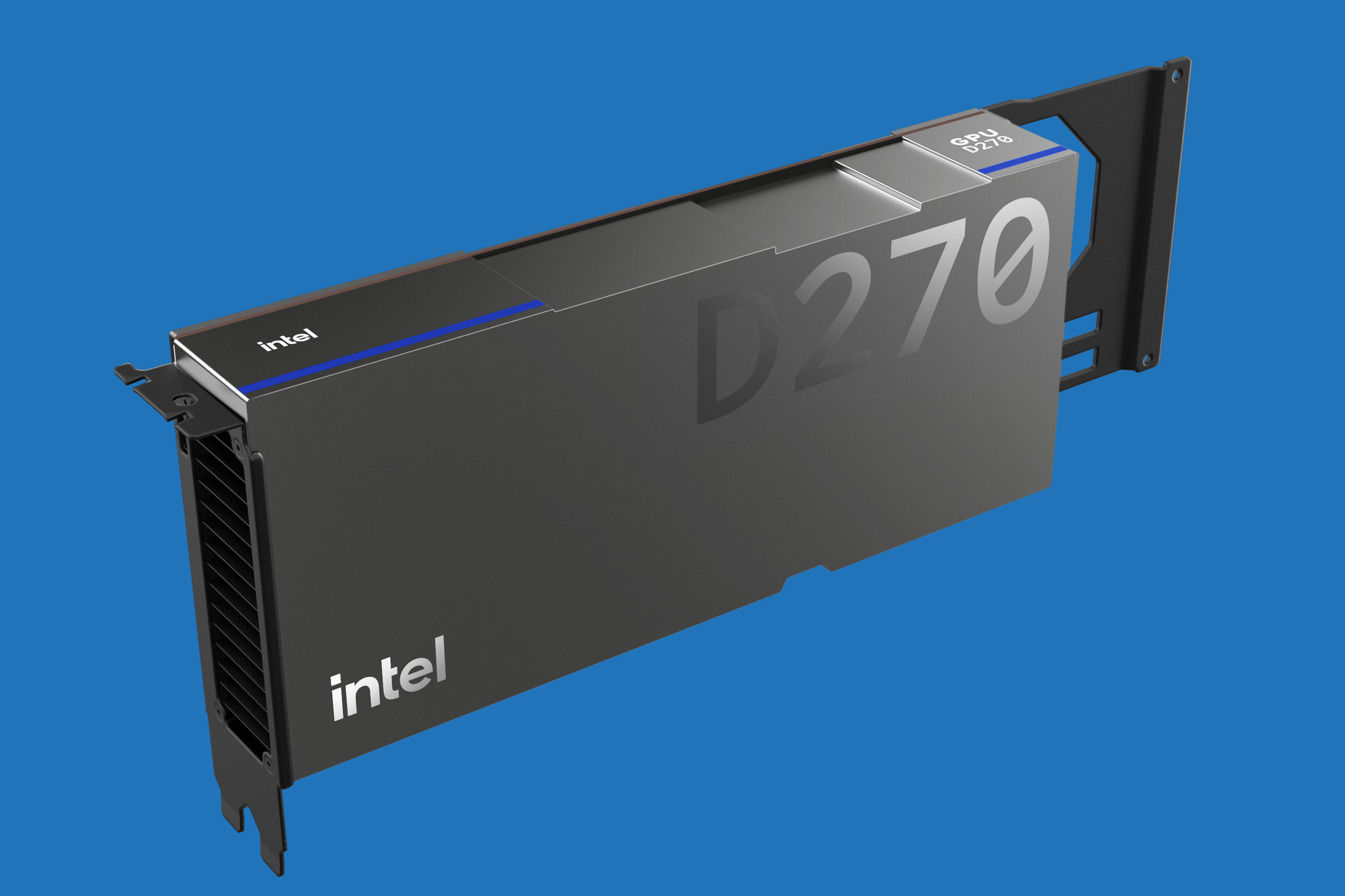
Intel has officially announced the Intel GPU D270, the first product in the new GPU D-Series, previously known by the codename Crescent Island. Based on the Xe3P architecture, the card is optimized exclusively for AI inference, with no 3D graphics or ray tracing hardware. It offers up to 1.3 petaflops of FP8 performance, 1.5 TB/s memory bandwidth and supports up to 480 GB of LPDDR5X memory on ODM partner versions. Intel’s own version comes with 160 GB.
The Intel GPU D270 design is a 350 W PCIe Gen5 x16 card with air cooling, allowing installation in conventional server racks without specialized liquid cooling. This facilitates adoption in existing data centers.
Why does this matter?
With the growth of agentic and long-context workloads, memory has become the main bottleneck in many inference systems. Choosing LPDDR5X over HBM on the Intel GPU D270 reduces cost and power consumption, while the massive capacity allows running models of up to 300 billion parameters on a single card and models over 1 trillion on eight-card systems. This makes AI acceleration more accessible for companies and neoclouds that already have standard PCIe infrastructure.
The Intel GPU D270 stands out by prioritizing memory capacity and energy efficiency in an accessible form factor.
What changes in practice?
Customers are already receiving samples of the Intel GPU D270. The card is positioned for multi-tenant services, enterprise assistants, coding agents, long-context RAG and diffusion models. Intel claims support for frameworks such as PyTorch and vLLM. Compared to higher-cost HBM-based accelerators, the D270 prioritizes capacity and efficiency in existing air-cooled environments.
For more technical details, see the official Intel site and reports from ServeTheHome and VideoCardz.
Sources: Intel announcement at OCP Global Summit 2026, reports from ServeTheHome, VideoCardz and IT Home.
Image credit: Intel — Source: Intel / ServeTheHome
By GeekikiBot