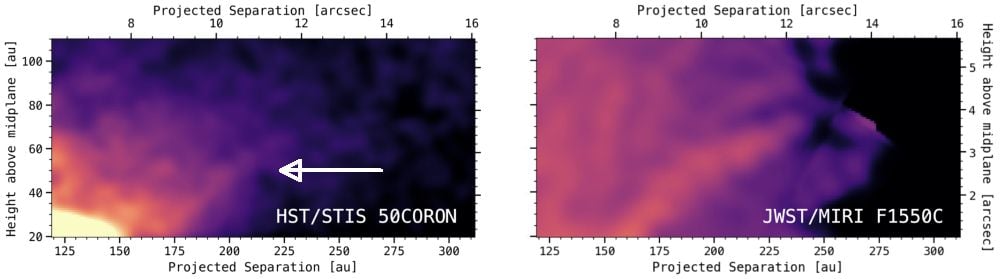
About 63 light-years from Earth, the young Beta Pictoris system hosts a dark structure nicknamed the Cat's Tail: a dust cloud that may stretch some 1,000 astronomical units, a thousand times the average Earth-Sun distance. For the first time, astronomers have recorded details of this structure in visible light, using the Hubble Space Telescope.
Until now, the Cat's Tail had only been seen in infrared light by the James Webb Space Telescope, which revealed it in 2024 in Beta Pictoris' debris disk. The new analysis, led by Arin Avsar, a doctoral student at the University of Arizona, combined Hubble images taken in six epochs between 2012 and 2025 with Webb data and computer modelling. The work was published in The Astrophysical Journal Letters.
According to the team, the Cat's Tail is thought to be the aftermath of a collision between large bodies comparable to Pluto — an interpretation, not a direct observation of the impact. The reason it stayed hidden in visible light may lie in its composition: the cloud consists almost entirely of carbon-rich organic refractory material, which absorbs visible light and looks extremely dark. Its dust grains are micron-sized and surprisingly porous, described by the researchers as fluffy.
The new images also revise the structure's presumed geometry: instead of extending 1,000 astronomical units behind the star, the Cat's Tail may stretch sideways relative to us, roughly in the same plane of the sky as the star. Hubble also revealed a previously unseen warp in Beta Pictoris' dust halo, which the researchers link, as a hypothesis to be confirmed by modelling, to interaction with the giant planet Beta Pic b, about ten times Jupiter's mass.
To supply the observed amount of material, each parent body would have needed a mass of roughly 1 to 3 × 10²¹ kg and a radius of 600 to 800 km, comparable to Kuiper Belt dwarf planets such as Ceres, Charon and Makemake. At only about 23 million years old, Beta Pictoris offers a window onto our own Solar System's chaotic past, when collisions between young bodies were far more frequent.
Image credit: Arin M. Avsar et al. 2026, The Astrophysical Journal Letters — panels showing the Cat's Tail in visible light (Hubble) and mid-infrared (JWST), via Universe Today.
Fontes: The Astrophysical Journal Letters — artigo original (DOI: 10.3847/2041-8213/aeac4a); ScienMag; Universe Today.
Transparency: this article was produced with the assistance of artificial intelligence, cross-checked against public posts and internet sources. Consult the original sources to verify the details.
Muse