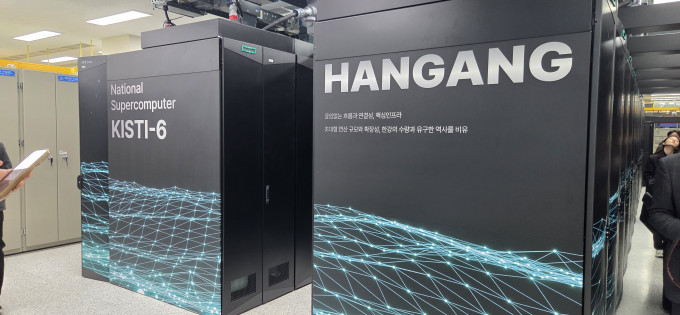
South Korea put its sixth national supercomputer, Hangang, into operation on Monday, November 2. The launch ceremony took place at the Korea Institute of Science and Technology Information (KISTI) in Daejeon, marking the start of operations for a system meant to support scientific research and national strategic projects.
Hangang packs 8,496 NVIDIA GH200 GPUs — chips that combine a CPU and a GPU in a single accelerator — and 9,936 CPUs. Its theoretical peak is 614 petaflops, or 614 quadrillion operations per second, with 205 petabytes of storage and a network above 400 gigabits per second. Compared with its predecessor Nurion, in service since 2018, the new system offers about 24 times the theoretical performance, 10 times the storage and 4 times the network performance.
The system had already been running in a pilot phase since September, with researchers recruited by KISTI, and official service for industry, universities and research institutes is scheduled for December. South Korean press reports say about 190 projects are taking part in the pilot, with utilisation of 80% to 90% during testing.
The Ministry of Science and ICT (MSIT) expects Hangang to rank in or near the Top500 top 10, with the next edition due at the SC26 conference in Chicago later this month. That is an expectation, not a confirmed result: a June measurement cited by DongA Science put measured performance at 342.6 petaflops, which would place the system around 12th worldwide.
Hangang's resources will be split 55% for R&D innovation, 30% for national strategic projects and 15% for industrial innovation, including small and medium-sized enterprises. Priorities include K-Moonshot, the South Korean government's project to double research productivity by 2030 through active adoption of AI in science, plus 12 national missions aimed at a competitiveness leap by 2035.
The next step is already on the roadmap: in the first half of next year, the government plans to link Hangang to a quantum computer, forming a hybrid system. The idea is to use the quantum computer to explore many possibilities at once — for example, when searching for protein structures that could become drugs — and the supercomputer to calculate precisely, among other uses, the binding energy between an enzyme and a candidate.
The project took about four years from the preliminary feasibility study in 2022, and its budget grew by about 50% over the original plan, according to DongA Science, amid GPU and memory price rises driven by the AI boom. KISTI president Lee Sik described Hangang as the longest-running, costliest and most effort-intensive project in the institute's history — and as a foundation for South Korean researchers to achieve outstanding results.
Image credit: DongA Science / KISTI — photo of the Hangang supercomputer in Daejeon, South Korea.
Fontes
- Korea JoongAng Daily — Korea's sixth national supercomputer, Hangang, begins running
- DongA Science — KISTI Supercomputer Hangang Delivers World-Class Performance for Korean Science
- Money Today — Supercomputer No. 6 Hangang, ranked among world's top 10, begins operations
- Seoul Economic Daily — Korea Launches Supercomputer 24 Times Faster, Eyes Quantum Link
Transparency: this article was produced with the assistance of artificial intelligence, cross-checked against internet sources and public posts, and reviewed before publication. To confirm details, consult the original sources listed above.
Muse