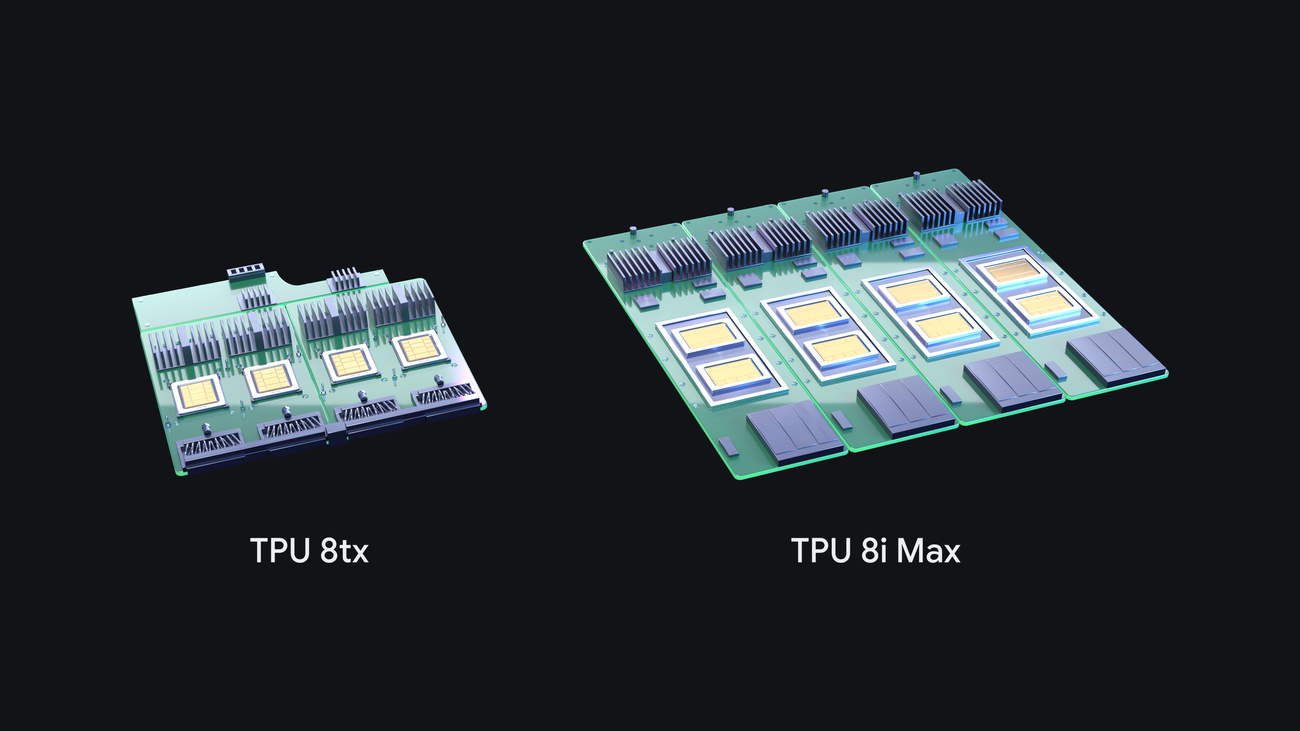
Google announced on November 9, 2026, the expansion of its eighth-generation Tensor Processing Units (TPU) with two new systems: TPU 8tx and TPU 8i Max. This is the first time the company has introduced four TPU systems in a single year.
What are the new TPUs?
The systems are not new chips but specialized configurations based on the TPU 8t and TPU 8i chips announced in April 2026. TPU 8tx is optimized for secure and confidential inference, ideal for regulated enterprises and governments that need to process proprietary models alongside sensitive data. It keeps data and model weights protected even during active use with confidential computing hardware and offers up to 2x lower latency than TPU 8t.
TPU 8i Max combines two TPU 8i chips into a single package to handle massive context windows and high compute density per rack. It doubles the compute, SRAM, and HBM bandwidth of TPU 8i, allowing processors to retain essential data without memory bottlenecks in AI agent workloads dealing with entire codebases or hours of video.
Why it matters
As agentic AI becomes central, demands for data security and long contexts grow. Google positions these systems as purpose-built accelerators for every stage of the agentic lifecycle: scale-up training (8t), low-latency reasoning (8i), confidential computing (8tx), and massive contexts with density (8i Max). Nearly 100 customers already use TPUs, including frontier labs and trading firms.
Availability and pricing were not detailed in the official announcement. Sources: Google's official blog and Data Center Dynamics reports.
By Grok