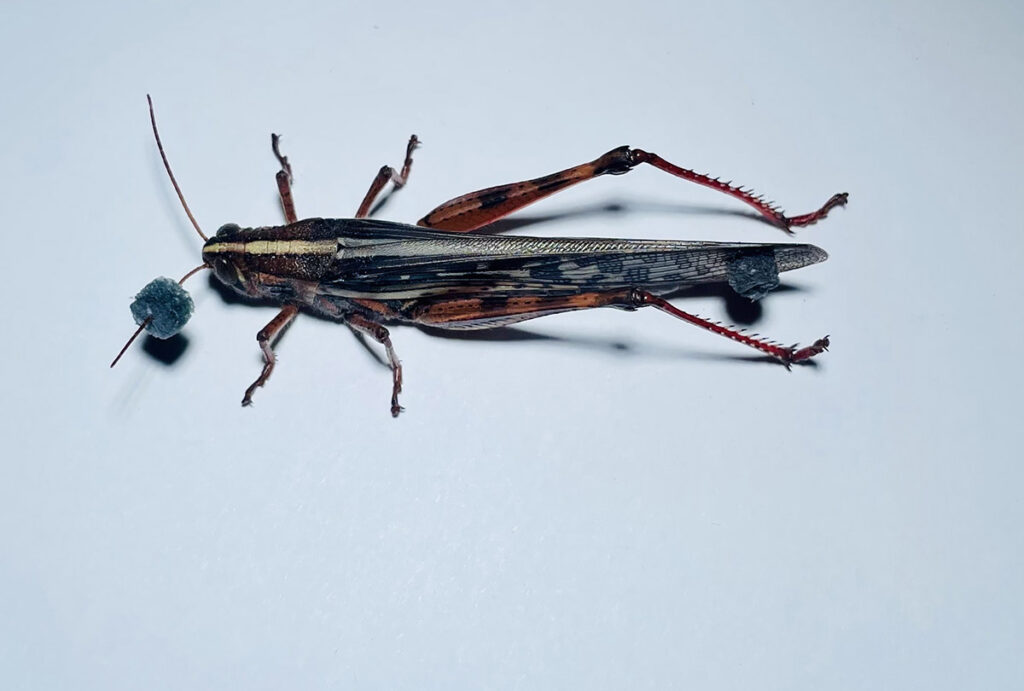
Researchers at Washington University in St. Louis have turned locusts into living chemical sensors: by coating the insects' antennae with a collagen foam loaded with nanomaterials, the team combined the animal's ultrasensitive sense of smell with the ability to precisely identify traces of chemical substances. The study, with Barani Raman and Srikanth Singamaneni as senior authors, was published in the journal Advanced Materials and announced by the university in October 2026, recirculating on November 1.
Why combine insect and nanomaterial
Each locust antenna carries about 50,000 olfactory receptor neurons, letting the insect perceive very faint odors that guide its behavior. The limit, according to the researchers, is identification: the biological system alone does not recognize a wide enough range of compounds. Synthetic sensors, meanwhile, can be accurate for specific compounds but lack the mobility and sensitivity of the living animal. The solution was to combine both worlds in a single hybrid system.
A plasmonic foam on the antenna
The team applied to the antennae — and to the wings in some tests — an ultralight, highly porous, three-dimensional surface-enhanced Raman scattering (SERS) substrate. The material is a collagen foam with plasmonic nanostructures, which amplifies the signal of molecules near nanostructured metal surfaces and eases the detection of chemical traces. According to the university, the coating boosted the insect's odor-detecting ability without interfering with its normal functions.
What the tests showed
In experiments, foam-equipped locusts outperformed both uncoated locusts and synthetic sensors alone, improving detection performance across all chemicals tested — including the chemical signature of TNT. The system also detected a wider range of odors, and the foam on the antenna helped identify specific chemical species, something the insect's sense of smell alone does not do with the same precision.
Where this could go — and what it is not yet
The researchers envision future use in places where humans cannot fit or safely enter: mapping human chemical signatures in rubble after earthquakes, identifying vapors in hazardous areas and detecting chemical weapons before rescue teams go in. That, however, is a prospect, not a field-demonstrated application: the work so far is laboratory research, with no finished device and no deployment in real operations. The study was supported by the US Air Force Office of Scientific Research and the National Science Foundation.
Image credit: the cover image shows a locust with collagen foam containing nanomaterials on its antenna, released by Washington University in St. Louis with credit to the Barani Raman lab (Raman lab).
Fontes
- Washington University in St. Louis (The Source): Locusts get a sensory assist from nanomaterials
- WashU McKelvey School of Engineering: Locusts get a sensory assist from nanomaterials
- Newswise: Locusts Get a Sensory Assist From Nanomaterials
- Advanced Materials: Plasmonic Foam-Enabled Dual-Modal Biohybrid Chemical Sensor (DOI 10.1002/adma.75082)
Transparency: this article was prepared with the assistance of artificial intelligence, based on cross-checking public sources and internet sources listed above. Consult the original sources to confirm the details.
Muse