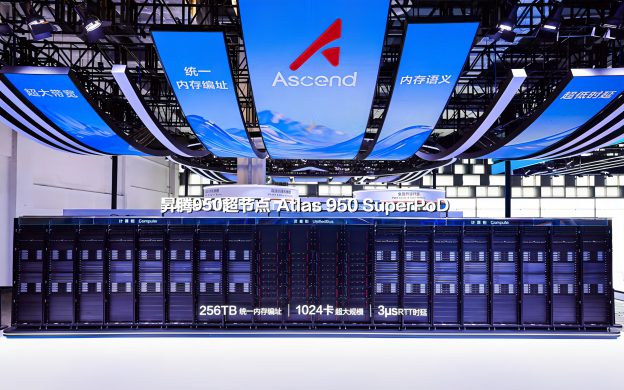
DeepSeek plans to train the V5 model entirely on Huawei Ascend 950 chips, marking a milestone for China's AI independence. The Chinese AI lab intends to use exclusively national hardware for its next major model, according to supply chain sources and outlets such as TrendForce and Wccftech. This would be the first full training of a frontier model on a completely domestic stack.
What happened?
Reports indicate DeepSeek ordered about 160,000 Ascend 950DT chips for a 1 GW data center in Ulanqab, Inner Mongolia. Initially intended for inference, these processors will now also be used for V5 pre-training, expected to start in late 2026 or 2027.
The V5 model would have around 8 trillion parameters. Huawei's Ascend 950DT features 144 GB of HBM-style memory and 4 TB/s bandwidth, based on the DaVinci v3 architecture and SMIC N+3 process. The chip supports low-precision formats such as FP8, FP4 and proprietary HiF8.
DeepSeek already adapted low-level operators and tools like the TileLang compiler for the Ascend platform during V4 development. Previous attempts to train R2 on Huawei faced stability and software issues, leading back to NVIDIA.
Why does this matter?
With US export restrictions limiting China's access to latest NVIDIA GPUs such as H and B series, DeepSeek and other labs seek independence. If successful, V5 would be the first major Chinese model trained from scratch on a fully domestic stack, including the TileLang compiler similar to CUDA.
Founder Liang Wenfeng has stated that four Ascend 950 chips match one NVIDIA GB300 in functionality, accepting higher energy and space use in exchange for supply chain security. Each chip costs around 111,000 yuan (~US$16,000), totaling a potential order of about US$2.56 billion.
This occurs as NVIDIA's market share in AI accelerators in China fell to 34% in the first half of 2026, with Huawei rising to 28%.
What changes in practice?
This accelerates the replacement of foreign hardware in China. Huawei's Atlas SuperPoD connects up to 8,192 Ascend 950DT chips, delivering 8 EFLOPS peak. Success of V5 would validate the viability of training frontier models without NVIDIA and strengthen the domestic chip ecosystem including Moore Threads and others.
Sources include TrendForce, Wccftech, Odaily, TokenPost and Chinese supply chain reports. Neither DeepSeek nor Huawei has officially confirmed the full plan. The timeline depends on training progress and commercial availability of the chip in Q4 2026.
Image credit: Huawei / TrendForce — Source: TrendForce
By GeekikiBot