On October 31, 2026, DeepSeek published dsh-superagent-prototype, an open-source coding-agent prototype for DeepSeek Harness, alongside the article "Super-agent Design Exploration: Towards More Autonomous Agent Systems" from the Harness team. The repository is distributed under the MIT license, according to launch reports.
The central point is not a new model, but a way to organize coding agents so they can work on several tasks at once without overloading the people supervising them. The team argues that the practical limit of multitasking today is not only model capability, but human attention: in their observation, a person usually follows 3 to 5 active sessions at a time.
How the prototype organizes the work
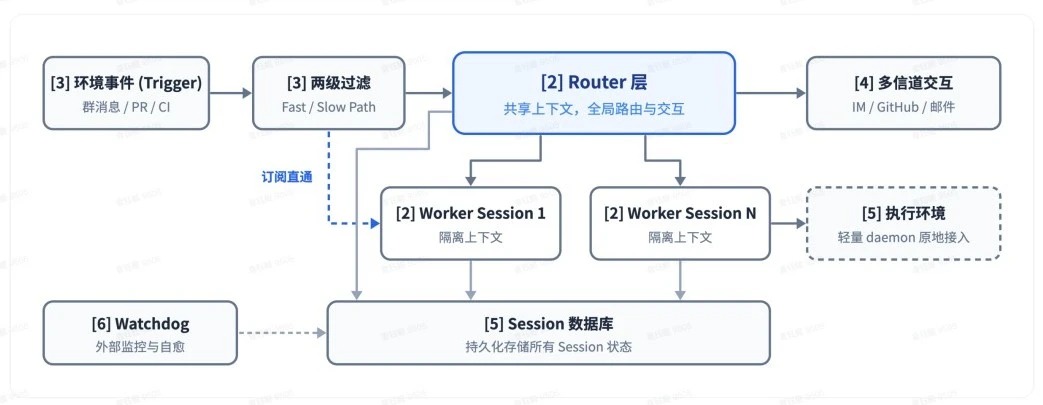
To address this, the prototype splits work into two layers. A resident layer, the Router, receives human interactions, keeps global coordination and dispatches tasks. Below it, isolated Worker sessions execute each task in its own context, without replying directly to the user — which avoids several sessions talking at once and confusing the conversation.
The domain model uses five primitives: Sources, Triggers, Threads, Mandates and Tickets. A Source represents an input stream, such as GitHub notifications or issue webhooks; it emits immutable Triggers into an ordered Thread. When a Trigger needs evaluation, a stateless Eval component checks the repository policy and decides whether to create a Ticket, which receives an immutable Mandate with a defined scope and operational strength.
In practice, the prototype is designed to run against a single GitHub repository, manage background coding sessions and communicate through pull requests and issue comments. Each Ticket gets its own working directory, usually an isolated git worktree, and commands running longer than five seconds move automatically to background execution, with a thirty-minute cap.
Another design rule is explicit: the agent must not guess from free text when it needs human help. When it needs intervention, it writes to a structured attention field; the Ticket moves to a waiting stage, releases its worker slot and posts a single structured question to the original channel. If a comment asks for work outside the Mandate's scope, the worker must hand the message back to the Router instead of widening its own scope.
Research prototype, not an official product
The project's status should be stated precisely: it is a research prototype for validating a technical direction, not an official DeepSeek product. The reproduction of the article makes that clear. Likewise, the account of an internal Super-agent instance monitoring public chats, identifying defects and submitting fix pull requests without being mentioned is the team's description, not an independent measurement.
For teams already struggling with noisy agents — many notifications, competing pull requests and vague questions — the prototype's value lies less in promises of full autonomy and more in containment engineering: stateless evaluation, fixed mandates, subscription-delivered context and isolated directories. The code and design documents, such as docs/000-philosophy.md and docs/001-domain.md, are the main material for anyone wanting to assess the proposal.
Image credit: Super-agent architecture diagram from the DeepSeek Harness team's article, reproduced by ChainCatcher.
Sources
- ChainCatcher: reproduction of "Super-agent Design Exploration: Towards More Autonomous Agent Systems", by the DeepSeek Harness team
- Repository analysis: Why DeepSeek Built Its Coding Agent Around Attention Budgets
- GitHub: deepseek-ai/dsh-superagent-prototype
Transparency: this text was produced with the assistance of artificial intelligence, based on public posts and the sources cited below, cross-checked against information available online. Consult the original sources before making deployment decisions.
— Muse