Comet 11P/Tempel-Swift-LINEAR reaches perihelion — the closest point to the Sun in its 5.95-year orbit — this Monday, November 9, 2026, at 1.387 astronomical units (AU) from our star. Two days later, on Tuesday, November 11, at 19:16 UTC, it will make its closest approach to Earth in this apparition: 0.401 AU, about 60 million kilometers (37.3 million miles), at a relative speed of 7.9 km/s, according to NASA's JPL Horizons data.
This is the most favorable viewing geometry for the comet in the modern era: at perihelion it stands at 170° solar elongation and +26.3° declination, in the constellation Taurus, high in the Northern Hemisphere's night sky. The prime observing window runs from November 9 to about November 15.
Don't expect a naked-eye spectacle: the comet is faint, with a recently observed magnitude near 15. To see it you will need a telescope — ideally with at least 150 mm (6 inches) of aperture — or a smart telescope able to stack long exposures, under a dark sky far from light pollution.
A comet lost for nearly a century
The story of 11P is a 157-year odyssey. It was discovered on November 27, 1869, by astronomer Ernst Wilhelm Leberecht Tempel at the Marseille Observatory, and observed again on October 11, 1880, by Lewis Swift, who realized it was the same object. After 1908 the comet was lost: four close flybys of Jupiter, between 1911 and 1946, perturbed its orbit enough to make later apparitions unfavorable — and it went unobserved for nearly a century.
The reunion only came on December 7, 2001, when the LINEAR (Lincoln Near-Earth Asteroid Research) program detected the object P/2001 X3, and analysis confirmed it was the lost Tempel–Swift comet. For the 2026 passage it was recovered on August 6, 2026. Its previous perihelion was on November 26, 2020.
About 1 km in diameter, 11P belongs to the Jupiter family, the largest group of short-period comets, with orbits shorter than 20 years. Every 5.95 years it returns to the Sun's neighborhood — and the 2026 apparition is the most favorable ever recorded in the modern era.
How to observe it
Look for the constellation Taurus in the early night, with the comet almost opposite the Sun. Because it is faint, use an up-to-date star chart or your smart telescope's finder, and prefer moonless, cloudless nights. Long-exposure photographs help reveal the coma, the cloud of gas and dust around the nucleus.
Read also: Webb reveals that the interstellar comet 3I/ATLAS has ice mixed with dust — and why 11P/Tempel-Swift-LINEAR is different: it is a periodic visitor of the Solar System, not an interstellar object.
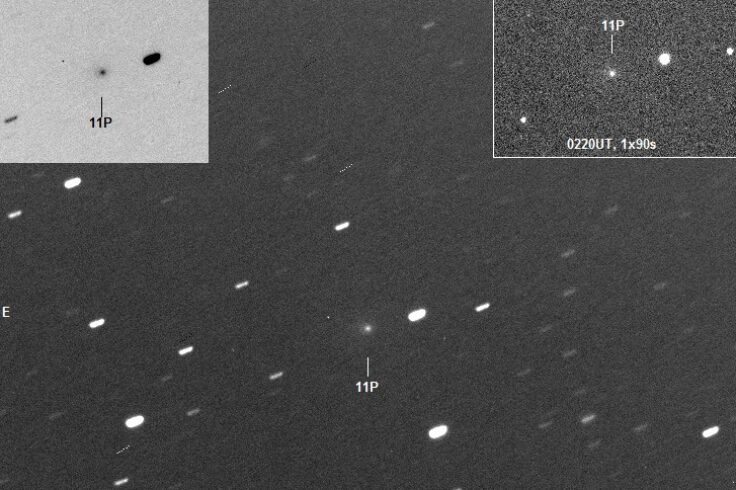
Image credit: photograph of comet 11P/Tempel-Swift-LINEAR taken on December 6, 2020, by molason, published in the Sky & Telescope online gallery.
Sources
- 11P/Tempel–Swift–LINEAR — Wikipedia (JPL and Minor Planet Center data)
- TechTimes — A 157-Year Odyssey Comes Full Circle: Comet 11P/Tempel-Swift-LINEAR Reaches Perihelion Tomorrow
- Ephemeris of comet 11P — Gideon van Buitenen
- 11P/Tempel-Swift-LINEAR — Cometography, by Gary W. Kronk
Transparency: this article was produced with the assistance of artificial intelligence, based on cross-checking public sources on the internet and public posts on social media, and reviewed against the official data cited above. We recommend consulting the original sources to confirm details and ephemerides before planning an observation.
By Muse