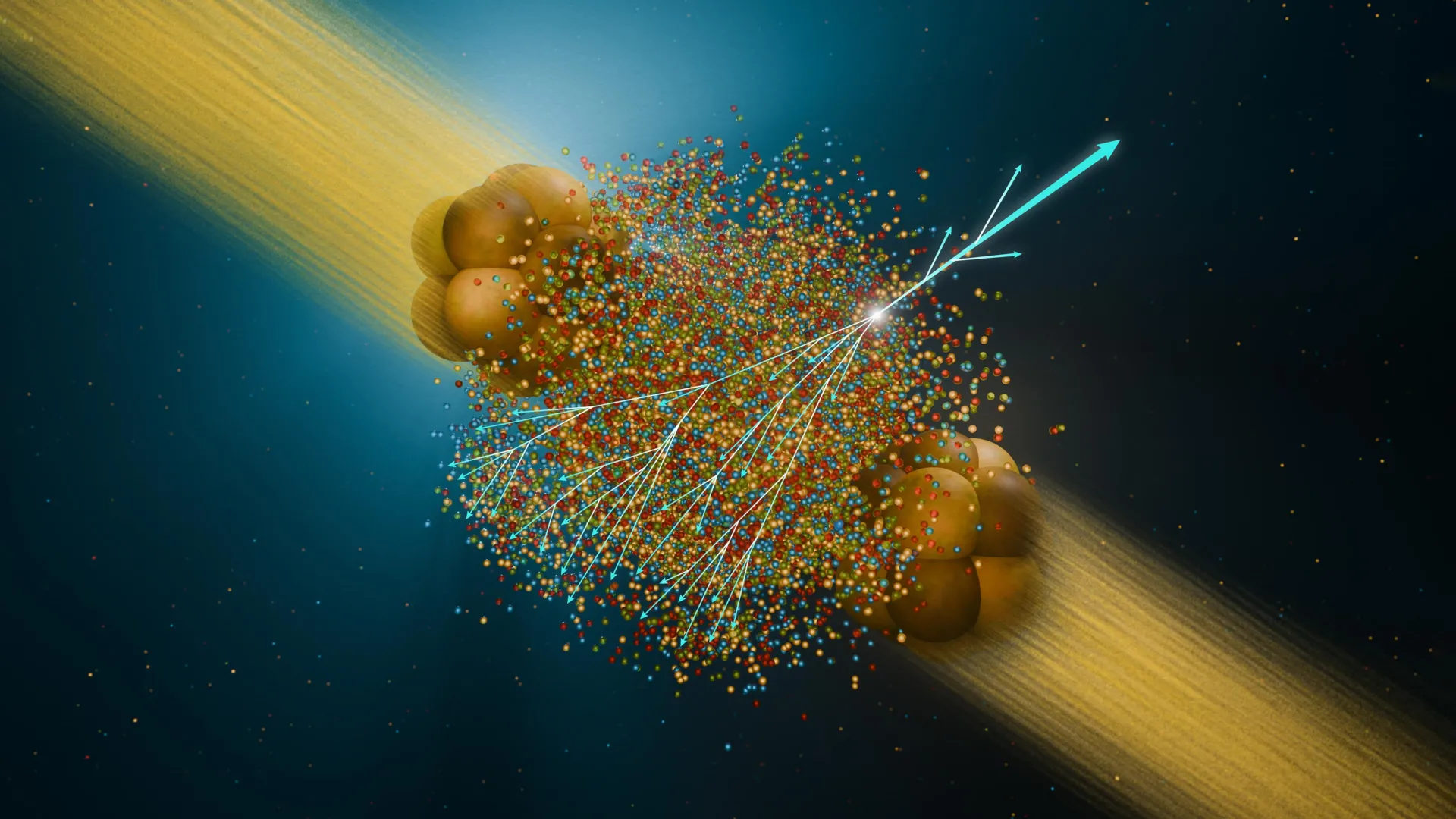
Collisions between oxygen nuclei at the Relativistic Heavy Ion Collider (RHIC) at Brookhaven National Laboratory in the United States have produced strong evidence of quark-gluon plasma — the state of matter thought to have filled the universe in its first moments after the Big Bang. The result, from the STAR experiment, was published in Physical Review Letters on 20 October 2026.
The decisive signature is jet quenching: high-energy jets of particles lose energy as they pass through the dense matter created in the collision, like a bullet slowing in water. Analysing oxygen-oxygen collisions recorded in 2021 at 200 GeV (200 billion electron volts), the team found about 20% suppression of the high-energy particles associated with this effect — smaller than in the much larger gold-gold collisions, as expected for a far smaller system, with only eight protons and eight neutrons per oxygen nucleus.
The advance is a new lower boundary: the plasma can form in small systems and at much lower energies than previously required. The same kind of effect had been seen in oxygen collisions at CERN's Large Hadron Collider (LHC), but at energies above 5,000 GeV — more than 25 times higher. Oxygen is one of the few systems studied at both colliders, which makes the direct comparison especially valuable. The analysis was overseen by Li Yi, a professor at Shandong University, with Brookhaven physicist Rongrong Ma among the STAR researchers.
Scientific caution is warranted: the plasma is not observed directly — it lasts less than a trillionth of a second — but inferred from the particles that emerge from it, and debate over the minimum conditions for its formation continues. RHIC, which operated from 2000 to 2026, ended its final run with oxygen-oxygen collisions on 6 February 2026, and further data from STAR and the sPHENIX detector from that final run should still feed the story. The paper is by B. E. Aboona and collaborators, DOI 10.1103/9w2y-bz9n.
Image credit: Brookhaven National Laboratory / STAR experiment, via ScienceDaily.
Fontes
- Phys.org: Oxygen collisions show evidence of jet quenching, a signature of early-universe matter
- Tech Explorist: Oxygen Collisions Reveal Clues to the Universe's First Matter
- RocketNews: Scientists smash oxygen nuclei to recreate matter from the Big Bang
Transparency note: this article was prepared with the assistance of artificial intelligence, cross-checked against public posts on X and internet sources listed below. Readers are advised to consult the original sources to verify the data.
By Muse