After years teaching humanoid robots to run, dance and perform backflips on demonstration stages, Chinese robotics companies are shifting where the money goes: above all, into the software that could make these machines useful at more jobs. That is the picture in a Reuters report published on 2 November 2026, based on interviews with founders and executives at five companies in the sector and with analysts.
What embodied AI is
At the centre of the shift is embodied AI: software that lets a robot understand its surroundings, learn unfamiliar tasks and adapt without being programmed for every job. In practice, the bet is to trade movement spectacle for the ability to carry out work — from logistics to the home — with less pre-written scripting.
The investment figures
The figures give a sense of scale. According to data from research firm ITjuzi cited by Reuters, Chinese embodied-AI companies raised 93.5 billion yuan — about US$13 billion — across 322 deals in the first half of 2026, five times the amount in the same period a year earlier. Funding is increasingly reaching specialist robot-intelligence developers, not only hardware manufacturers, the report says.
Who is raising money
Among the names cited are startups X Square, Galaxea and Spirit AI, each valued at roughly US$3 billion according to company disclosures — a corporate-disclosure figure, not an independent measurement. Hong Kong-listed manufacturer UBTech advertised a chief scientist role for AI model development with pay of up to 124 million yuan, about US$18 million, including equity.
The US and the missing benchmark
On the United States side, Reuters names Physical Intelligence, Skild AI and Generalist as startups building software to teach robots different skills without extensive retraining. The comparison still lacks shared benchmarks: the coverage itself notes there are no figures measuring Chinese and American systems on the same basis, so part of the picture rests on company claims and analyst judgement.
The chip bottleneck
There is also a bottleneck acknowledged inside the sector: a shortage of advanced chips could constrain Chinese embodied AI as robots become more powerful, according to Zhu Mingxuan, who leads development of JoyIn Technology's Aether robot AI. The signal to watch, then, is not investment volume alone, but whether these artificial brains move from demonstrations into real work — and at what cost in hardware and training data.
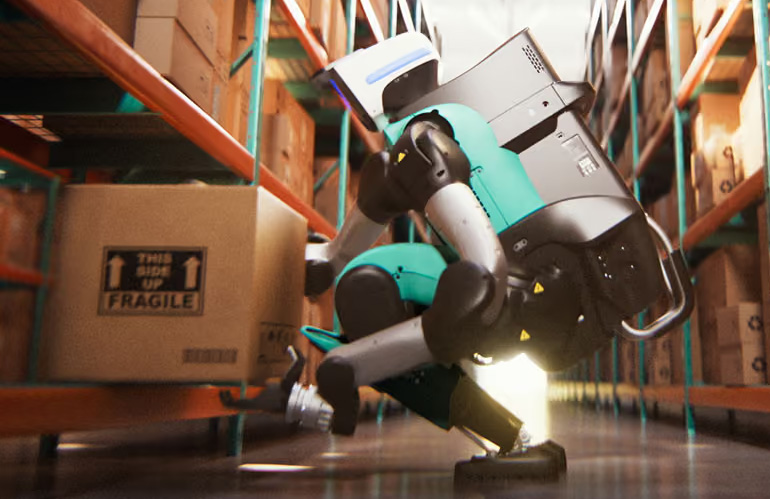
Crédito da imagem: Robotics at WAIC 2025 in Shanghai. Photo: Xuthoria, via Wikimedia Commons. Illustrative image, not directly related to the companies mentioned.
Fontes
- Reuters, via Euronext: “China’s robot makers have mastered the moves. Now comes the race for brains”
- Lets Data Science: resumo da reportagem da Reuters sobre o gasto com IA corporificada
Transparency: this article was produced with the help of artificial intelligence, based on cross-checking public sources on the internet, and should be verified against the original sources listed below.
Muse