Axelera AI on Thursday (12) unveiled the details of Axelera Titania, its third-generation silicon architecture for artificial intelligence inference in data centers. Announced in Eindhoven, in the Netherlands, the chiplet is presented as a European alternative to high-cost AI servers, promising up to seven times more throughput per watt than the best data center servers available today — a company expectation, still without independent benchmarks.
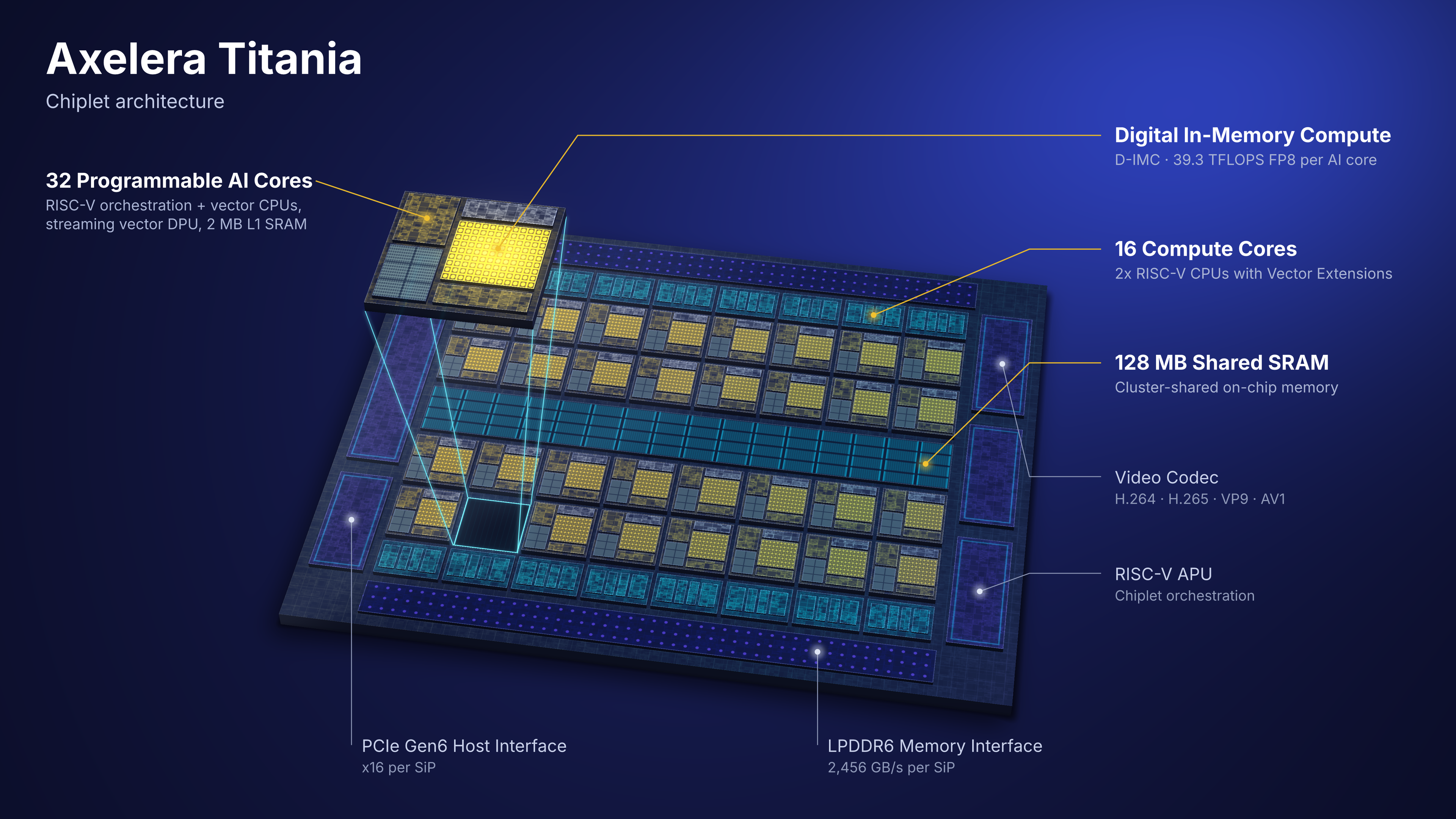
Axelera Titania combines the company's digital in-memory computing (D-IMC) architecture with a new chiplet design, high-capacity LPDDR6 memory, high-bandwidth scale-up connectivity and programmable RISC-V compute in a single package. Each system-in-package (SiP) contains two Titania chiplets and will be offered in standard PCIe cards and in OCP UBB baseboards with eight OAM modules connected in a scale-up network.
The promised numbers
According to the company, Axelera Titania is expected to deliver up to 7x more throughput per watt and up to 20x better total cost of ownership (TCO) than today's leading data center servers. The company also says it has more than $300 million in confirmed commitments for the platform, with products reaching customers through OEM partners in inference server configurations with air and liquid cooling.
The AX8 reference server, with eight SiPs, is designed to deliver 20 PFLOPS of FP8 compute, 1 TB of accelerator memory and 19.6 TB/s of memory bandwidth in a standard 4U air-cooled server, with typical power consumption of 5 to 6 kW. According to the company, a single AX8 server can hold a 1.6 trillion-parameter model in FP4 with room for KV cache — and two of them fit in a legacy 15 kW rack, while five fit in a 30 kW air-cooled rack.
LPDDR6 instead of HBM memory
Instead of relying on scarce high-bandwidth memory (HBM), Titania uses LPDDR6, which provides 128 GB per package with lower power consumption and no dependence on HBM supply or packaging. The bet makes sense for sparse mixture-of-experts models, which have many parameters in total but few active at a time: in those cases, memory capacity and effective utilization matter more than peak bandwidth.
Software and compatibility with the previous generation
The platform will be supported by the Voyager toolchain and ships with support for tensor, expert and pipeline parallelism, as well as speculative decoding, KV cache offloading and disaggregation. A single card serves LLMs, vision-language models and video, with on-chip 8K decode and 4K encode in H.265 and AV1.
The Axelera Titania PCIe card was designed as a drop-in replacement for the Axelera Server 250p, the four-chip card of the Europa generation — meaning models deployed today on Europa can move to Titania in 2028 without being ported again. The same Voyager SDK and AxeleraScript language apply across all three generations.
Context and timeline
Axelera Titania is the third generation of Axelera's architecture, after Metis, focused on the edge, and Europa, launched on September 15, 2026 for enterprises. The chiplet itself had already been presented before, with support from the EuroHPC Joint Undertaking's DARE initiative, a European digital autonomy project based on RISC-V; today's announcement brings the full technical details, performance targets and commercial timeline.
Production is planned for the third quarter of 2027, with customer deployment commitments through the beginning of 2028. The company promises a deeper technical look during SC26, the supercomputing conference taking place November 15–19 in Chicago.
“The biggest challenge most organizations face as inference becomes the dominant AI workload is the tokenomics of their infrastructure,” said Fabrizio Del Maffeo, co-founder and CEO of Axelera AI. CTO and co-founder Evangelos Eleftheriou said the architecture “already turns 88 percent of its memory bandwidth into tokens on Europa silicon that is shipping today” — a company statement about the current generation, not an independent measurement of Titania.
Featured image: Titania chiplet architecture. Credit: Axelera AI.
Sources
- Axelera AI Unveils Titania Architecture — Business Wire, November 12, 2026
- Axelera AI — Newsroom
- Axelera AI launches inferencing chiplet, supported by funding from EU's RISC-V project — Data Center Dynamics
Transparency: this article was produced with the assistance of artificial intelligence, based on cross-checking public sources on the internet. The performance targets cited are expectations disclosed by the manufacturer and have not yet been verified by independent benchmarks. Please consult the original sources to confirm the information.
By Muse