Update: the Roman alignment has been completed by NASA — this article follows the commissioning of the Roman telescope. Read the previous article: NASA’s Roman Telescope Sees 30% Better Than Expected and Could Operate Until 2048.
NASA has completed the Roman alignment, the milestone that leaves the Nancy Grace Roman Space Telescope one step away from starting its science observations. According to the mission’s official blog, published on November 13, 2026, the observatory’s instruments were brought into precise sync after a series of test observations.
The Roman alignment is one of the mission’s most demanding requirements: to carry out its science, Roman must be at least ten times more stable than the Hubble and Webb telescopes. “Roman’s power comes from two things: how big a view it gives us, and how small we can make the uncertainties in its measurements,” said Dominic Benford, Roman’s program scientist at NASA Headquarters in Washington.
Why alignment is so demanding
The team precisely aligned the observatory’s optics and instruments on the ground before launch. But launch vibrations, temperature changes and the lack of gravity in space can cause small shifts. To correct them, scientists made test observations that measured those shifts and updated the observatory’s “internal map.”
18 detectors working together
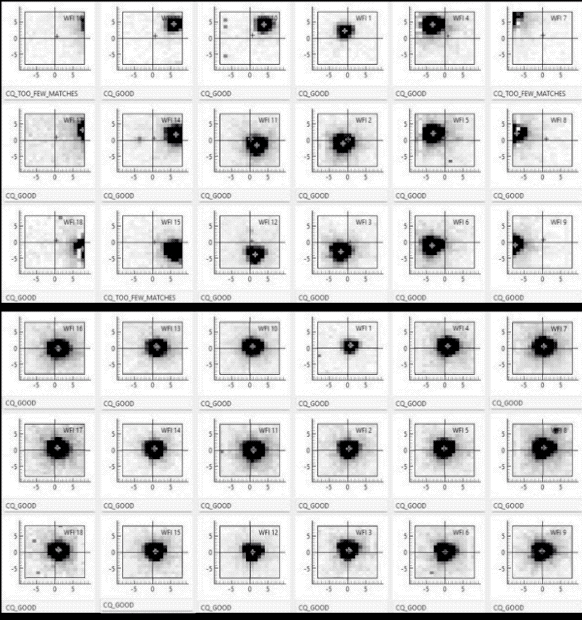
Roman’s Wide Field Instrument (WFI), the 300-megapixel infrared camera, has 18 detectors that work together during observations. Besides collecting the science images, the instrument guides the spacecraft by tracking reference stars — fixed points that let it detect and correct small changes in orientation.
“The 18 detectors in the Wide Field Instrument are meant to work together when we’re locking onto guide stars,” said Tyler Desjardins, a Roman astrophysicist at the Space Telescope Science Institute in Baltimore. “We need to know the positions of our guide stars very precisely so we can accurately aim and correct tiny drifts.”
By observing stars and comparing their measured positions with the expected ones, the team found where adjustments were needed. “Roman is now internally aligned to within a tiny fraction of a hair’s breadth of perfection,” said Tony Sohn, a Roman astronomer at the Space Telescope Science Institute.
The coronagraph and the next step
The alignment work also prepares the Coronagraph Instrument, designed to photograph faint objects close to bright stars. The team adjusted the telescope’s secondary mirror, a smaller mirror that connects the telescope to the coronagraph, and the masks and optics inside the instrument.
“The wave nature of light makes starlight spill when forming images, flowing into areas surrounding the star where planets could be found,” explained Brian Kern, a Roman optical engineer at NASA’s Jet Propulsion Laboratory in California. “A coronagraph uses carefully chosen masks to absorb and redirect that spilled starlight, removing enough to uncover the planets.”
The next test will exercise more than 3,000 small moving parts that drive the coronagraph’s deformable mirrors, which can reshape light waves to reject more and more starlight. The technique has been demonstrated in a laboratory, but the second stage of active starlight control in space, with real starlight and real planets, would be a record-breaking first.
There is also a bonus: while the coronagraph stares at a star for long periods, the Wide Field Instrument will keep monitoring guide stars in a neighboring patch of sky — and, on the side, collect unprecedented deep fields of cosmic regions never before observed in detail.
What comes next
Launched on August 30, 2026 aboard a SpaceX Falcon Heavy, Roman is traveling toward the Lagrange point L2, about 1.6 million kilometers from Earth, where it is expected to enter orbit in early December. With the Roman alignment complete, the observatory is nearing the end of commissioning — and the first science images should be released in early 2027.
Image credit: NASA / Roman Space Telescope Fine Guidance Sensor team (public domain, via NASA’s official website). The animation shows how stars, once off-center in the guide windows, were aligned with precision.
Sources
- NASA — Instruments on NASA’s Roman Space Telescope Get in Sync for Science (November 13, 2026)
- The Daily Galaxy — NASA’s Roman Telescope Reaches a Major Milestone That Could Change How We Search for Alien Worlds (November 14, 2026)
- Geekiki — NASA’s Roman Telescope Sees 30% Better Than Expected and Could Operate Until 2048
Transparency: this article was produced with the assistance of artificial intelligence, cross-referencing public posts and internet sources, including official NASA statements and updates. To confirm the details, consult the original sources listed above.
By Muse


