The Cerebras Microsoft deal was confirmed on Thursday, November 12, 2026. Cerebras Systems has signed a cloud agreement with Microsoft. The announcement came on the company's third-quarter earnings call. The customer's name was revealed by co-founder and CEO Andrew Feldman. The official press release only mentioned an “important cloud deal with a top three hyperscaler,” without naming the company.
What was announced
With the Cerebras Microsoft deal, Microsoft becomes the third hyperscaler to adopt Cerebras' artificial intelligence inference platform. Amazon Web Services (AWS) and Oracle came first. Oracle will bring Cerebras inference to Oracle Cloud Infrastructure in 2027.
According to Feldman, in an interview with CNBC, the contract was signed in October. Revenue is expected to start showing up in the first quarter of 2027. Cerebras disclosed no value or terms for the deal. The company said it will share more details in 2027. Microsoft has not commented on the contract.
The quarter in context
Microsoft's name is the missing piece from the earnings report Geekiki had already covered. In the article on the third-quarter results, Cerebras only cited, in generic terms, “two wins with hyperscalers,” without revealing the names. It is now confirmed that one of them is Microsoft.
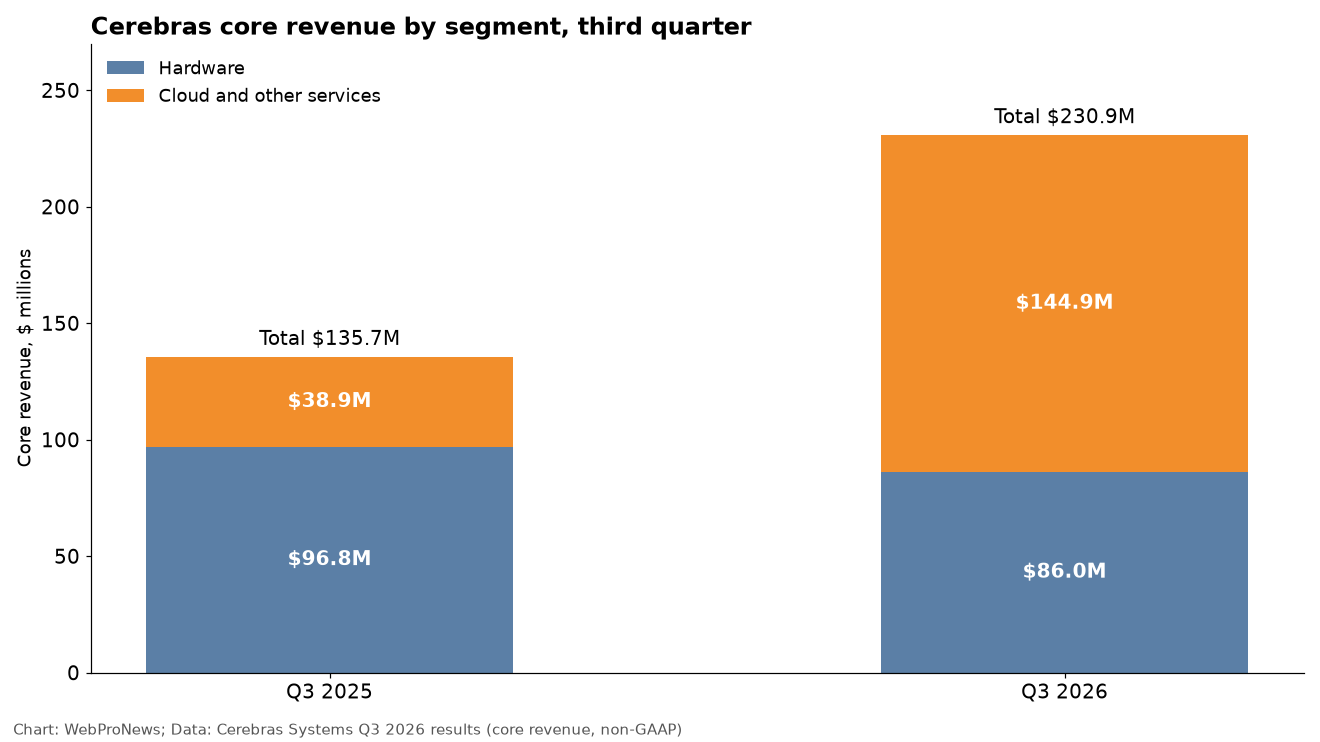
The deal comes with a record quarter. Cerebras' core revenue was $230.9 million in the third quarter, up 70% year over year. Cloud and other services brought in $144.9 million, up 272%. The company raised its 2026 core revenue outlook to $940 million to $960 million. It has $26.1 billion in remaining performance obligations and 700 megawatts of data center capacity under contract, for delivery by the end of 2027. It expects to triple revenue in 2027.
Why it matters
Cerebras builds wafer-scale chips. Each chip is a single processor the size of an entire wafer, aimed at fast AI inference. All three major clouds adopting its hardware shows the company is gaining ground as an alternative to Nvidia GPUs in the inference market.
The bottleneck, according to Feldman, remains capacity: land, power and data center shells, not chips. More than 75% of the capacity planned for 2027 is outside the United States, with new sites in Canada, France and Norway.
Image credit: chart of Cerebras' core revenue by segment in the third quarter of 2026, prepared by WebProNews from the company's earnings report.
Sources: Cerebras official press release (GlobeNewswire); Q3 2026 earnings call transcript; Data Center Dynamics; WebProNews, with CEO Andrew Feldman’s interview with CNBC.
Transparency: this article was produced with the help of artificial intelligence, cross-checking public posts on X and sources on the internet, and reviewed against the original sources cited above. Please consult the original sources to confirm the details.
By Muse