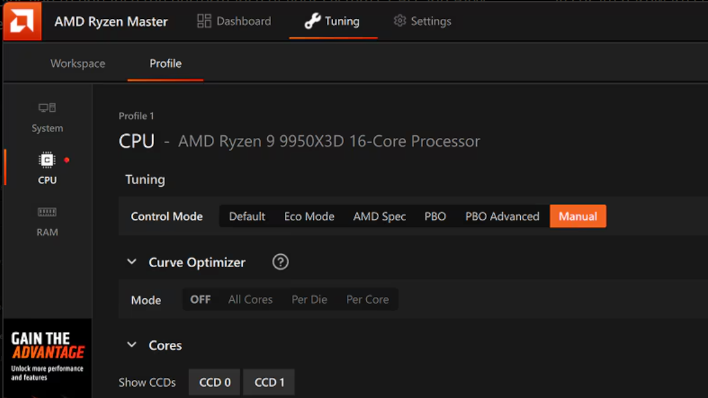
AMD has taken its first official step toward Ryzen processor overclocking on Linux. Company engineer Shyam Sundar S K sent a three-patch series to the Linux kernel's platform-driver-x86 mailing list on October 10, proposing the AOD (AMD Overclocking) driver, with initial coverage published by Phoronix on October 21.
AOD is a WMI driver that talks to the platform firmware — the same interface used by Ryzen Master on Windows — and exposes the controls through Linux's sysfs interface. In its initial form, it allows adjusting the processor's power and current limits: PPT (Package Power Tracking), TDC (Thermal Design Current) and EDC (Electrical Design Current), along with each one's supported range and step size. It can also switch SMT (Simultaneous Multithreading) on or off at platform level, and read the current memory clock.
What the driver does not do yet
Expectations should be kept in check: the patch series is under review and has not been merged into the mainline kernel, and there is no confirmation of which kernel release might carry it. There is also no graphical interface and no Ryzen Master for Linux announced by AMD — AOD is only the foundation on which third-party tools can be built.
Another practical limitation: the new PPT, TDC and EDC limits only take effect after a reboot, and the attributes are write-only — the firmware applies the values at the next boot and does not report the active limits. That differs from AMD's HSMP, which changes the limit at runtime but loses the setting on reboot.
Why it matters for Linux gaming
Until now, adjusting these limits on Linux meant going through the BIOS or unofficial tools. With the AOD driver in the kernel, gaming-oriented distributions and projects — such as SteamOS and Bazzite — gain a standardized base for offering performance controls, and developers no longer need to reimplement firmware communication on their own. Because the firmware supports more commands than those wired up in this first version, there is room for the driver to grow over time.
Sources: Hardware Busters, VideoCardz, HotHardware, Slashdot, TweakTown, NeoTeo.
Image credit: Ryzen Master software screenshot, image by AMD reproduced by HotHardware.
Transparency: this article was produced with the help of artificial intelligence, based on cross-checking public posts and sources on the internet. Consult the original sources to confirm the details before sharing.
Muse