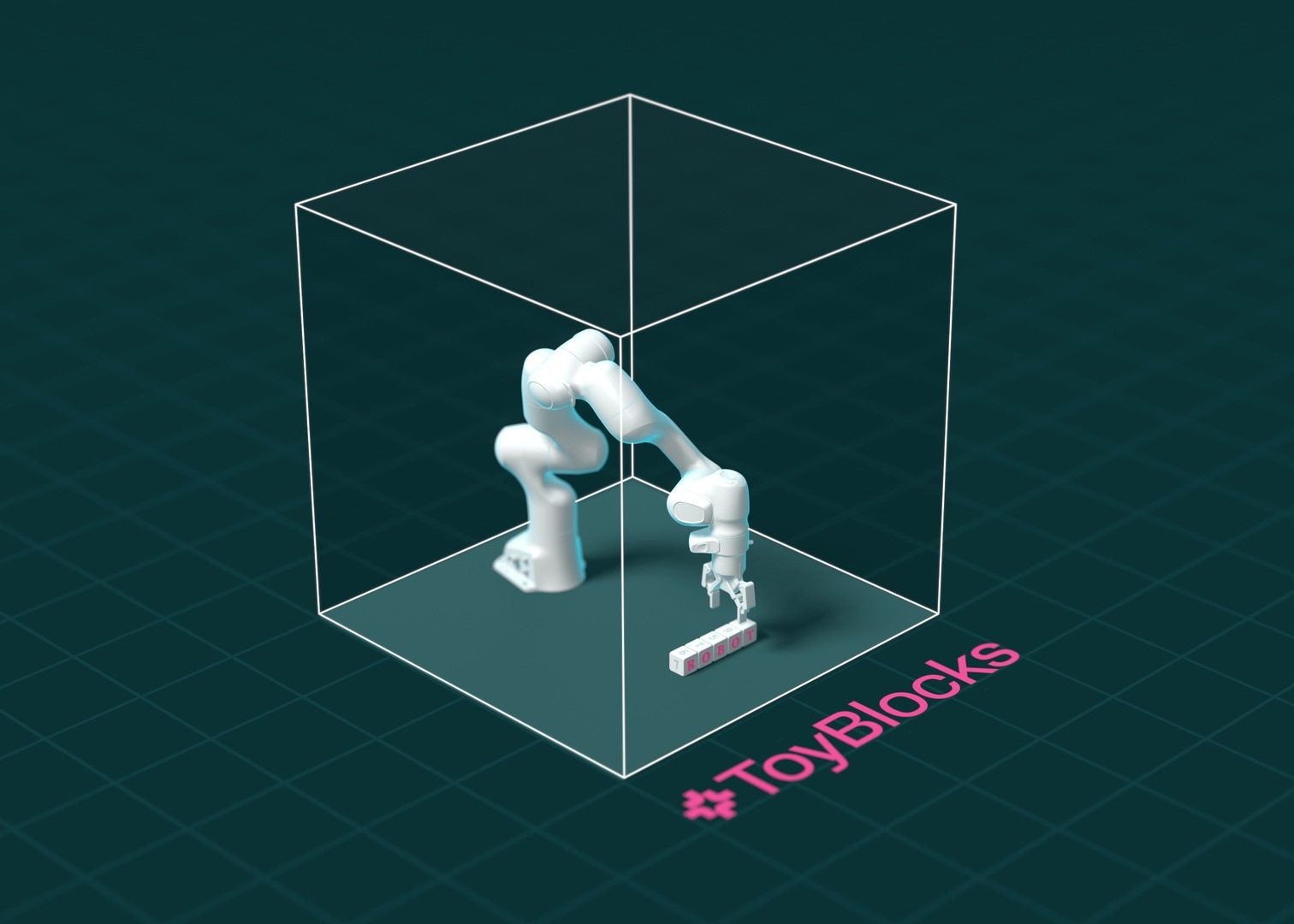
The Allen Institute for AI (Ai2) released ToyBlocks on November 6, 2026, an open simulation framework built to investigate how robots learn — and, above all, why they fail. In the environment, a robot arm pushes, flips and stacks blocks on a tabletop, in tasks that demand spatial reasoning and dexterity at the same time. It is the first of what Ai2 calls FoundationWorlds, controlled worlds the institute wants to use as a laboratory for robot learning.
Demonstrations without teleoperation
Instead of a person guiding the robot through every movement, ToyBlocks generates demonstrations automatically. Short skills, such as pushing a block or flipping it without picking it up, are learned through reinforcement learning and motion planning in Isaac Lab, NVIDIA's simulation framework. A task-and-motion planner chains these skills to solve complete tasks, and each plan executed in simulation becomes a training demonstration. According to Ai2, hundreds of plans can be generated and executed in parallel on a single GPU, at up to 24 times real-time speed.
85,336 demonstrations and two trained models
The initial ToyBlocks release includes 85,336 long-horizon demonstrations, covering about 1,600 hours of simulated execution and 144 million recorded frames. The open package brings together simulation assets, task and demonstration generators, training and evaluation code, and two trained models: Molmo 2, which acts as the high-level planner, and ManiFlow, which controls the arm's movements. The core code is Apache 2.0 licensed. A second release is promised, with a larger dataset, more skills and broader benchmarks, plus integrated reinforcement-learning training.
The first results are not reassuring
ToyBlocks' value lies in the tests it enables. In the initial experiments, popular action models such as ManiFlow, π0.5 and MolmoAct 2 generalized poorly on the environment's tasks, despite large-scale pretraining — a sign that spatial generalization remains far from solved. In a block-spelling test, the Molmo 2 and ManiFlow combination completed 111 of 200 episodes in simulation (55.5%) and 15 of 30 episodes on the physical Franka FR3 arm (50%), in the easiest three-block setup. The two percentages come from different numbers of trials and should not be read as estimates of general reliability.
A natural-language interface
ToyBlocks also includes a web interface that lets users connect Claude — or another frontier model — and instruct the robot in natural language, plus Model Context Protocol (MCP) tools for agentic-system experiments. The project builds on Ai2's earlier open work in robot learning, including MolmoAct 2, MolmoBot and MolmoSpaces.
Image credit: ToyBlocks illustration, via the Allen Institute for AI blog on Hugging Face. The image shows the official illustration of the ToyBlocks simulated block environment.
Sources
Ai2 official blog — ToyBlocks
Hugging Face Blog — ToyBlocks: A controlled world for robot learning and evaluation
Ai2 official ToyBlocks video on YouTube
Transparency: this article was produced with the assistance of artificial intelligence, cross-checked against public posts on X and internet sources. Information classified as an institute announcement is confirmed by the official release; consult the original sources to verify the details before making any decision.
Muse