Researchers at UC Berkeley and NVIDIA unveiled at CoRL 2026, the robot learning conference held this week in Austin, Texas, open-source tools in which teams of AI agents write, test and refine industrial robot programs in simulation — without relying on large volumes of training data. Programming an industrial workcell traditionally takes weeks or months, and the code can only be implemented after the robot and all the equipment are already installed.
RoboSimStudio: an interface for the Newton engine
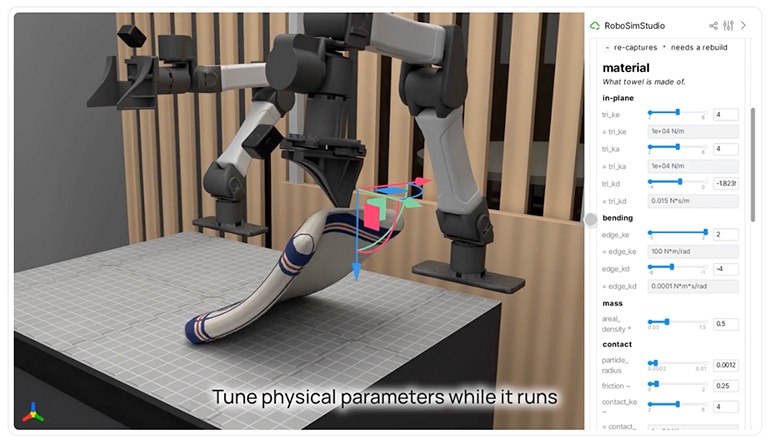
The starting point is RoboSimStudio, built by graduate student Eric Chen in Ken Goldberg's lab at UC Berkeley. The tool is an interface for NVIDIA's open-source Newton physics engine — powerful, but with hundreds of parameters that kept many developers away. With sliders and a visualizer, RoboSimStudio makes those parameters adjustable. In September, Chen gave the tool and a video to a new frontier model: within about an hour, the model produced a Newton simulation closely matching the video, through iterative trial and error.
GaP: each skill gets its own agent
The Graph-as-Policy (GaP) framework splits a task into skills — perception, grasp planning and collision-free motion — and assigns each node of the graph to its own AI agent, so the AI agents work in parallel without interfering with one another. The graph is equivalent to a ROS graph and can be converted to ROS 2. The output is Python code that calls existing vendor modules, such as KUKA, for low-level drive control, without replacing the robots' controllers.
VABAR: a six-task benchmark
To measure progress, the team created VABAR (Variational Automation Benchmark for Agentic Robotics), a benchmark of six tasks — tool sorting, tool hanging, gear meshing, syringe packing, cable insertion and cable routing — built on the open-source Isaac Lab-Arena framework and the Newton engine, with standardized variations, difficulty tiers and success metrics.
"Agentic robotics is a fundamental shift in how robots are programmed," said Ken Goldberg, professor at UC Berkeley. "Instead of collecting massive amounts of data and hand-tuning every behavior, teams of agents can quickly generate, test, and refine robot programs that allow human engineers to interpret how the programs work for fine-tuning and verification."
Bosch is already evaluating these AI agents for industrial automation scenarios. According to Liu Ren, senior vice president and AI fellow at Bosch Research, the approach "generates interpretable code that engineers can thoroughly analyze before production deployment." Jeff Mahler, co-founder and CTO of Ambi Robotics, said agentic robotics "converted production data into robot behavior updates, increasing throughput across our U.S. fleet while keeping engineers in control."
Context: the week of physical AI
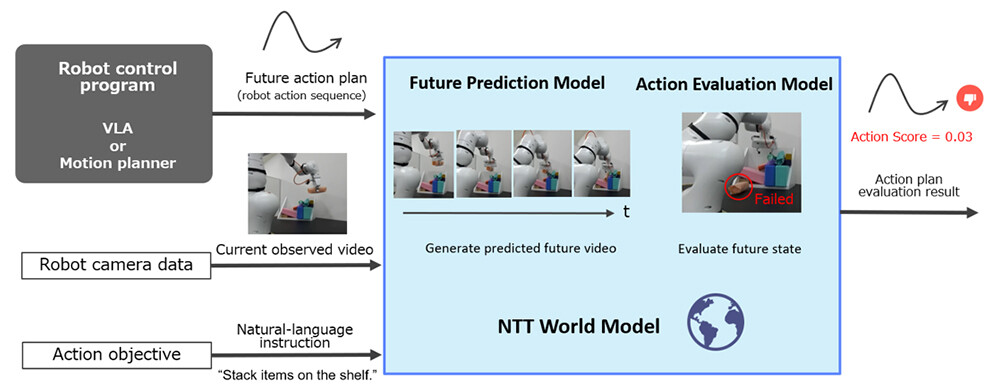
The work joins two other physical AI milestones presented this week: GR00T 2, NVIDIA's robot model, also unveiled at CoRL 2026, and NTT's physics-based world model, which predicts failures before a robot acts. Together, they show robotics with AI agents moving away from training on massive data toward systems that reason, simulate and correct themselves.
Image credit: UC Berkeley, via The Robot Report — screenshot of RoboSimStudio.
Sources: The Robot Report (November 11, 2026) · RoboSimStudio · Graph-as-Policy (GaP) · VABAR · CoRL 2026
Transparency: this article was produced with the assistance of artificial intelligence, based on cross-checking public posts on X and sources from the internet. Please consult the original sources to confirm the details.
By Muse