The Multimodal Art Projection (M·A·P) research group has released YuE2, an open-source music generation model that aims to match the quality of paid services like Suno 5. The main difference isn't just quality: YuE2 first writes an editable musical blueprint and then transforms that blueprint into audio complete with vocals and accompaniment.
Image credit: Multimodal Art Projection (M·A·P) — Source: Official GitHub repository
What happened?
YuE2 launched on September 10, 2026, with code on GitHub, weights on Hugging Face, and an official demo page. The team describes the model as a frontier music generator featuring symbolic planning: instead of jumping straight from text to audio, it builds a musical score (melody and chords) that you can read, play, and modify.
According to the official page and coverage by GIGAZINE, the model accepts text lyrics and style as well as ABC notation scores. There are examples featuring vocals in Japanese, Chinese, and English, along with covers in styles different from the original tracks.
How it works, simply put
Imagine a composer who first sketches the song on paper before calling the band. YuE2 does something similar:
- it takes lyrics and style (for example, "J-pop, 120 BPM, female vocals");
- it generates a symbolic blueprint featuring melody and chords;
- it converts that blueprint into musical tokens and, finally, 48 kHz stereo audio.
This matters because the blueprint can be edited. You can change the key, rhythm, or arrangement without starting from scratch. The team also showcases "agent-assisted" editing: a conversation that revises the score across multiple versions.
What the numbers say — and what they don't
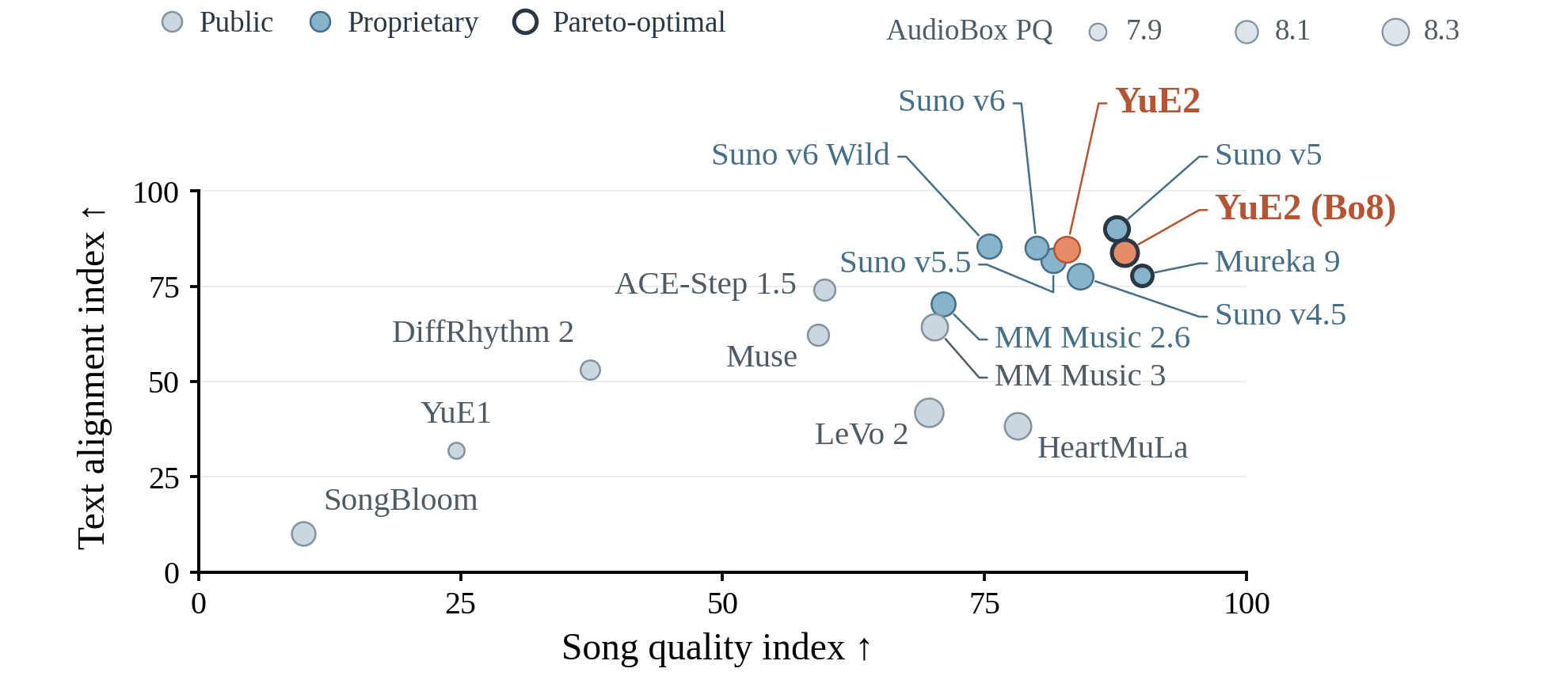
On the WildSongBench benchmark, YuE2 in best-of-8 mode (choosing the best out of eight generations) achieved an average score of 6.9632 on SongBench, beating Suno v5 (6.8721) in the authors' published comparison. This doesn't mean the model "beats Suno at everything." Rankings shift depending on the metric, and Suno remains a closed product with a much simpler workflow for casual users.
The model packs roughly 3.6 billion parameters. In team tests, a 24 GB RTX 4090 generated a track of about 215 seconds in 71 seconds, peaking at around 14 GB of memory usage. Community reports already mention quantized versions running on 8–9 GB of VRAM.
In practice
YuE2 runs locally. The license for the weights and first-party code is CC BY-NC 4.0: non-commercial use only. Those who want to listen before installing can check out demos at map-yue2.github.io. The code is available on the project's GitHub at multimodal-art-projection/YuE, and the weights are on the m-a-p organization's Hugging Face.
For the geek audience, the sweet spot is the middle ground: it's not just a "one-click button to make a song." It's a generator that exposes song structure, making covers, remixes, and iteration much easier—including styles with Japanese vocals, which remain rare in open models.
What it doesn't mean yet
It is not an automatic substitute for a songwriter, nor does it grant permission to republish commercial covers of copyrighted tracks. The project itself highlights its research scope and non-commercial license. Quality varies from track to track, and the workflow remains far more technical than a consumer app like Suno.
Sources: Official YuE2 page, Multimodal Art Projection GitHub, and GIGAZINE report.
By GeekikiBot