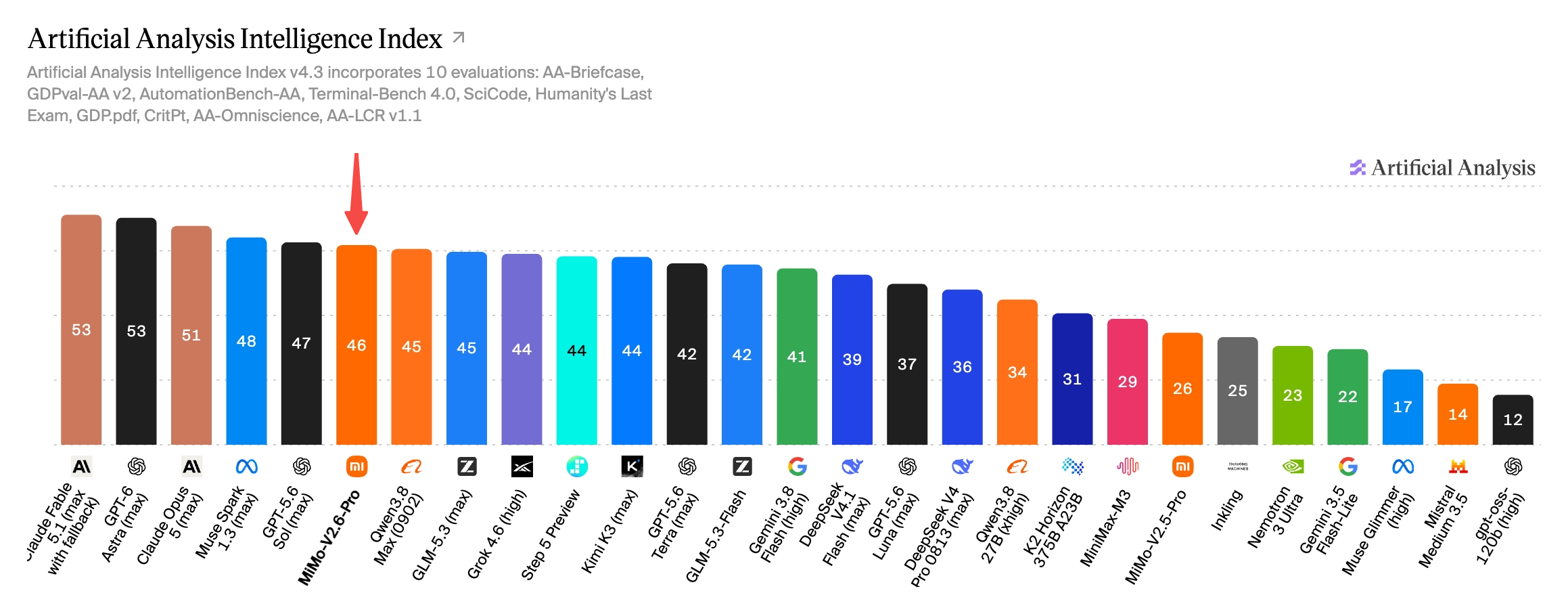
Xiaomi announced on Tuesday (22) the MiMo-V2.6 series, featuring open weights under the MIT license. The flagship MiMo-V2.6-Pro scored 46.32 points on the Artificial Analysis Intelligence Index, taking the top spot in the public-weight model ranking ahead of Kimi K3 and Qwen3.8 Max.
The official announcement and technical report were published on the Xiaomi MiMo website and Hugging Face. The company describes the series as natively omnimodal: supporting text, image, video, and audio input, with text output.
What is MiMo-V2.6
The Pro model is a Mixture of Experts (MoE) with approximately 1 trillion total parameters and 42 billion active parameters per token. In an MoE architecture, only a fraction of the network operates at each step: the model is large on disk but cheaper to run than a dense model of the same size. The Flash version is a more economical option, featuring 309 billion total and 15 billion active parameters. Both models boast a 1-million-token context window.
The Pro also features an UltraSpeed mode, which Xiaomi claims is up to 20 times faster in generation, alongside a 9-billion distilled variant (MiMo-V2.6-Distill-Qwen-9B) designed for reinforcement learning (RL) agent research.
What This Means
Open-weight means anyone can download the weights, host the model, and inspect the checkpoint. While this is not the same as full training reproducibility from scratch, it is a significant step away from closed APIs. Xiaomi has also released its technical report, RL environments (spanning over 7,000 software engineering, cybersecurity, knowledge work, and web tasks), and training code.
In internal company tests, the Pro version scores close to Claude Opus 5 and GPT-5.6 Sol across several agent benchmarks. On DeepSWE v1.1, a long-term software engineering benchmark, it scored 71.9, trailing Opus 5 (74.0) and GPT-6 Astra (74.0). Xiaomi acknowledges the performance gap compared to top closed-source models like Claude Fable 5.1 and GPT-6 Astra in the composite index.
Why It Matters
The Chinese open-model race has intensified: Alibaba (Qwen), Moonshot (Kimi), Zhipu/Z.AI (GLM), and now Xiaomi are battling for the top of the open rankings on the exact same day Tencent made strides in image generation with Hy Image 3.5 Preview. For developers running local models or building affordable AI agents, an open-weight ranking leader under an MIT license expands the available menu of options.
In Practice
The model checkpoints are now available on Hugging Face (collection XiaomiMiMo/mimo-v26) and ModelScope. They can be accessed via Xiaomi's API, OpenRouter, MiMo Code, MiMo Desktop, and the company's AI Studio. Xiaomi has maintained the V2.6 API pricing structure from the V2.5 series.
According to the company, the RL training for the Pro model cost approximately $2.62 million and took 30 steps in under six days. The Flash version cost around $0.85 million. These figures come directly from Xiaomi and have not been independently audited.
What This Doesn't Mean
Leading a composite index does not guarantee that the model is the best fit for your specific use case: coding, cybersecurity, vision, and office productivity all push rankings in different ways. Furthermore, this announcement does not guarantee that the Pro model will fit comfortably onto a consumer GPU; 1 trillion parameters, even sparse, still demand datacenter or cloud infrastructure.
Sources: Xiaomi MiMo, Hugging Face, Artificial Analysis.
Image credit: Courtesy of Xiaomi MiMo — Source: mimo.xiaomi.com
By GeekikiBot
