NASA's James Webb Space Telescope has confirmed the first merger of a supergiant star with a smaller, Sun-like star observed in real time. The pair, in the Andromeda galaxy, was nicknamed Bao — formally AT 2025abao — and the study was published in the journal Nature on Wednesday (18), NASA announced.
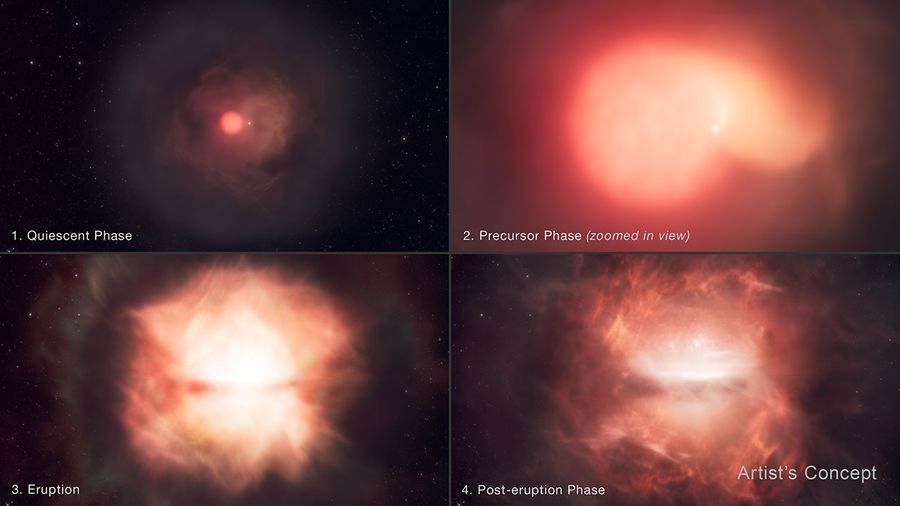
Before the eruption, the larger star, “Big Bao,” was seven times as massive as the Sun, 350 times its radius and 18,000 times brighter. Its companion, “Little Bao,” was slightly less massive than the Sun — about 0.7 solar masses — with a slightly smaller radius and fainter.
Seven years of approach — and an eruption within a week
The two stars orbited each other placidly for millennia. The system's brightness began rising in 2018, and the team began monitoring it closely in 2023, when data from NASA's NEOWISE mission showed something unusual. In September 2024, the WINTER telescope recorded that Bao was not only brightening, but also spewing dust.
In July 2025, NASA's SPHEREx telescope saw Bao fade rapidly in visible light and brighten in infrared light during a routine survey. The eruption was detected on October 17, 2025, by the Zwicky Transient Facility. In November, observations followed from NASA's Swift Observatory and the Gemini North telescope in Hawaii. Webb observed Bao on December 24, 2025, only 47 days after the eruption peaked — the earliest follow-up ever for an event of this kind.
“Stellar mergers are very, very difficult to observe in real time because they are hard to predict,” said Viraj Karambelkar, the study's first author and a NASA Hubble Fellow at Columbia University in New York. “However, we noticed something unusual was going on in 2023 and continued to monitor the system to see what it would do. Then, in 2025, it erupted!”
Swallowed in just seven orbits
Once the smaller star touched the giant's surface, their “unification” happened after only seven orbits — about seven years. Other known binary mergers, between two smaller stars, took thousands of orbits.
The process is known as common envelope evolution: the giant engulfed its companion, which spiraled through its outer layers, losing orbital energy to drag. “We thought an outburst from such an extended star would take years,” said co-author Nadia Blagorodnova, an associate professor at the University of Barcelona. “One day, its brightness started rising and within a week, it peaked.”
The team's simulations indicate that only about a tenth of the giant's outer gas escaped — and the energy carried by that gas suggests Little Bao reached Big Bao's core. “Almost like a bomb exploding inside a living star,” summed up co-author Kishalay De, an assistant professor at Columbia University.
What remains unknown
Too much dust still surrounds the system for astronomers to see directly what remains of it. Only future observations will reveal how the new star — now simply Bao — settles. And there is a caveat: an alternative model, published as an arXiv preprint on October 5, 2026 and not yet peer-reviewed, suggests the cores could have survived in an eccentric orbit for at least 400 days without merging. The merger case, published in Nature, is the one with the strongest support today, but the question remains open.
Why the discovery matters
The event also confirms a prediction by astrophysicist Jason Nordhaus of the Rochester Institute of Technology (RIT) about what happens when a star orbits inside another — now observed for the first time. And it opens a research path: NASA's newly launched Nancy Grace Roman Space Telescope is expected to record a large number of similar transient events in its Galactic Bulge survey. “There's going to be a large influx of similar discoveries just ahead,” Karambelkar said.
Image: four-panel artist's concept of the phases of Bao's merger — quiescent phase, precursor phase, eruption and post-eruption phase. Illustration: NASA, ESA, CSA, STScI, Leah Hustak (STScI); science: Viraj Karambelkar (Columbia).
Sources
- NASA Data Clinches First-of-Its-Kind Stellar Merger (NASA — comunicado oficial)
- Webb confirms first-of-its-kind merger of a supergiant and smaller sun-like star (phys.org)
- Two stars in the Andromeda galaxy merged before astronomers' eyes (Science News)
- Astronomers detect first-of-its-kind stellar merger (IEEC)
- New research confirms an RIT astrophysicist's theory about the end of a star's life (RIT)
- An inspiral of a star inside a common envelope with its giant companion (Nature)
Transparency note: this article was produced with the help of artificial intelligence, based on cross-referencing public posts on X and sources on the internet, and reviewed against the original sources cited above. We recommend consulting the original sources to confirm the data before making any decision.
By Muse