Wayve, Stellantis and NVIDIA announced on Friday, October 23, 2026, in Paris, at the Assises du Véhicule Autonome, a collaboration with the French Government to advance the deployment of autonomous vehicles in France and accelerate the technology's development across the European Union. The announcement is confirmed by official press releases from Wayve and Stellantis published the same day.
The partnership combines Stellantis' vehicle engineering and manufacturing, through its L4-Ready Platforms, with the Wayve AI Driver, the London company's AI driving system, which will integrate NVIDIA Halos OS on the NVIDIA Hyperion compute and sensor architecture. According to the companies, this combination positions France as the base for an ecosystem spanning the full value chain, from silicon to vehicles.
Among the reasons given for choosing France are one of Europe's largest ride-hailing markets and the AI Action Summit held in Paris in 2025, where 109 billion euros in AI investment were announced. French Transport Minister Philippe Tabarot said France is committed to adapting its regulatory framework to accelerate autonomous vehicle development while maintaining strict safety and data sovereignty requirements, and described the initiative as the approach needed to move from trials to real-world deployment.
The collaboration also involves work with local French partners. Engagement with unions, city authorities and mobility stakeholders will be led by the local partners responsible for transport operations, with the stated aim that the transition benefits workers, communities and riders.
For context, the initiative builds on a strategic partnership between Stellantis and Wayve announced in May 2026, combining Wayve's AI driving with the STLA AutoDrive platform. On October 9, 2026, in Turin, the companies demonstrated Fiat 500e and Maserati Grecale vehicles with a Level 2++ hands-free, door-to-door supervised driving assistant, targeted to launch in 2028, starting in North America. Do not confuse the timelines: that schedule is for the supervised assistant, and Friday's announcement sets no date for driverless operation in France.
According to Wayve itself, the AI Driver is built on end-to-end embodied AI that learns from real-world experience, rather than relying on high-definition maps, hand-coded driving rules or custom hardware. Executive statements quoted in this article are statements by the companies and the government, not independent verification of the promised results.
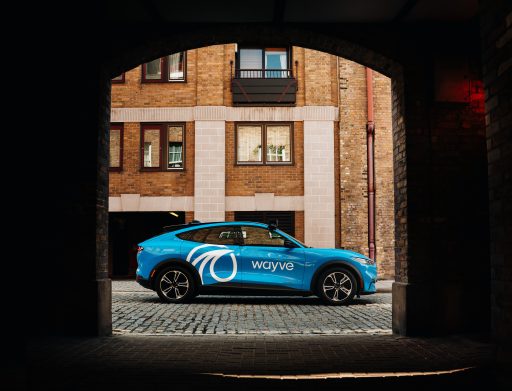
Image credit: Wayve, via the company's official press kit (caption requested by Wayve: “Source: Wayve”). The photo shows a Wayve test vehicle in London and is illustrative; it does not depict the deployment announced in France.
Sources
- Wayve — official press release, October 23, 2026
- Stellantis — official press release, October 23, 2026
- Unite.AI — independent coverage of the announcement
Transparency: this article was produced with the assistance of artificial intelligence, based on cross-checking official press releases, an independent second source and public posts, and reviewed against the original sources. Consult the original sources to confirm the details.
Muse