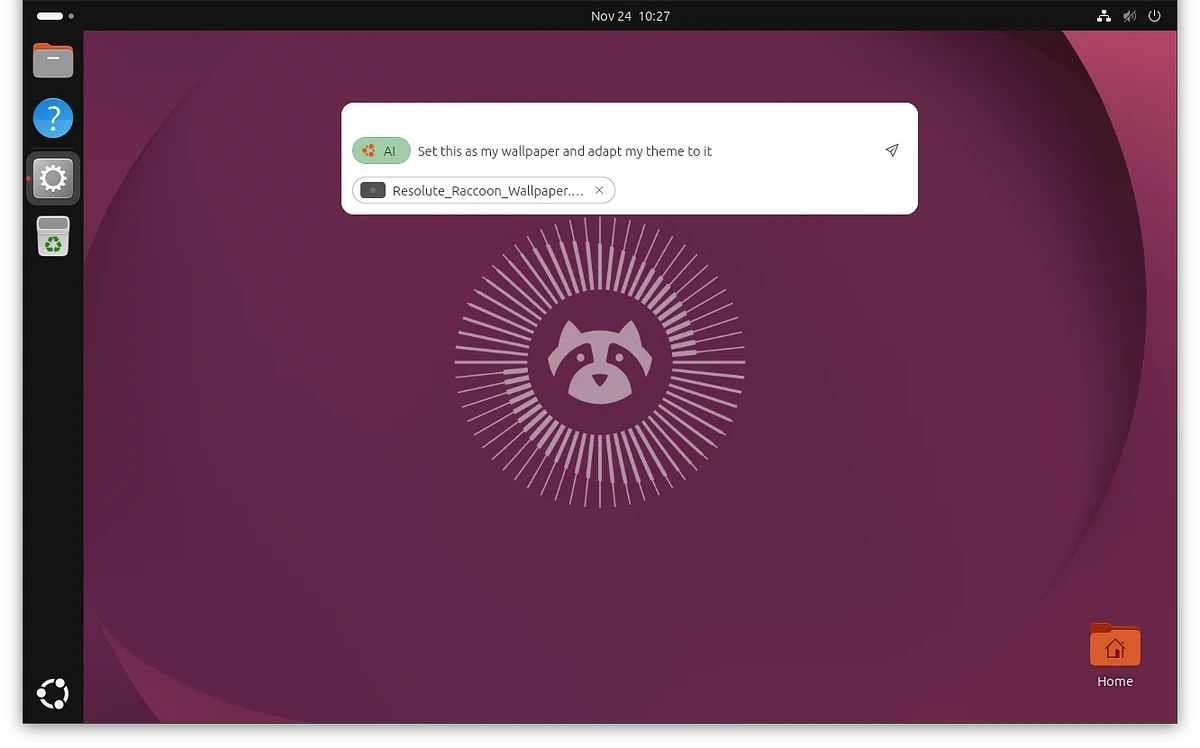
Canonical detailed on Tuesday (November 24) its plans for a new Ubuntu launcher with artificial intelligence — and made a point of correcting a misunderstanding: the warty-prototype, published on the Snap Store in October and widely discussed, was only an automated UI simulation meant to spark design conversations. Now, according to engineer Didier Roche of the Ubuntu Desktop team, there is real working code, shown in a screenshot on the official Ubuntu Discourse forum.
One entry point, by keyboard and voice
The idea goes beyond replacing the app grid: to create a unified entry point for the daily workflow, fast at opening apps and finding files, by keyboard and by voice, connecting apps, local context and smart assistance only when the user explicitly asks for it. Instead of scattering AI widgets across the desktop, Canonical wants a single place for these interactions — including the system's future AI features.
Roche's example is direct: in the screenshot, the launcher shows a prompt box with an “AI” badge and the request “Set this as my wallpaper and adapt my theme to it”, with the wallpaper file attached.
Four non-negotiable principles
From day one, the project follows four rules Canonical calls non-negotiable:
- Strictly optional: all AI features are opt-in. Anyone who wants just a fast launcher, without AI, gets a first-class experience — and the default install will not ship gigabytes of models.
- Local-first: the priority is on-device inference with local models, rather than sending queries to cloud services.
- Privacy-first: because processing happens locally, files, local context and daily habits stay on the user's disk.
- Security-first: using Ubuntu's confinement and sandboxing architecture, components must run with strict isolation, so experimental capabilities cannot compromise the system.
First installable version in January 2027
The work builds on steps already taken, such as Myna, the AI speech-to-text feature released in tech preview in Ubuntu 26.10, and the discussions about the future of AI in Ubuntu at the Ubuntu Summit. Canonical wants to build the project together with the community — testing early builds, challenging UX decisions and suggesting real workflows.
In January 2027, the team promises to share more details of the architecture and publish the first installable version, with the fundamentals in place, so users can install it, break it and send feedback. There is nothing to download yet: for now, it is a plan with real code behind it, but still at an early stage.
Read also: CVE-2026-109518: falha grave no APT permite trocar pacote verificado e obter root no Debian e no Ubuntu.
Image: screenshot of the Ubuntu launcher running, with the AI prompt box and the Resolute Raccoon wallpaper, published on the official forum. Credit: Didier Roche / Ubuntu Discourse (Canonical).
Sources
- Ubuntu Discourse — Beyond a launcher: a new way to interact with Ubuntu (Didier Roche, Canonical)
- Phoronix — Ubuntu Outlines Plans For Its AI-Powered New Way To Interact With The Ubuntu Desktop
- OMG! Ubuntu! — Ubuntu details plans for a new AI-powered desktop launcher
- XDA Developers — Ubuntu shows off an early version of its AI-powered launcher
Transparency note: this article was produced with the assistance of artificial intelligence, cross-checked against public posts on X and internet sources, and reviewed before publication. Please consult the original sources to confirm the information.
By Muse