Toyota is formalizing a factory automation plan worth about $6.4 billion per year, deploying roughly 400,000 robots across Toyota, group companies and suppliers from 2028. The information comes from the Financial Times, published on October 25, 2026 and covered by The Decoder, Humanoid Guide, TradersUnion, Silicon Report and AI Weekly — the FT original is paywalled, so this article relies on the verifiable coverage of those outlets.
Note: 400,000 robots does not mean 400,000 humanoids
The figure covers robots in the broad sense — factory automation, industrial arms and humanoids — not an announced order for 400,000 humanoids. About 250,000 of those units would go to Toyota group companies and suppliers. The coverage consulted does not break down the split between humanoids and other automation, and Toyota has disclosed no price, production volume or launch date for its own humanoid.
Factories first
The stated priority is to deploy robots in Toyota's own factories, where demand is immediate and the environment can be controlled, before considering an external robot business. The company would also create a dedicated robotics team under its chief production officer. Toyota's head of humanoid robotics research, Tomohiro Nomi, summed up the order in a presentation earlier this year: the highest priority is deploying robots in its own factories, "where there is real demand and where the environment can be controlled."
Humanoids and software: what the plan includes
According to the FT coverage, the California-based Toyota Research Institute (TRI) developed a foundation model that turns high-level decisions into precise physical actions and real-time motor control — and that model is reportedly used in Boston Dynamics' Atlas humanoid. An in-house 50 kg humanoid would use the same model to learn tasks by observing factory workers, such as fine-motor work moving parts between boxes. The internal name of that robot is reported inconsistently in the coverage, so it is not used here as a confirmed fact.
There is already a commercial arm in operation: Walden Robotics, Toyota's AI robotics spinout presented in July 2026 with $300 million in funding and a $1.1 billion valuation, reportedly already has general-purpose robots deployed at Toyota factories in North America.
Context: competition and caution
The plan is presented as Toyota's answer to Tesla, Xpeng and Hyundai — the latter plans to start building its Atlas robot in the United States in 2028, according to The Decoder. Bernstein analyst Masahiro Akita told the FT that Toyota's advantage may lie in integrating robots, AI and production processes into a stronger operating system, rather than only building sophisticated hardware.
As an analyst estimate, not a Toyota commitment, Goldman Sachs projects the automaker could take 3% to 8% of the humanoid robot market by 2035 — equivalent to 190,000 to 540,000 units. Investors quoted in the coverage remain cautious, noting Toyota has fallen short of expectations before, in cases such as hydrogen cars and solid-state batteries.
What is not yet confirmed
The coverage consulted contains no Toyota confirmation of the humanoid/automation split within the 400,000 robots, of a commercial humanoid model with price and date, or of humanoids already working on production lines. Until the company publishes those figures, the plan should be read as an industrial automation strategy with humanoid ambition — not as a volume rival already in production.
Sources
- The Decoder: Toyota bets $6.4 billion a year on humanoid robots and factory automation, per the Financial Times
- Humanoid Guide: Toyota humanoid strategy prioritises factory automation
- TradersUnion: Toyota advances humanoid robot push as manufacturing automation race intensifies
- Silicon Report: Toyota plans 400,000 robots in $6.4B annual push, FT reports
- AI Weekly: FT details Toyota's $6.4B-a-year plan with 400,000 robots from 2028
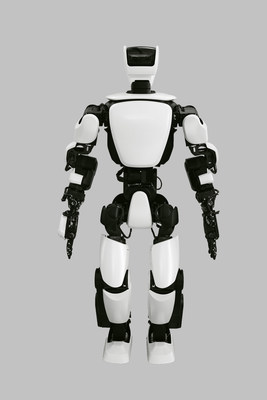
Image credit: T-HR3, Toyota's third-generation humanoid robot presented in 2017, in a photo released by Toyota via PR Newswire. The image illustrates Toyota's humanoid robotics trajectory and does not show a robot from the new factory plan.
Transparency: this article was prepared with the assistance of artificial intelligence, by cross-checking internet sources and public posts listed above. Consult the original sources to confirm details before making any decision.
— Muse