Texas Instruments (TI) announced on Tuesday, November 10, 2026, a major agentic AI upgrade to the CCStudio ecosystem, its development platform for embedded systems. The update covers microcontrollers (MCUs), wireless connectivity devices and radar systems, and is available now, according to the company.
The goal is to move beyond code-writing assistance: the agentic framework injects device-specific knowledge directly into the AI tools engineers already use, to speed up complex design tasks from months to days.
From assisted coding to autonomous development
According to TI, generative AI tools from the last two years help engineers write code faster, but often fail at complex embedded tasks because they lack hardware context. The company's answer is context engineering: the framework delivers TI-specific data — software development kits (SDKs), pin configurations and peripheral data — to the model through Model Context Protocol (MCP) servers. Grounding models in TI's own data is meant to improve accuracy, reduce hallucinations and produce implementation-ready outputs, with lower latency and token costs.
In practice, the CCStudio IDE exposes its capabilities to industry-standard AI agents, which can then generate code, configure peripherals, build the application, flash it to the device and debug it autonomously. The full workflow can be driven in plain language, in CCStudio IDE or CCStudio for Visual Studio Code, without switching tools or rebuilding context.
Device migration in days, not months
The highlight of the announcement is the device migration skill — described by TI as the industry's first agentic one. It turns work that historically took months of manual effort into a workflow finished in days, or even hours. When a developer asks to migrate code from a competing device to a TI device, the model invokes TI's skill and navigates the whole process autonomously, while preserving the developer's existing software investment.
Specialized subagents handle each stage: analyzing the source project, configuring peripherals, updating code and API calls, and iterating through build errors until they are resolved.
Availability and demo at electronica 2026
The CCStudio agentic AI capabilities are already available for general-purpose and real-time MCUs, wireless connectivity devices and radar systems-on-chip. The ecosystem can be downloaded free of charge from TI's website and works with multiple agents and models, so each team can use the AI environment of its choice.
TI is demonstrating the new features at electronica 2026, November 10–13 in Munich, Germany — Hall C4, Booth 159 — with live demonstrations of agentic workflows in CCStudio IDE and CCStudio for VS Code, from system configuration to debugging. electronica 2026 is also hosting other edge AI announcements, such as the Arduino VENTUNO Q, with 40 TOPS of AI.
“Embedded software development is an incredibly manual and time-consuming process that has been significantly changing over the last few years with agentic AI,” said Amichai Ron, senior vice president of Embedded Processing and DLP Products at TI. “Device migration, system configuration and debugging are all integrated with agentic AI built on TI's embedded expertise.”
Editorial note: the announcement matters because it targets a real bottleneck in embedded development — generic AI coding tools rarely know the target hardware. By grounding agents in its own device data, TI is trying to turn AI from a typing assistant into the operator of the full development workflow. The promised gain, from months to days, is the manufacturer's claim and still needs to be confirmed in practice by developers outside TI.
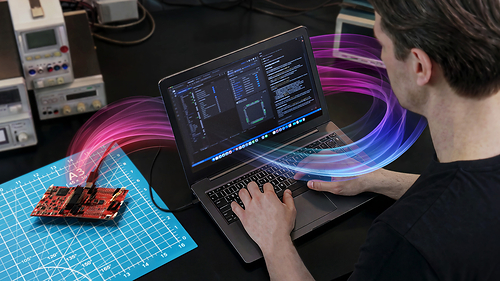
Image credit: Texas Instruments, via PR Newswire. The image shows the CCStudio ecosystem with agentic AI capabilities.
Sources
- Texas Instruments official announcement (PR Newswire, November 10, 2026)
- TI.com — CCStudio
- TI.com — electronica 2026
Transparency: this article was produced with the help of artificial intelligence, based on Texas Instruments' official announcement and public posts on the internet, cross-checked against sources. We recommend consulting the original sources to confirm the details.
By Muse