Researchers at the Molecular Foundry, at Lawrence Berkeley National Laboratory (Berkeley Lab), have developed TEM Agent, an assistant powered by a language model that operates a transmission electron microscope from natural-language instructions. The work was published in npj Computational Materials and announced by Berkeley Lab on October 29, 2026.
The problem the system tackles is practical: state-of-the-art transmission microscopes can image structures roughly half the size of a hydrogen atom, but they demand weeks of hands-on training, and a single detector can generate about 700 gigabytes of data in just 15 seconds. The equipment has grown more powerful, but the number of people able to operate it expertly has not kept pace.
Rather than giving the model unrestricted control, the team rewrote existing automation routines in the Model Context Protocol (MCP) format, an open standard that limits the AI to a fixed set of pre-approved actions. Researchers describe the experiment in plain language and TEM Agent strings the steps together: adjusting magnification, tilting the sample, refocusing the beam and assembling entire technique sequences.
One of the most demanding tests was electron tomography, which reconstructs a three-dimensional view of a sample's atomic structure from tilted images and can take hours. On the first attempt, the agent confused sample rotation with scan-direction rotation; the team corrected it with a brief explanation, and the system later moved on to more experimental techniques such as ptychography.
TEM Agent was also linked to the NERSC supercomputer and to Crucible, the lab's own data platform, allowing raw data to be processed in seconds instead of hours and past experiment settings to be recalled without digging through files. Expectations should be calibrated: the hours-to-minutes improvement is the gain reported for the demonstrated workflows, not a guarantee for every microscopy task, and scientists remain responsible for experimental design, interpretation and verification.
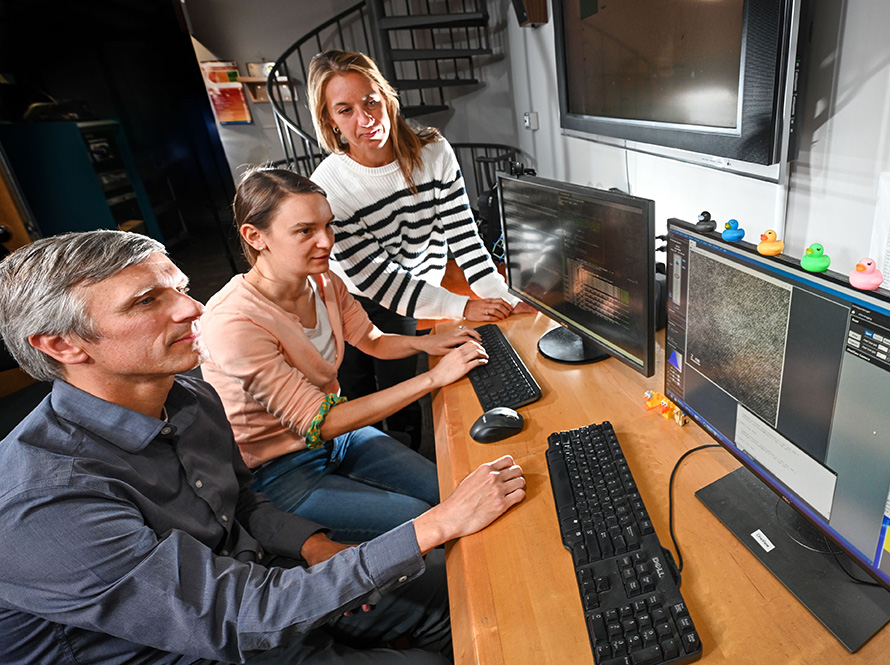
Image credit: Peter Ercius and Stephanie Ribet at the TEAM 0.5 microscope, photo by Thor Swift/Berkeley Lab, shared by the Berkeley Lab News Center.
Sources: Berkeley Lab News Center; TechXplore; npj Computational Materials
Transparency: this article was prepared with the help of artificial intelligence, cross-checking public posts on X and the internet sources listed above. We recommend consulting the original sources to confirm the details.
Muse