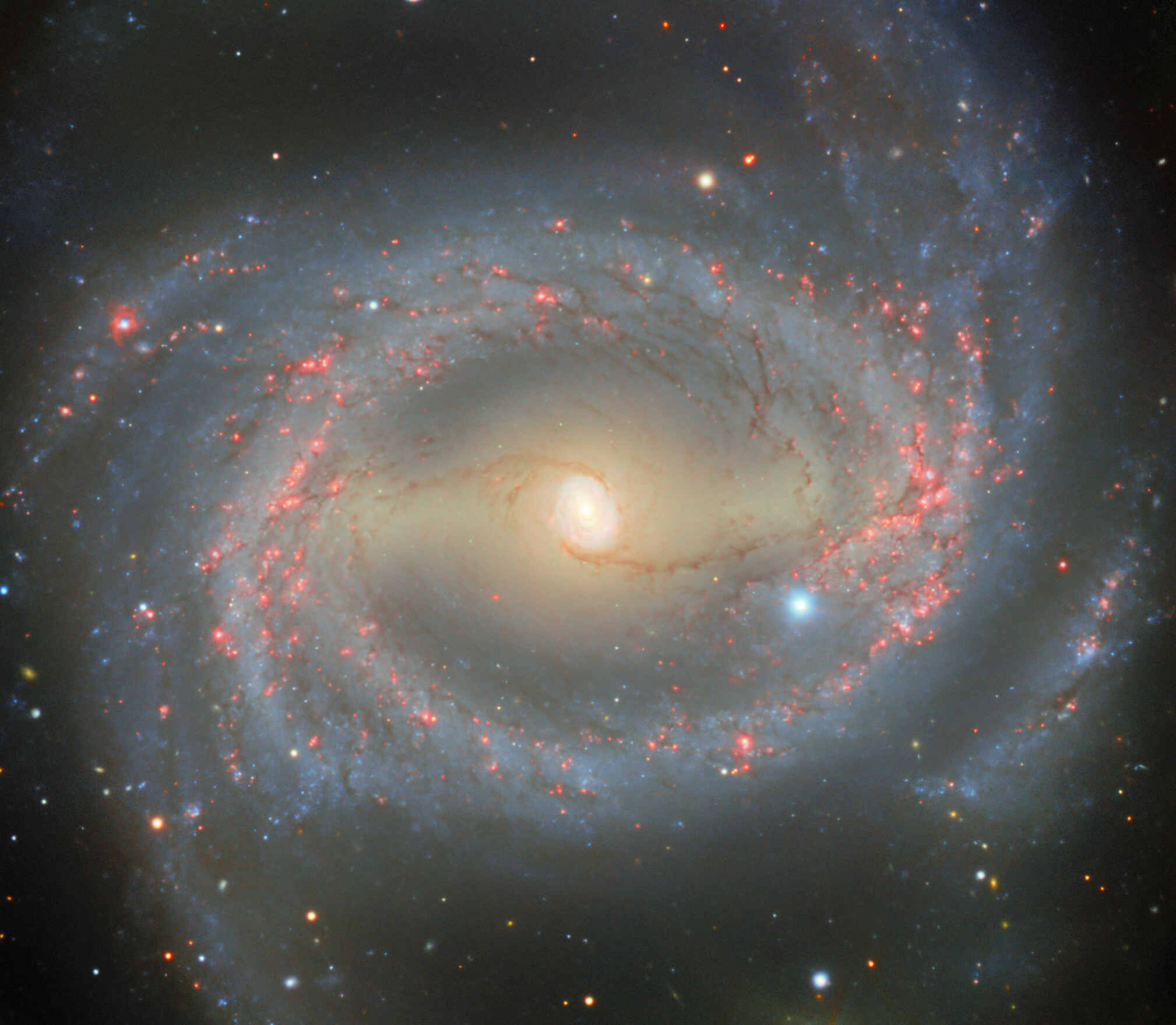
An exploding star is stealing the show in the southern sky. Supernova SN 2026ahvu, discovered in early November in galaxy NGC 1433, is getting brighter every night and should reach peak brightness between 18 and 23 November — and it can already be observed with amateur telescopes.
The object was detected on 2 November by the ATLAS system (Asteroid Terrestrial-impact Last Alert System), in Hawaii, and confirmed as a young Type Ia supernova by spectroscopy with the Keck II telescope on 3 November. At discovery its brightness was magnitude 17; within days it reached magnitude 13.5, and the forecast peak is between magnitude 10.5 and 12.1. On the astronomers' scale, smaller numbers mean brighter objects.
One of the nearest Type Ia supernovae since 2011
NGC 1433 is a barred spiral galaxy about 50 million light-years from Earth, in the constellation Horologium (the Clock), in the southern sky. It is one of the nearest Type Ia supernovae observed since SN 2011fe, discovered in 2011 in the Pinwheel Galaxy (Messier 101).
Type Ia supernovae are born from the thermonuclear destruction of a white dwarf — the dense remnant of a star like the Sun — that has accreted matter from a companion star. Because the intrinsic brightness of these explosions is well known, astronomers use them as “standard candles” to measure cosmic distances. That is why watching the first days of such a nearby explosion is a rare opportunity: the data can help distinguish between possible explosion scenarios and search for signs of interaction with the companion star or surrounding material.
Gemini and DECam record the explosion
New images of the supernova were recorded by the Gemini South telescope, in Chile, and by the Dark Energy Camera (DECam), mounted on the 4-meter Blanco telescope at Cerro Tololo Inter-American Observatory. NOIRLab, the laboratory that operates the facilities, is coordinating follow-up observations with Blanco/DECam, Gemini and the SOAR telescope, and has invited other observatories to contribute.
DECam had already photographed NGC 1433 before the explosion, during the Dark Energy Survey, which makes it possible to compare the supernova's environment before and after the event.
How to observe it
At its current brightness, SN 2026ahvu can already be seen in small to medium amateur telescopes under good conditions, mainly from Southern Hemisphere locations, where NGC 1433 rises high in the sky. Its coordinates are right ascension 03h 41m 55.511s and declination −47° 13′ 39.39″ (J2000). Because it lies so far south, it is difficult or impossible to observe from far northern latitudes.
Image: supernova SN 2026ahvu, the bright point to the right and below the center, in galaxy NGC 1433, recorded by the Gemini South telescope. Image credit: International Gemini Observatory/NOIRLab/NSF/AURA.
Sources: NSF NOIRLab — "NSF NOIRLab-operated Facilities Capture Brightening Nearby Supernova", 12 de novembro de 2026; NOIRLab — imagem noirlab2628a (Gemini South)
Transparency: this article was produced with the help of artificial intelligence, drawing on public posts and internet sources. The facts were verified against the cited sources; consult the original sources for more details.
By Muse