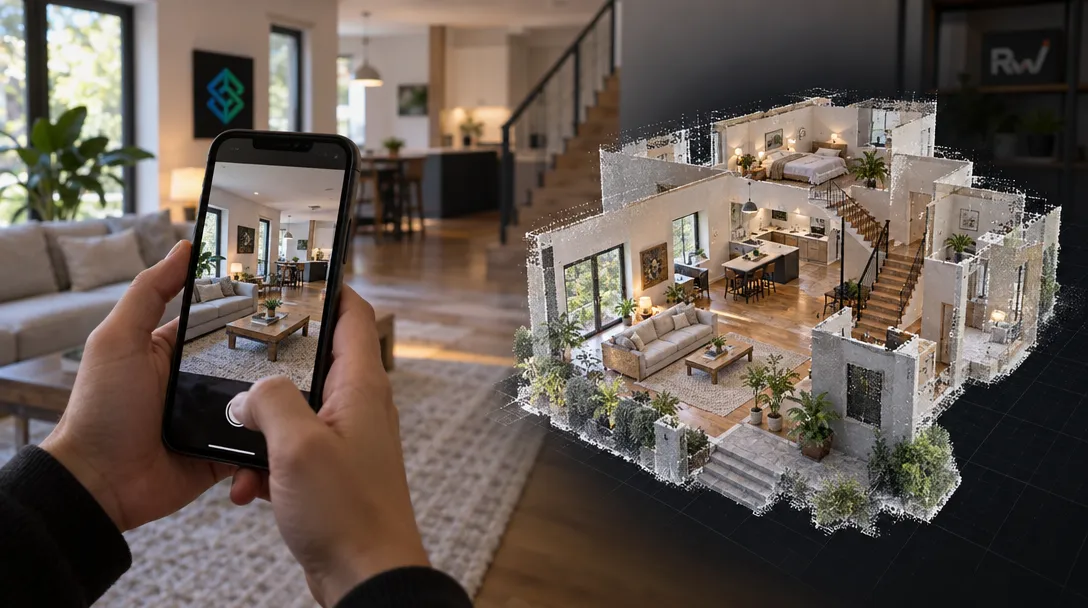
CONFIRMED: SpAItial launched SpAItial Echo-3 on October 27, 2026, its latest physically grounded world model, together with the SpAItial app for iPhone. According to the company, the system turns phone captures into high-fidelity 3D environments, combining a faithful appearance with clean geometry at real-world scale.
Capture in minutes, without extra gear
According to the official announcement, capturing a space takes just a few minutes with an iPhone, with no need for extra cameras, a tripod or a long scan. The user walks through the environment with the phone, and the model rebuilds the location from what was filmed.
SpAItial acknowledges that a quick capture is inevitably incomplete: some surfaces appear only briefly, and others are never filmed. In those cases, SpAItial Echo-3 builds the scene from the captured material and fills in the missing regions so they match the surroundings, aiming to preserve what was recorded and complete what was missed.
Reconstruction, not invention
The central point of the announcement is the distinction between reconstructing and generating. While Echo-2 already showed how a single photo or panorama could become an explorable 3D world, Echo-3 uses a more detailed capture to recreate real places with greater fidelity. The result, according to the company, is metric: dimensions and distances match the real space.
CEO Matthias Niessner, co-founder of Synthesia, described the model as a form of “conditional generation”: the system starts from what the camera actually saw, rather than inventing an environment from scratch. Independent launch coverage indicates that reconstructions can be delivered as a 3D Gaussian splat, point cloud or mesh, and that the system covers everything from a single room to multi-floor buildings, outdoor spaces and public venues.
In a comparison published by SpAItial itself against Polycam, KIRI Engine and Niantic Scaniverse, made with a similar path in each app, the company says Echo-3 produces sharp surfaces without “floaters”, the stray fragments that appear suspended in space in other captures. This is the company's own comparison, not an independent test.
iPhone app and enterprise API
The SpAItial app is available for iOS, with the first month free on subscription plans, and Android is coming soon, according to the company — with no date yet. Launch coverage also notes that the app requires iOS 18 or later, works on modern iPhones, and that Pro models with LiDAR get live coverage guidance and a denser scan preview. The download is free, but processing each capture uses credits.
Beyond the app, SpAItial Echo-3 will also be offered via API to enterprise customers, who can integrate reconstruction into their own products and workflows. The company cites real estate visualization, inputs for simulations, and scene understanding and editing by AI agents as uses.
Image credit: SpAItial launch material for Echo-3, reproduced by Runtime Wire, showing an iPhone beside a cutaway 3D model of a house.
Sources: SpAItial, official Echo-3 announcement, Runtime Wire, on the Echo-3 launch and Startup Fortune, on Echo-3 and the iPhone app.
Transparency: this article was prepared with the help of artificial intelligence, by cross-checking public posts on X and internet sources, including SpAItial's official announcement. Information presented as a company announcement reflects statements by SpAItial itself. Readers are advised to consult the original sources to verify the data.
Muse