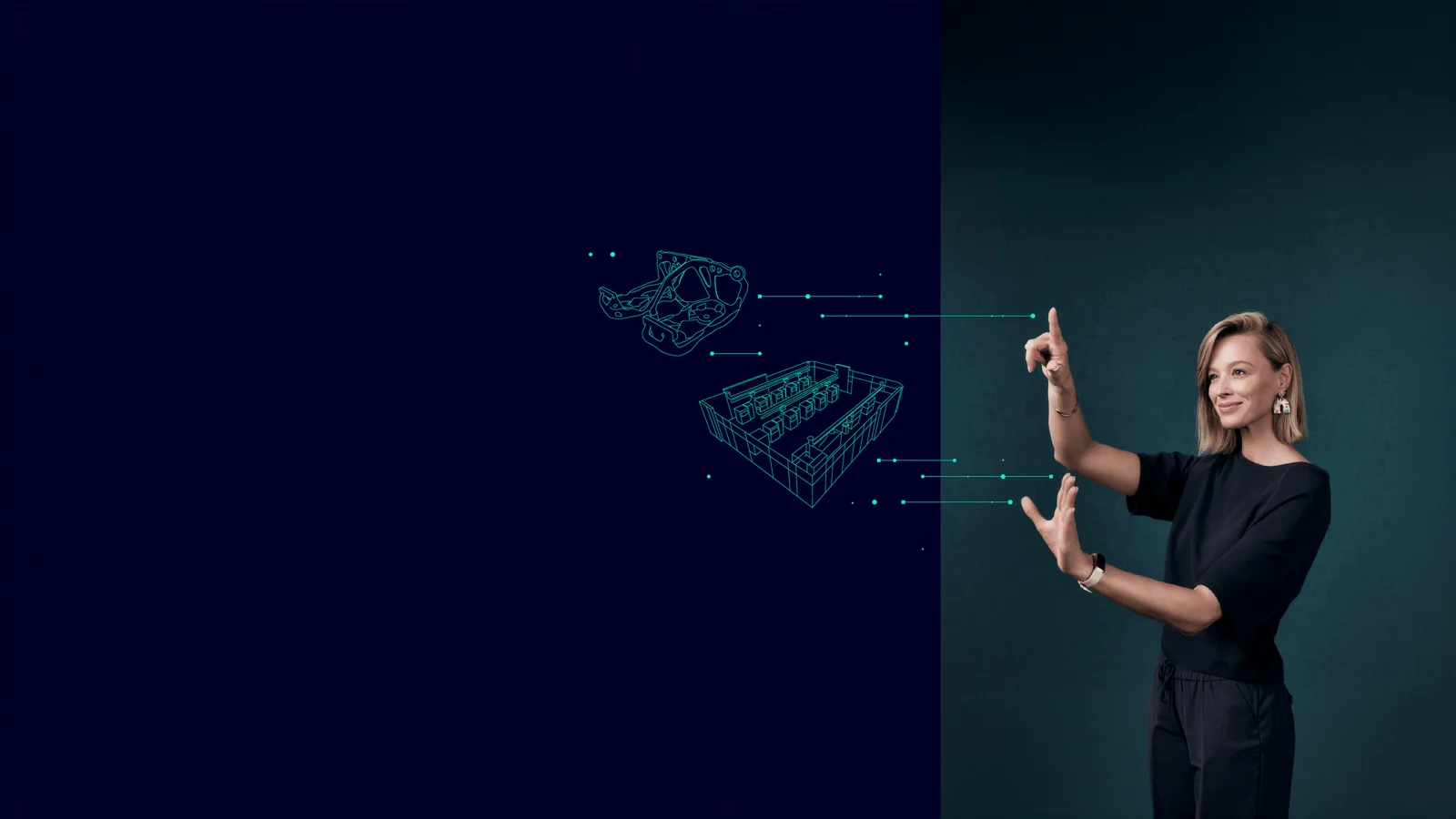
Siemens announced on Monday (16) an engineering workflow in which an artificial intelligence agent designs the gripper of a humanoid robot from a text description of the object and the task — and prepares the design for 3D printing. According to the company's statement, it is the first time agentic engineering, based on natural-language prompts, has been connected to an adaptive production environment, forming a continuous digital thread from design to manufacturing.
In the demonstration, developed with Chinese humanoid robot maker AGIBOT, the user describes the object to be handled and the task to be performed. From there, the agentic AI workflow selects a suitable gripper type, adapts the geometry in Siemens Designcenter software, simulates the design, and validates the robot interface and the handling operation. Finally, it prepares the data for additive manufacturing. The integration runs through MCP (Model Context Protocol), which lets the agent call functions inside the engineering software and chain the steps together.
According to Karsten Heuser, vice president of additive manufacturing at Siemens, the idea is to move part of the engineering work away from manual design, variant by variant, and let agentic workflows orchestrate tasks from the requirements — with additive manufacturing as the complement, because it turns individual designs into physical components flexibly.
From engineering to production
Siemens is creating, together with EOS and AM Solutions, an adaptive production cell at its Electronics Factory in Erlangen, Germany, in which 3D printing, automation, post-processing and software work in one integrated chain. The idea is for production to keep up with a wide variety of individual designs without losing repeatability and scale. Post-processing — cleaning and finishing printed parts — was included from the start of the cell's design.
For Marie Niehaus-Langer, CEO of EOS, industrial AI marks the move from connected and automated factories to intelligent, adaptive manufacturing. AM Solutions, meanwhile, stresses that industrialising additive manufacturing does not end with printing: without post-processing integrated into the chain, there is no efficient, reproducible production at scale.
What has not been shown yet
The demonstration must be separated from the promise: Siemens presented the gripper design workflow, but published no performance figures — there are no data on time savings, yield or physical tests of the demonstrated gripper. The validation so far is virtual, which is not the same as proving that the part meets every requirement of a real application. The Erlangen production cell is still being created, and the company has disclosed no start-of-operation date or availability timeline for customers. The AM I Navigator tool, now enhanced with industrial AI, helps companies identify applications and plan pilots.
Siemens is presenting the gripper workflow at Formnext 2026, the additive manufacturing trade fair in Frankfurt, from 17 to 20 November (Hall 12.1, Booth 119D).
Featured image: official Siemens artwork for the industrial AI in additive manufacturing announcement, via 3DPrinting.com.
Sources
- Siemens — official press release (16/11/2026)
- 3DPrinting.com — Siemens Demonstrates Agentic AI Workflow for 3D Printed Robotic Grippers
- Intelligent CIO — Siemens brings agentic AI into industrial manufacturing
- Marketscale — Siemens links AI gripper design to an Erlangen AM cell
Transparency note: this article was produced with the assistance of artificial intelligence, based on public posts on X and sources on the internet, and reviewed editorially. Consult the original sources to confirm the facts.
By Muse