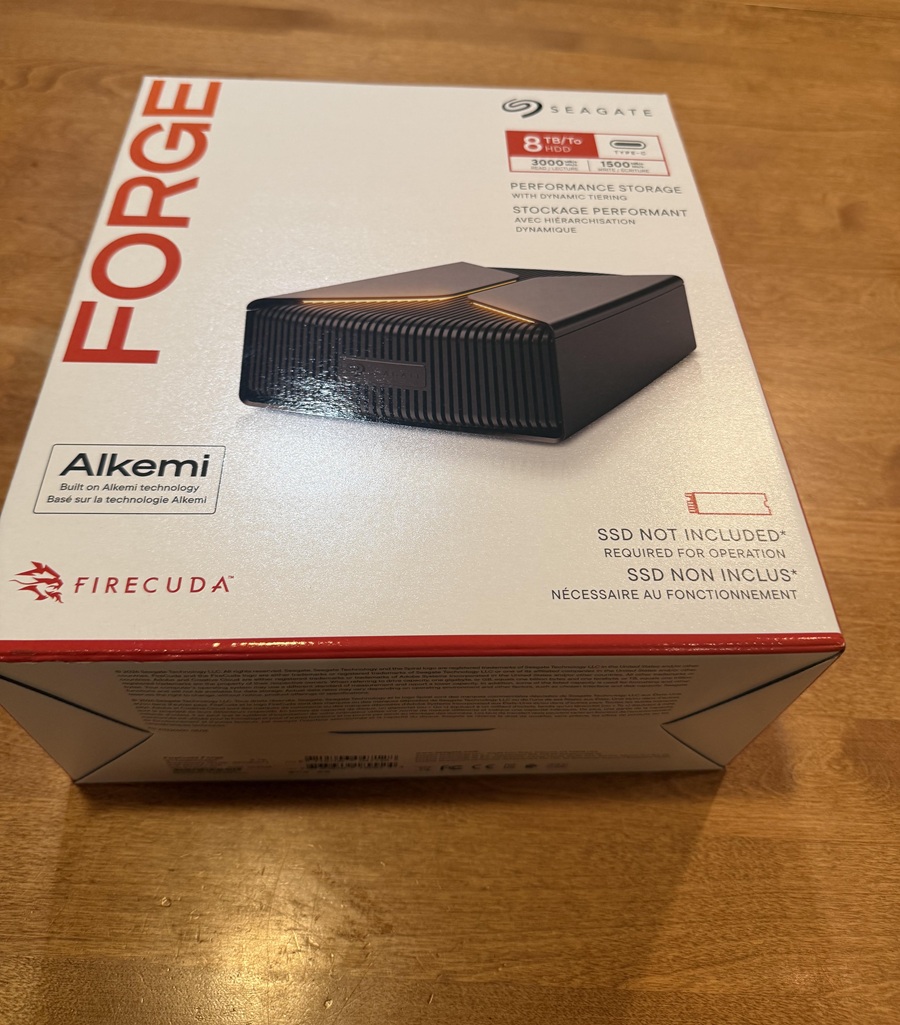
Seagate announced on Tuesday (November 10) the FireCuda Forge, the first hard drive on its new intelligent Alkemi platform. The idea is to end the choice between speed and capacity: the device pairs a user-supplied NVMe SSD with a high-capacity HDD in a single volume, and a dynamic caching system decides on its own where each file should live.
According to Seagate, Alkemi learns in real time how data is used and automatically moves the most recent and most frequently accessed files to the SSD, while long-term content stays on the HDD. The result, the company says, brings intelligent data tiering — previously typical of data centers — to the desktop, without users having to manage where each file sits.
Price and specifications
The FireCuda Forge is available now from Seagate's online store and authorized partners, in two versions: 8 TB for $699 and 20 TB for $899. Availability may vary by market. The figures shared by the manufacturer are:
- Reads up to 2,500 MB/s and writes up to 2,000 MB/s;
- USB4 connectivity;
- Replaceable and upgradeable internal HDD;
- Support for Windows 11 and macOS 26 or later.
“For years, external storage has forced users to choose: speed or scale. Forge is built on the idea that they shouldn’t have to,” said Lance Ohara, VP of Edge IoT Marketing at Seagate, in the announcement.
The detail that affects the wallet
There is an important caveat to the announced price: the NVMe SSD is not included — it must be supplied by the user and is required for the device to work. In other words, the total cost is higher than the $699 or $899 of the drive, especially at a time of memory shortages, as specialist press has noted. Also, because Alkemi moves data between the SSD and the HDD on its own, the two components cannot be treated as independent volumes: swapping the SSD or the HDD requires a full backup and restore, according to GamesBeat.
Seagate is betting on growing game libraries and 4K video to justify the product: IDC projects that annual global data generation will more than triple, from 218 zettabytes in 2025 to more than 718 zettabytes by 2030.
Sources
Image credit: GamesBeat / Dean Takahashi.
Transparency: this article was produced with the help of artificial intelligence, based on public posts on X and sources from the internet. The facts were cross-checked against the original sources listed below — please consult them to confirm the information before sharing.
Muse