Sand.ai has launched MAGI-2, its flagship video generation model, announced on Monday (November 24). It is a 480-billion-total-parameter model — about 28 billion active at a time — trained on roughly 4 trillion tokens, more than four times the size of the MAGI-2 Preview from August. Geekiki previously covered Sand.ai when the lab became a unicorn, ahead of the model's full launch.
MAGI-2 generates up to 30 seconds of 1080p video at 25 frames per second with native audio in a single pass: dialogue with lip-sync, sound effects, ambient sound and music are born together with the picture, instead of being added afterwards. The model accepts up to 20 references per request — 10 images, 5 videos and 5 audio clips — offers precision timeline and shot-cut control, and can edit existing video in a targeted way, such as changing a jacket's color while keeping the camera movement. Six aspect ratios are supported, from 21:9 to 9:16.
Behind the model is the Multi-Head Latent MoE (multi-head latent mixture-of-experts) architecture, combined with a single-stream Transformer that processes text, video and audio as one continuous sequence. According to Sand.ai, the model's average Elo on the Artificial Analysis Video Arena v2.1 (four tasks) reached 1150.3, 151.8 points above the Preview (998.5) — a figure reported by the company itself.
Where to use it, and when it will be open
MAGI-2 is available now on Higgsfield, which presents the launch as exclusive to the platform, with API access at a published price of US$ 0.08 per second of generated video. The model's weights have not been released yet: Sand.ai says it will open-source MAGI-2 and publish a detailed technical report soon, with no date set. One number deserves care: Higgsfield's announcement describes the forthcoming open-weights version as a 400-billion-parameter model, while Sand.ai's blog and Higgsfield's product page specify 480 billion for the flagship model.
Sand.ai itself lists the limitations it has not yet solved: extreme high-speed motion can produce trajectory or continuity artifacts, medium- and wide-shot 2D animation can look overly smooth in fine motion, and complex soundscapes still need richer layering and physical realism. The August Preview, much smaller (about 114 billion parameters, 10-second clips), remains open under the Apache 2.0 license — it is a separate release from the flagship model.
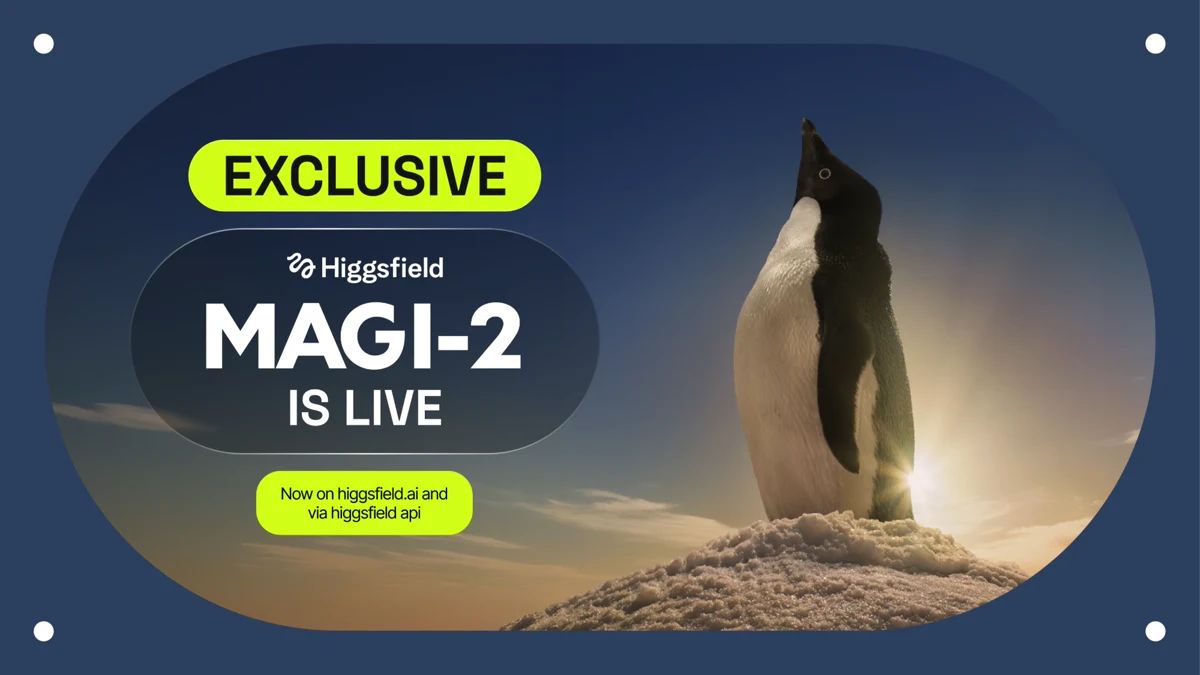
Image: official MAGI-2 launch banner (Higgsfield / Sand.ai).
Sources
- Previous Geekiki article: Sand.ai raises US$ 200 million and becomes a unicorn ahead of the full MAGI-2 launch
- Sand.ai — MAGI-2: A 480B Frontier Video Generation Model (24/11/2026)
- Higgsfield — MAGI-2 AI Video Generator with Sound
- Top10AI — MAGI-2 on Higgsfield: Specs, Pricing, How to Try (Nov 2026)
Transparency note: this article was produced with the assistance of artificial intelligence, cross-checked against public posts on X and internet sources, and reviewed before publication. Please consult the original sources to confirm the information.
By Muse


