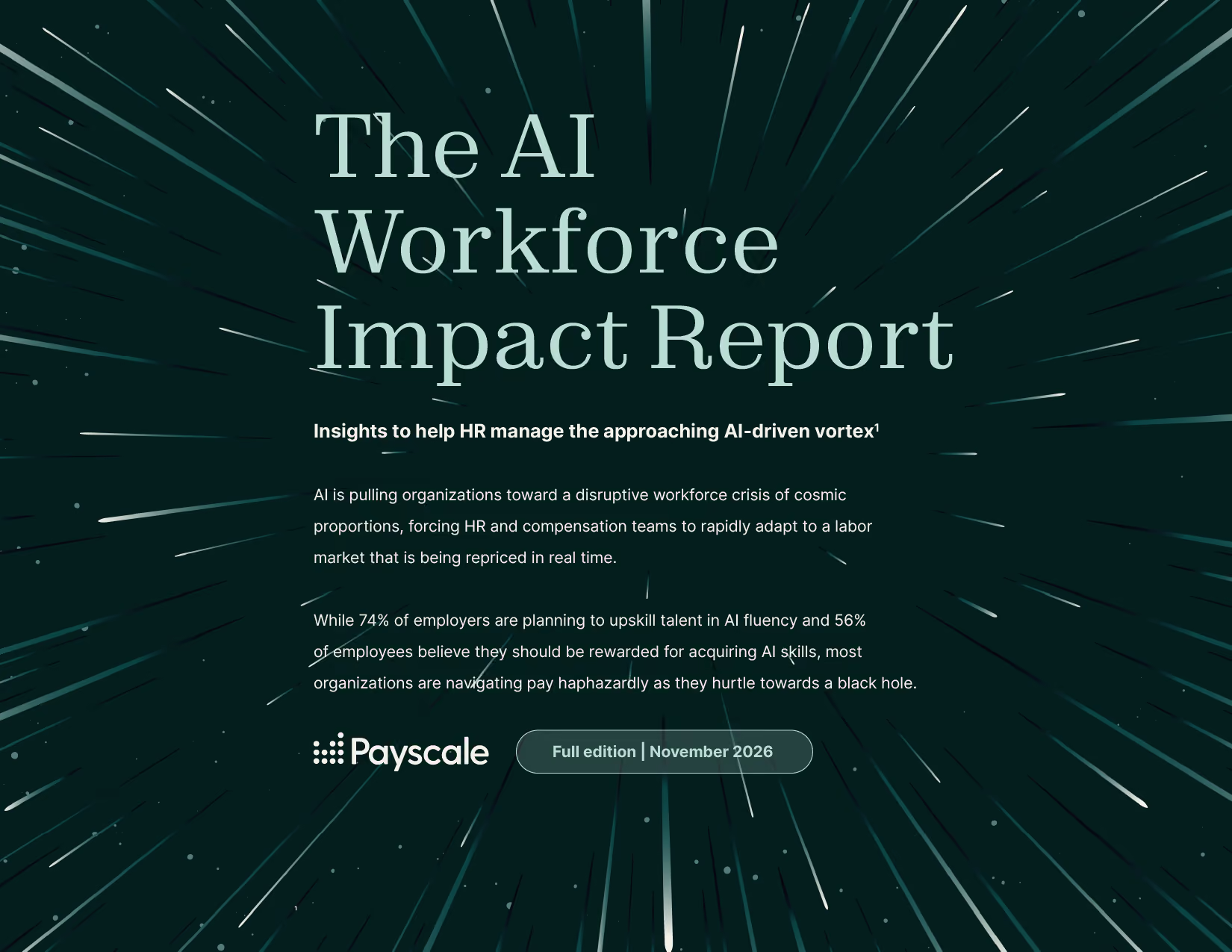
Payscale released its full AI Workforce Impact Report on November 10, measuring how artificial intelligence is changing jobs, skills and pay. The study surveyed 500 employers and 1,000 employees in the United States in August 2026 and cross-checked the results with Lightcast job-postings data.
The central finding is the speed of change versus the slowness of pay: 61% of organizations say they are rewriting job descriptions because of AI-driven transformation, but 49% say their salary structures are not keeping pace with the changes, and 48% say market benchmarks no longer reflect the skills required in transformed roles.
Three gaps between intent and reality
The AI Workforce Impact Report describes three gaps. The first is intent: 74% of employers plan to invest in AI upskilling over the next 12 months, but only 29% of employees see that plan — a 45-point gap. The second is fairness: 56% of employees think they should earn more for developing AI skills, but only 16% report a pay rise for it, while 70% say their pay has not changed. The third is compensation: 58% of organizations pay, or plan to pay, a premium for AI skills, but strategies vary so widely — 23% already treat AI fluency as a baseline requirement, 19% keep structures unchanged and 13% are still deciding — that Payscale speaks of wage scatter.
Jobs: optimism and pessimism diverge
Employers and employees also disagree on jobs. Among employers, 74% expect AI to affect hiring or team size in the next 12 months: 30% foresee more roles, 10% fewer, 32% growth in some areas and cuts in others, and 2% rehiring roles eliminated earlier. Among employees, pessimism runs higher: 20% expect layoffs, versus 10% of employers, and only 15% expect more roles.
On productivity, the report flags burnout risk: 26% of employers expect AI to mean more work in the same amount of time, and 28% of employees say they are already doing more work in the same time, with 61% saving less than 10 hours a week with the technology.
The AI market in numbers
Lightcast market data cited in the AI Workforce Impact Report shows the pressure: AI-related job postings have grown 8.7 times since 2022, from 9,241 in January 2022 to 80,597 in August 2026, with a median pay of $147,500 in sector postings. At the same time, 40% of employers say they cannot find professionals with enough AI fluency.
In short, AI is expanding roles rather than eliminating jobs en masse — but companies still do not know how to price the new skills, and employees feel the difference in their pay.
Also on Geekiki: Study on AI's impact on the job market shows uneven effects across professional sectors.
Image credit: official cover of the AI Workforce Impact Report, Payscale.
Sources: Payscale — 2026 AI Workforce Impact Report; GlobeNewswire — Payscale announcement, November 10, 2026; HR Tech Edge — analysis of the report preview.
Transparency: this article was produced with the assistance of artificial intelligence, drawing on public posts and internet sources. The data cited comes from Payscale and Lightcast; check the original sources to confirm the information.
By Muse


