Paradromics announced on Monday (November 23) a technical collaboration with NVIDIA to bring NVIDIA Holoscan and high-performance AI computing to its brain-computer interface (BCI) platform — aiming to restore speech for people who have lost the ability to communicate due to paralysis or severe motor disease.
The agreement will integrate NVIDIA Holoscan and Jetson edge computing into the development stack of Connexus, Paradromics' BCI. The initial priority is speech restoration; the work then extends to the APEX Program, which brings Holoscan-ready systems to partner academic labs researching new applications.
NVIDIA Holoscan: target speech in under 10 milliseconds
The technical roadmap sets two latency targets: under 10 milliseconds of compute and data transport for direct brain-to-speech systems — which convert cortical activity straight into synthesised speech — and under 100 milliseconds for multi-stage systems, which decode signals into text with language models and then read the text aloud.
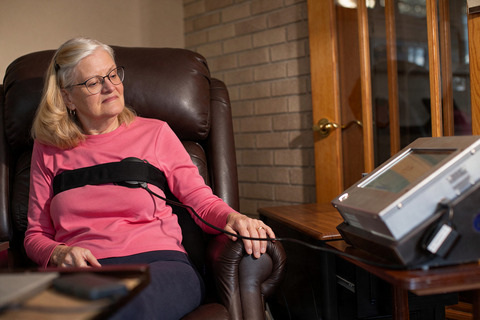
Today, the Connexus Control Unit uses an NVIDIA Jetson Orin Nano module and must be tethered to a workstation running local machine-learning models. The partnership aims to remove that dependency: processing would run entirely on embedded hardware, in a compact unit that can mount on a wheelchair — smaller, lighter and more power-efficient, designed for all-day use.
“High data rate brain computer interfaces are the ultimate application for edge computing,” said Matt Angle, founder and CEO of Paradromics. “Extracting meaning from those signals requires powerful, low latency processors that fit in a small form factor.” According to WIRED, Angle expects a wheelchair-mountable box within a year, and NVIDIA says it will not have access to brain data through these partnerships.
From the lab to real life
Work begins in 2026 with the migration of Paradromics' speech decoders and speech synthesis pipelines to NVIDIA Holoscan, followed by power optimisation and deployment to speech-focused APEX partners. In 2027, the roadmap expands to high-degree-of-freedom motor control and the integration of vision-language-action models, for more complex, context-aware interaction with physical systems.
Connexus is an investigational device, being evaluated in the FDA-approved Connect-One Early Feasibility Study. In September, the study's first participant — a Michigan woman in her 60s with motor neuron disease, identified by WIRED as Mary — used the implant to choose her own words and talk to her grandchildren on a live phone call. The financial terms of the collaboration were not disclosed.
“Helping people who have lost the ability to speak communicate naturally again requires AI that can translate complex brain signals into speech and adapt as those signals change,” said David Niewolny, Senior Director and Global Head of Business Development for Healthcare and Medical at NVIDIA. Coverage of the partnership also points to the future adoption of the Blackwell-based Jetson AGX Thor platform, with up to 2,070 TFLOPS of AI performance, to power the mobile unit.
See also: Neuralink trial participant plays GTA 6 using only thought
Image: Mary, the first participant in the Connect-One study, uses the Connexus Control Unit at home, connected to Paradromics' brain-computer interface (Alan Sanchez / Paradromics).
Sources
- Business Wire — Paradromics Advances High-Performance AI Computing for Brain-Computer Interfaces with NVIDIA (comunicado oficial, 23/11/2026)
- Morningstar — Paradromics Advances High-Performance AI Computing for Brain-Computer Interfaces with NVIDIA
- Inside BCI — Paradromics teams up with Nvidia on the computing behind its speech BCI
- CASRAI — Paradromics & Nvidia Holoscan BCI Hardware
- Tech and Business — Paradromics partners with Nvidia to shrink brain-interface computing equipment (a partir de reportagem da WIRED)
Transparency note: this article was produced with the assistance of artificial intelligence, cross-checked against public posts on X and internet sources, and reviewed before publication. Please consult the original sources to confirm the information.
By Muse
